October 13th

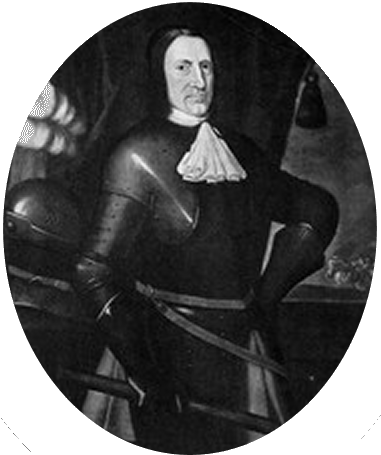
Wm Bradley


On 13th October 1593, Oswold Ridinge, Robert Greene, William Giltencrosse, Steven Gedney, and William Deane were all before Patrington Manor Court for making affray, upon each other, and upon Thomas Blenckarne, and drawing blood of Oswold Ridinge; fined 3 shillings and 4 pence.

On 13th October 1743, William Wilberfoss Smith III died aged 75 Wrightstown, Bucks County, Province of Pennsylvania, USA. Emigrated from Weighton, Yorkshire in 1684 as an indentured servant to William Penn, and in 1686 built a cabin which is considered to be the oldest continuously occupied home in the United States.

On 13th October 1799, Rev George Lambert was called to pray with a Hull woman who had been in labour for several days, and treated by 4 surgeons who could not deliver the baby. She died.

On 13th October 1815, William Bradley, the Yorkshire Giant,  printed handbills inviting visitors to see him at 15 Queen Street, Hull during Hull Fair for a shilling.

On 13th October 1857, John Johnson, chimney sweep, was fined £5 or 7 days in prison at Beverley Magistrates Court, for employing a boy of 13 to go up a chimney in the house of Wilberforce Herdsman. Employing under 21s as sweeps was not finally outlawed nationally until 1875. Legislation in 1840 set the minimum age at 16, but was rarely enforced.

On 13th October 1859, the Theatre Royal, Humber Street, Hull, burnt down just 10 days after re-opening following a fire in September.

On 13th October 1926, in a 2-day visit to Hull, HRH Prince of Wales laid the foundation stone of the Ferens Art Gallery, visited HERIB and other factories and institutions, and took a trip on the Humber in SS Brocklesby. At Craven Park, 10,000 schoolchildren sang for him. Crowds were estimated at 200,000. this interesting clip begins with a reference to the West Riding, but stick with it, Hull is definitely there. https://www.youtube.com/watch?v=YQhZrcaMUuo

October 12th

On 12th October 1536, 9,000 armed men from across East Yorkshire mustered on Market Weighton Hill as part of the Pilgrimage of Grace. Robert Aske led one group to York via Pocklington, and William Stapleton led a march on Hull, besieged it and captured it for the rebels. Holderness gentry Sir John Constable, Sir Wm Constable and Sir Ralph Ellerker had taken refuge in the town from the revolt.

On 12th October 1643, the Earl of Newcastle abandoned the 2ndsiege of Hull after 5 weeks and withdrew Royalist forces to York. To prevent pursuit, the Royalists destroyed bridges and roads and cut the banks of waterways as they retreated. The date was observed as a day of public thanksgiving in Hull until the Restoration.

On 12th October 1697, Robert Pattinson, Humber pilot, was fined 30shillings for damaging the ‘dolphin’ at the entrance to the River Hull while handling a vessel entering the Haven.

On 12th October 1767, Beverley gentleman John Courtney reported in his diary seeing a firework display for the first time, in the Market Place, paid for by subscription.

On 12th October 1896, at Hull Fair, one of the attrractions was the first showing in Hull of moving pictures, only 8 months after Louis Lumiere’s first performance, included scenes of Whitefriargate, the W’force Monument, the Corporation Pier, the Humber Ferry.

On 12th October 1933, Louis Armstrong performed at Beverley Road Baths, Hull, during his European Tour.


louis armstrong

October 8th

On 8th October 1536, Beverley men mustered on Westwood Low Green in response to the Lincolnshire rebellion against the Act of Dissolution. Elizabeth Stapleton encouraged them, despite the reluctance of her husband, and her brother-in–law William Stapleton became the rebels’ captain.

On 8th October 1643, Capt Strickland led a failed Royalist attack on Hull’s Hessle Gate, and was shot dead. Many of the attackers were killed.

On 8th October 1708, William Robinson died in Hull. Former Sheriff of Hull, donor of a hospital to Trinity House, left bread for 12 widows to be given each year on Christmas Day. They were required to go to his grave in Holy Trinity churchyard to receive their dole.

On 8th October 1805, Beverley corporation ordered that all rogues and vagabonds found wandering in the town must be apprehended and conveyed to a magistrate. A board  showing this order can be seen in St Mary’s church loft.

On 8th October 1862, Hornsea businessman Joseph Armytage Wade turned the first sod with a silver trowel at a ceremony to mark the start of building the Hull to Hornsea Railway.

On 8th October 1874, George Wombwell visited Beverley on his way to Hull Fair; in Saturday Market he exhibited elephants, giraffes, a rhino, and big cats; other shows also stopped over in the town before going to Hull.

On 8th October 1929, Wm Jackson & Son Ltd opened their landmark store in Paragon Street, Hull, designed by Hull architects Gelder and Kitchen, with a cafeteria and restaurant on the first floor. After the war, when the fire-damaged property was repaired, a 3rd floor was added as a ballroom. This was to become one of the city’s most popular night-spots for many years.

On 8th October 1985, Clive Sullivan MBE died aged 42. 1st black captain of any British national sporting team. He played rugby league with both Hull and Hull Kingston Rovers during his career. Holds records for most tries in a career (250) and most tries in a match (7). Commemorated in Clive Sullivan Way and the Clive Sullivan Memorial Trophy.(b 9.4.1943 Cardiff)


Clive Sullivan

October 6th

site of Haltemprice Priory

On 6th October 1515, the Sheriff of Hull, Mr Mattison and 200 citizens fought the monks of Haltemprice Priory and threatened to pull down the monastery, over a dispute concerning jurisdiction over Wolfreton and Willerby, and fresh water supplies. Peace was restored by the Mayor of Hull, George Mattison and the issue was eventually resolved in the Star Chamber. One of many incidents in Hull’s ‘water wars’. photo shows site of the monastery.

On 6th October 1613, an enquiry determined that a chantry dedicated to St Mary, and a chaplain to celebrate daily services there, had been paid for by 6 1/4 acres of land, 10 messuages and 3 tofts, given to the town of Hedon by John de Burton and Henry Maupas. Chantries were abolished by Edward VI, along with other signs of Catholicism.

On 6th October 1670, Ann Barone was fined in the Patrington manor court for not making bread according to the assize – i.e. not the regulation size, weight etc.

On 6th October 1748, Mary Jackson, tenant farmer of Everingham, lost 36 of her 45 cattle to rinderpest, the cattle plague then affecting much of the East Riding.

On 6th October 1850, Hedon solicitor James Iveson, died after a long career controlling the political life of Hedon, a Rotten Borough described as ‘Lawyer-ridden’. He was also Town clerk, Mayor, land agent, and steward on behalf of the Constables of the Holderness Seigniory. The Iveson dynasty was involved in land enclosures, surveying and other profitable work. James was renowned for rudeness. Part of an ultra conservative council which for years resisted public health improvements. Collector of architectural remains from demolished churches. Engaged for some 20 years of protracted negotiation with Trinity House over Spurn Point.  portrait in Hedon Town Hall

On 6th October 1890, Chas Collier, aged 17 years, former pupil of Hull Trinity House School, died of typhoid fever in the Barque Miltiades off the west coast of Africa.

James Iveson, Hedon Town Clerk

October 3rd

On 3rd October 1667, Mark Turington, Peter Gorbut, Christopher Gray & Jane Sansbie were fined at Patrington for having bad fences or fences in bad repair.

On 3rd October 1810, Rev George Lambert of Hull wrote in his diary: ‘times never were more alarming than the present. Failure, bankruptcies and suicide are taking place every day, and public credit shaken to its foundation. No man knows today what will be his circumstances tomorrow’.

On 3rd October 1821, Dr Raffles preached to 600 people on board the Valiant in Queen’s Dock, Hull, a new floating chapel bought by The Port of Hull Society for the Religious Instruction of Seamen. It was used for 28 years until the vessel was leaking and abandoned in 1850.

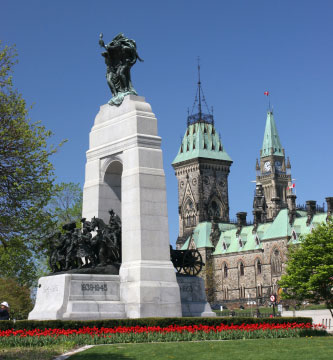
On 3rd October 1884, Elsie March, sculptor, painter and metalworker, was born in Sutton (or Old Hall, Burstwick?), one of 8 artist siblings born to foreman seed crusher George Henry March. Moved to Battersea 1901. With 5 of her brothers, created the Canadian War memorial in Ottawa completed in 1938. see photo (d 1974, Kent)

On 3rd October 1898, Ernst Adolf Powolny opened a restaurant in King Edward Street which became a Hull institution, providing high class food in opulent surroundings, as well as tea dances and catering for civic events. Closed temporarily by a fire in 1934, it finally closed after being destroyed by the Blitz on 8.5.1941. Known affectionately as ‘Polly’s’.

Elsie March

September 30th

On 30th September 1540, King Henry VIII’s commissioners dissolved the priory at Swine.

On 30th September 1541, King Henry VIII took part in (i.e. strongly influenced the outcome of) the Hull mayoral election, and presented the new mayor with his sword.

On 3oth September 1581, Peter Crewe was appointed one of the 2 Hull chamberlains, a week after his fellow aldermen fined him for using faulty weights.

On 30th September 1643, Thomas Raikes, due to stand down after his year as Hull Mayor, was encouraged to stand for a second term, in view of his vigilance on behalf of the town during the events of the Civil War, and in particular the 2nd siege of Hull, which was still ongoing. He was re-elected.

On 30th September 1686, Elizabeth Boyse obtained a licence from Hull town council to sell wine and keep a tavern at her home (described as a mansion house), at the sign of the King’s Head in High Street.

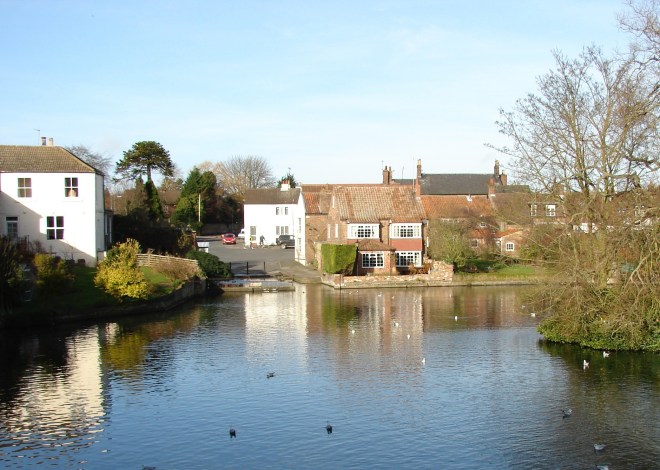
On 30th September 1904, the first of 52 cases of diphtheria were reported in Nafferton; the epidemic killed 7 people, mainly children at the National School.  The school was closed, but infections continued as many local families lived in overcrowded conditions. photo shows modern Nafferton


Nafferton


September 25th

On 25th September 1781, the Church authorities had Auburn Chapel taken down before it joined the rest of the village at the bottom of the cliff.

On 25th September 1882, Alfred Deakin, 11 and Frederick Gillett, 12, died as a result of an accident at a fireworks display in Hull Botanice Gardens. Several others were injured, 3 of them seriously. The inquest gave a finding of accidental death.

On 25th September 1917, Army gunners at Paull Point Battery prevented a Zeppelin attack on Hull, holding the craft in their searchlight until it was chased off by a fighter plane. The Battery was to the right of the houses on the photo – now known as Fort Paull.

On 25th September 1991, Officer cadet Kate Saunders, 22, became the first woman to eject from an aircraft when a bird strike caused her RAF Harrier to crash; she suffered a broken leg, broken pelvis, crushed vertebrae and 20% burns. The pilot, Sqn Ldr Ashley Stevenson, pulled her from the burning wreckage, and was awarded the Queens Commendation for Brave Conduct.

Paull

September 22nd

On 22nd September 1690, Beverley Corporation gave permission to create a racecourse between the Newbald and Walkington roads. Horse racing had probably taken place on Westwood for 300 years, but this was the first time a course was formally laid out.

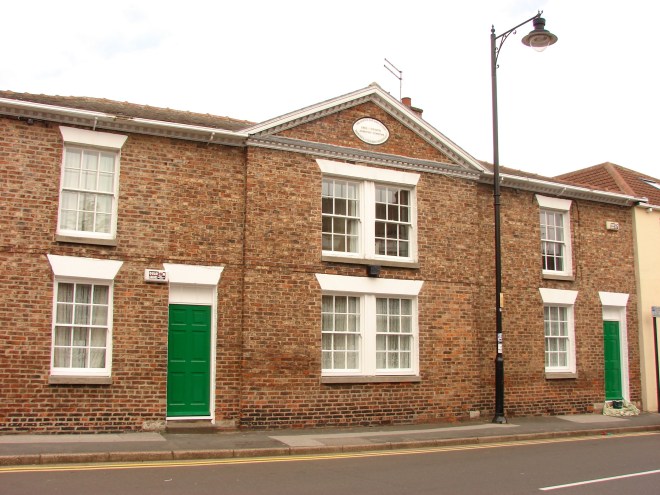
On 22nd September 1716, Leonard Chamberlain, draper, died at Hesslewood House, Hessle, and left property and estates in Sutton, Stoneferry, Selby, Dunswell and Hessle and his charitable bequests continue to this day. A Presbyterian, he supported those who had been discriminated against on religious grounds, gave money for educating the poor ‘of whatever persuasion or denomination soever’.  Commemorated in Chamberlain Road and Chamberlain Street, Sutton. photo shows one of the Sutton properties

On 22nd September 1761, to mark the coronation of King George III and Queen Charlotte, Col Duncombe’s Battalion of militia drilled in Beverley Market Place, and fired volleys, while the Corporation held a dinner for the officers, the bells rang, and in the evening there were illuminations.

On 22nd September 1778 was the official opening of The Dock, Hull. (It became known as Queen’s Dock after Victoria visited the city in 1854). The first ship in was the whaler Manchester, decorated all over with flags of the nations, followed by the Favourite, the largest ship in the port at 1,000 tons (burthen). 20,000 spectators were entertained by cannon fire and a musket salute from the garrison, and the great and the good were fed and sumptuously entertained.

On 22nd September 1856, Count de Werdinsky died in Hull aged 53, in abject poverty, after variously representing himself as a Polish count, inventor and doctor. He was a bankrupt, a fraudster, and had several counts of assault and indecent assault against women. His memorial is in the Western Cemetery

On 22nd September 1914, the crews of HMS Aboukir, Cressy and Hogue, 3 Navy cruisers, were sunk by a German u-boat, with the loss of 1,450 lives. This not only led to a public outcry, but also the need to provide for a large number of orphaned children. Some of the children were admitted by Hull’s Sailors’ Children’s Society and put up in its holiday home in Hornsea, as well as in the Newland Homes. By 1915, 108 children of seamen lost in action were admitted, from across the country.

leonard chamberlain sutton.JPG


September 20th

On 20th September 1188, St John’s church at Beverley and most of the town were damaged by fire. St John’s remains were not found until 1197.

On 20th September 1535, John Colynson and Thomas Savage, yeomen of Holme on Spalding Moor were declared outlaws after spending more than a year in sanctuary in Ripon. They sought sanctuary in 1534, confessing to stealing a horse. Savage confessed to the murder of Amery Burdett, but Colynson did not confess, though a coroner’s jury found them both responsible, and indicted others as accessories.

On 20th September 1769, Felice de Giardini, famous violinist, played at the start of a 3-day festival to celebrate the installation of the new organ at Beverley Minster, the first festival of its type in the north of England. New music by Handel was performed, including the recently completed Messiah; tickets were 2s6d and 5s.

On 20th September 1779, Mr Foster, Bridlington quay master, reported that John Paul Jones’ American squadron of ships had attacked a large fleet of colliers and ran them into the harbour.

On 20th September 1813, Thomas Nutbrown was born in Eastrington.  Probably the same person who, aged 14 in 1828, applied to the Howden poor relief officers for some new clothes, and was granted a second hand coat. He died aged 72 in Leeds Township, Quebec, Canada, on 25 Sept 1885.

On 20th September 1883, Rev Edward Cragg Haynes died aged 62 in Swinefleet, after serving there for 32 years. Born in Barbados, classed as ’free coloured’, had links to the Clapham Sect. Set up a Grammar School in Swinefleet attended among others by Joseph Rank. (christened 3.6.1821)

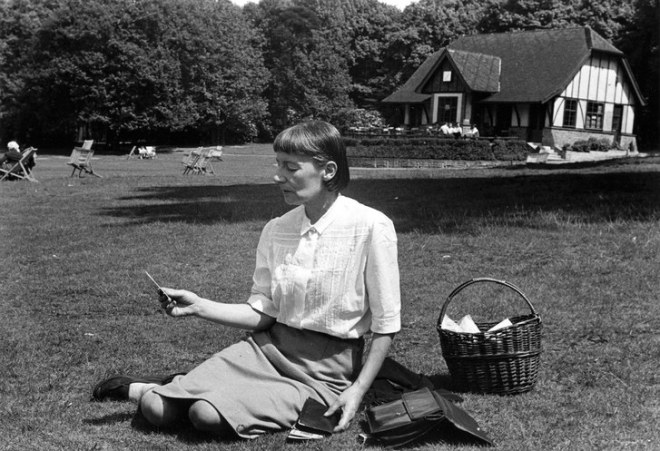
On 20th September 1902, Stevie Smith was born Florence Margaret Smith in Hull. Poet and novelist, most famous for ‘Not waving but drowning’. D 7.3.1971 see photo

On 20th September 1903, Annie Marshall, 16, domestic servant, from Lissett, was raped, shot twice, suffocated with grass and thrown in the river at Scampston by Charles William Ashton, 19, of Cottingham, farmhand.  Ashton knew her well. He was found guilty of murder and hanged at Hull Prison on 11thDecember the same year.

On 20th September 1954, the Selby to Driffield rail line was closed for regular passenger traffic, a service of one regular non stop train each way plus occasional summer excursions ran until June 1965. The line was abandoned after the last freight train ran later that year.

On 20th September 1955, Robert Greenwood Tarran, of the Wolds, Beverley High Road, Hull, died aged 63. Civil engineering contractor, and founder of Tarran Industries Ltd, former Sheriff of Hull, and chief Air Raid Warden during WW2. He moved the Wilberforce monument, at his own expense, and was responsible for building 20,000 prefabs after the war. He was also suspected of complicity in profiting from deals over council land in Endike Lane, in a law case during which his colleague Digby Willoughby committed suicide.

StevieSmith

September 15th

On 15th September 1415, Henry V issued a General Pardon to the Mayor and town of Hull.  It is not clear for what they were being pardoned, though it may have been a general relaxation of taxes in gratitude for providing soldiers – or ships – after his success at Agincourt.

On 15th September 1561, William Calverde rented from Hull Corporation land called Hurne Close in Myton, with the right to pasture 20 sheep in the Common Carr of Myton.

On 15th September 1636, Hull Corporation was warned to prevent seamen arriving from ports infected with plague from coming ashore. Hull was in the midst of a serious 3-year outbreak which began in 1635.

On 15th September 1636, James II turned out of office 11 of the 13 elected Hull aldermen, the Mayor, High Steward, Recorder and Town Clerk, and replaced them with his own choice. This put Marmaduke Lord Langdale, in the powerful position of Governor of the garrison and Recorder, backed by 1199 soldiers, billeted on the residents. In December that year, Langdale was himself ejected.

Marmaduke_Langdale2

On 15th September 1864, Crown Prince Umberto of Italy stayed overnight at the Beverley Arms, after attending the St Leger at Doncaster, and left to visit James Hall’s stud at Scorborough.

On 15th September 1948, Mr J.H. Wilson, 33, labourer-driver, employed by East Riding  Agricultural Committee, was badly injured when he drove a lorry across a temporary rail crossing at Garton on the Wolds. The lorry was wrecked by a train, killing 3 Polish and Hungarian workers, and injuring another 4. The workers were people displaced by WW2, who were travelling to a Garton farm to help with the harvest. An enquiry recommended steps to improve the crossing.