December 26th

On 26th December 1220, William de Forz II, Count of Aumale and Lord of Holderness was with King Henry III at the Royal court at Oxford; the King made an appointment William hoped to get; disappointed, he left Oxford for Lincolnshire, and began a rebellion, known as the war of Bytham.

On 26th December 1489, George Gusterd, weaver of Bishop Burton, claimed sanctuary at Beverley for the murder of a servant of Edward Barnaby, a gentleman. He did not know the servant’s name.

On 26th December 1495, William Middleton was threatened with a pole-axe by John of Cottingham, John of Wawne, Thomas Warde, Robert Bate, and (- ) Mykill, and was so afraid for his life that he took sanctuary in Wawne church and stayed there for 10 hours, afterwards leaving the area. He applied to the Chancery Court for leave to prosecute his attackers, but the outcome is not recorded.

On 26th December 1645, Rev Nicholas Osgodby was reported to be using the forbidden Prayer Book in secret.

On 26th December 1750, the chapter house roof of Howden church collapsed, to join the rubble of the chancel which had collapsed in 1696.

On 26th December 1890, residents of Hornsea had a fair on the frozen surface of the Mere, and a sheep was roasted on the ice.

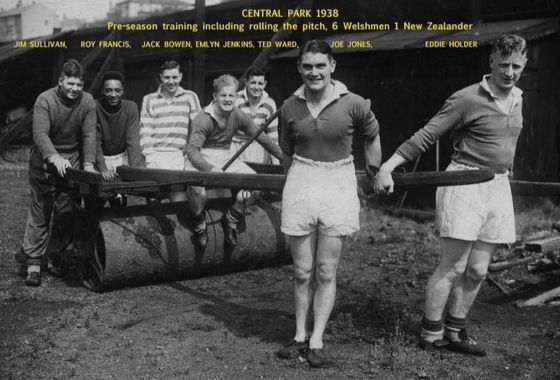
On 26th December 1955, Roy Francis played his last game after 6 years with Hull FC, and became UK’s first black professional sporting coach, and team manager 1971 to 1973.
roy-francis

December 23rd

On 23rd December 1226, Robert ‘Furfan’ de Ros, of Roos, died, aged about 54. 1stLord of Helmsley, son-in-law of the Scottish king William the Lion, a Knight Templar and one of the barons enforcing the Magna Carta. His tomb is in the Temple church, London.

On 23rd December 1510, Peter Swake and Roland Dale of Catton claimed sanctuary at the church of St Cuthbert, Durham, as accessories to homicide. About 25.11.1510, they were present when Richard Horsley of Catton was taken from his mother’s house in Catton to a field, where he received several wounds, from which he died about a month later. They feared being  indicted as accessories. On 5.7.1511, another Catton man, William Ratcliff, entered the sanctuary with the same story, although he had taken sanctuary in Beverley for the homicide the previous year.

On 23rd December 1535, Austin Tennant of Hull claimed sanctuary at the church of St John, Beverley, for homicide and felony (details not recorded).  On the same day, the sanctuary received another 4 fugitives, from Leeds, Wakefield, and Thornton and Tealby in Lincs, 3 for felony and 1 for debt.

On 23rd December 1640, Sir John Lister died in Hull, aged 53. He left land at Thorngumbald to provide income for the poor, and money to set up the almshouses known as Lister’s Hospital. Twice Mayor of Hull, and MP, he built the house now known as Wilberforce House. He is commemorated in Holy Trinity church, where he also left money for repairs.

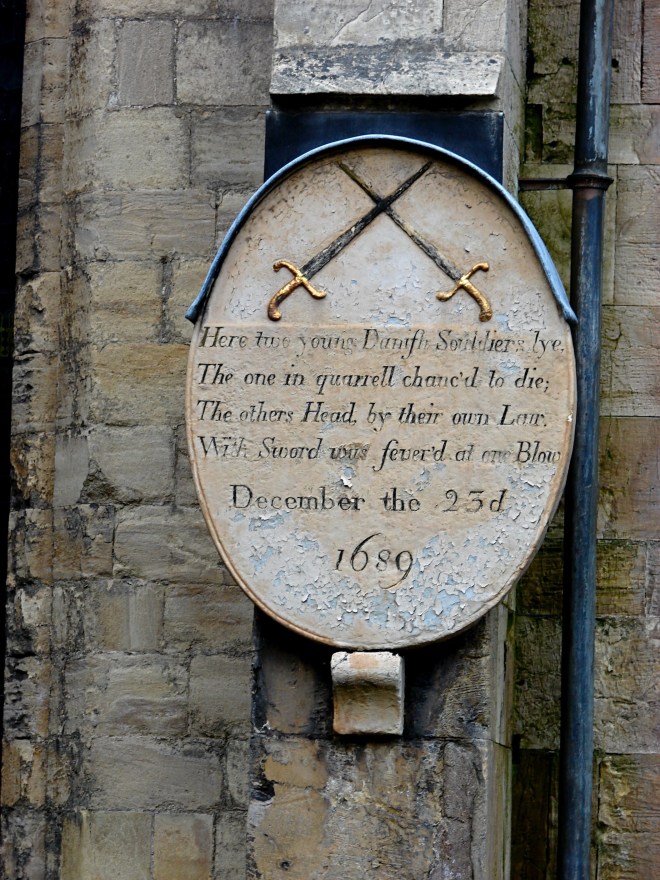
On 23rd December 1689, Johannes Frederick Bellow, a Danish trooper, was executed in Beverley Market Place for killing fellow soldier Daniel Straker, in a duel. Both are buried in St Mary’s churchyard.

On 23rd December 1732, a hurricane removed the roof and steeple of Hornsea church, destroyed 24 houses and overturned a windmill, and interrupted the parish clerk in the act of concealing smuggled goods in the crypt of the church.

danish soldiers st mary's.JPG

November 18th

On 18th November 1620, the son of Thomas Peirson of Shipton (now Shiptonthorpe) hoped for a post in the kitchen at Londesborough House, the seat of Francis Clifford, Earl of Cumberland. Either he was not suitable, or there was no post available. He was given 12d costs as compensation. Posts were usually filled by personal recommendation, often from families who had worked in the house in the past.

On 18th November 1910, Benjamin Bolton, aged 48, of 5 Suffolk Terrace, Hornsea, died after falling from a moving train near Brough.  A prominent Hornsea citizen, member of the Conservative Party and member of Hornsea Music Union, he played cricket for Hull, Hornsea & Yorkshire and bowled out W G Grace. The inquest returned a verdict of accidental death. (b23.9.1862 Cottingham)

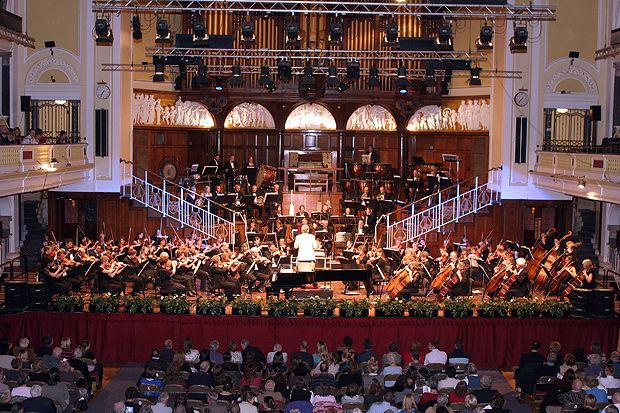
On 18th November 1938, Sir Henry Joseph Wood, founder of the Proms, resigned as conductor of the Hull Philharmonic Society after 15 years. The committee considered Sir Malcolm Sargent as his replacement, but he was not available. Basil Cameron was engaged. photo shows the orchestra in Hull City Hall

hull-philharmonic-orchestra-lst198215

October 28th


charterhouse.JPGOn 28th October 1451, the Mayor and town of Hull and the Prior and Convent of the Charterhouse reached agreement on 8 areas of dispute between them, chiefly relating to ownership of land and streets between the town walls and the Charterhouse, including the Trippett and the northern part of Pole Street, the rent due for them, and garden fences of the Charterhouse encroaching on the public highway.
On 28th October 1510, William Sedyngton of Flambrough claimed sanctuary at the church of St John, Beverley, for debt.

On 28th October 1880, during a storm, the Saffron, Jabez, and Earl of Derby separately crashed into the piers at Withernsea and Hornsea, 2 at Withernsea and 1 at Hornsea; both piers were substantially damaged. The Hornsea pier had only opened 5 months before, and was completely demolished in 1897. The Withernsea pier had been open 2 years, and was to have several more ships crash into it before being demolished, apart from the 2 remaining towers.

On 28th October 1910, the Aldbrough Rocket Brigade rescued the crew of the trawler Castor of Grimsby, which ran aground on Aldbrough beach, whilst the Hornsea Lifeboat crew took an hour against high winds to row to the site. Later the Secretary of the Hornsea branch of the RNLI said that Hornsea did not have strong men like they had in Bridlington and it was the worst place on the coast to get a lifeboat.

October 19th

On 19th October 1469, John Fisher was born in Beverley, the eldest son of Robert and Agnes Fisher. Chancellor of Cambridge University, Bishop of Rochester, and chaplain to royalty.  He was executed for treason 22.6.1535 on Tower Hill, for speaking out against Henry VIII’s divorce, and refusing to acknowledge the heirs of Henry and Ann Boleyn as legitimate successors to the throne. A Catholic martyr, he was canonized as St John Fisher.

On 19th October 1781, Rev George Lambert reported in his diary on a very high tide which inundated many houses in Hull.

On 19th October 1826, a Huggate parish jury of 12 men, 2 affearers (assessors of fines) and the pinder, set penalties for anyone allowing cattle into public lanes at night at 2s6d per head, for the first offence, and 5s per head for every offence afterwards; for allowing pigs in the streets without a ring between May Day and Michaelmas 3d per head; for allowing geese in the streets between Old Mayday and Old Lammas, 1s; for allowing anyone to stay who does not have a certificate allowing them to settle, £1 19s 11d.

On 19th October 1890, John Connell, boatman, of Waxholme, in the Coastguard Service, took part in the rescue of crew from the Grimsby vessel Genesta when it ran aground. All were rescued, except the captain, who died of exposure. Connell went on to the vessel as it was breaking up to rescue a man too weak to help himself. Connell was awarded the Humane Society Silver Medal. The unmanned vessel broke free the following day and travelled to Withernsea.

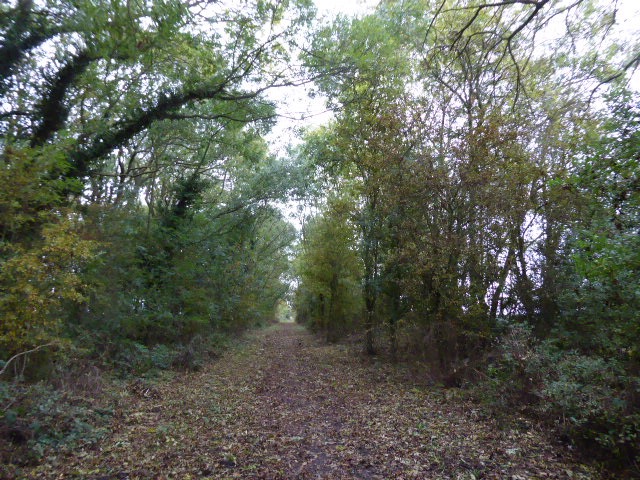
On 19th October 1964, rail passengers took their last trips on the Hull to Withernsea and Hull to Hornsea rail lines, which closed as a result of the Beeching Report. Goods services to Withernsea continued to 30.4.1965, to Hedon 3.5.1965, and to Marfleet to 1972. photo shows part of Hornsea Rail Trail today.

Hornsea Rail Trail


October 8th

On 8th October 1536, Beverley men mustered on Westwood Low Green in response to the Lincolnshire rebellion against the Act of Dissolution. Elizabeth Stapleton encouraged them, despite the reluctance of her husband, and her brother-in–law William Stapleton became the rebels’ captain.

On 8th October 1643, Capt Strickland led a failed Royalist attack on Hull’s Hessle Gate, and was shot dead. Many of the attackers were killed.

On 8th October 1708, William Robinson died in Hull. Former Sheriff of Hull, donor of a hospital to Trinity House, left bread for 12 widows to be given each year on Christmas Day. They were required to go to his grave in Holy Trinity churchyard to receive their dole.

On 8th October 1805, Beverley corporation ordered that all rogues and vagabonds found wandering in the town must be apprehended and conveyed to a magistrate. A board  showing this order can be seen in St Mary’s church loft.

On 8th October 1862, Hornsea businessman Joseph Armytage Wade turned the first sod with a silver trowel at a ceremony to mark the start of building the Hull to Hornsea Railway.

On 8th October 1874, George Wombwell visited Beverley on his way to Hull Fair; in Saturday Market he exhibited elephants, giraffes, a rhino, and big cats; other shows also stopped over in the town before going to Hull.

On 8th October 1929, Wm Jackson & Son Ltd opened their landmark store in Paragon Street, Hull, designed by Hull architects Gelder and Kitchen, with a cafeteria and restaurant on the first floor. After the war, when the fire-damaged property was repaired, a 3rd floor was added as a ballroom. This was to become one of the city’s most popular night-spots for many years.

On 8th October 1985, Clive Sullivan MBE died aged 42. 1st black captain of any British national sporting team. He played rugby league with both Hull and Hull Kingston Rovers during his career. Holds records for most tries in a career (250) and most tries in a match (7). Commemorated in Clive Sullivan Way and the Clive Sullivan Memorial Trophy.(b 9.4.1943 Cardiff)


Clive Sullivan

October 4th

On 4th October 1253, heavy flooding in Holderness resulted from a dry year and heavy rain. The River Hull changed its course.

On 4th October 1541, the Privy Council of England again sat in Hull.

On 4th October 1642, Capt John Hotham, after the Yorkshire Treaty of Neutrality was signed, began to return from Doncaster to Hull. The treaty was rejected by Parliament, and he detoured and captured Cawood Castle for Parliament, the Archbishop having fled.

On 4th October 1643, 400 Parliamentary soldiers went out of the besieged town of Hull and destroyed the Royalist forts in Sculcoates and Derringham Bank.

On 4th October 1785, Thomas Jackson of Blackfriargate, Hull, complained to the Mayor and corporation about nuisance caused by one of the town waites (official musicians) holding dancing lessons in Hales Entry.

On 4th October 1909, Hornsea Urban District Council conducted a poll of ratepayers, who voted to allow the council to enclose the Promenade Gardens and charge for admission.

On 4th October 1952, ship’s cook Cyril Brown, 44, and 19 shipmates were lost when Hull trawler Norman was wrecked. The sole survivor was Norman Spencer, 19. see Pathe news https://www.britishpathe.com/video/one-survivor-aka-trawler-disaster


September 9th

On 9th September 1513, Marmaduke Constable, of Flamborough was knighted for his role in the Battleof Flodden Field, and a letter of thanks from Henry VIII is displayed in Wassand Hall. Ralph Ellerker, senior of Risby and his son Ralph were also both knighted. This causes some confusion in the historical record, as there were 2 Sir Ralph Ellerkers alive at the same time.

On 9th September 1643, Rev James Sibree reported that on Sunday he had preached twice, visited the cemetery 3 times, and interred 43 bodies of his fellow citizens. During the cholera outbreak, many church services were held outdoors in the Market Place, by ministers of different denominations, and attended by more than 3,000 people. photo shows Cholera Memorial in Western Geneeral Cemetery.

On 9th September 1878, George Carr, aged 45 and Joseph Carr, aged 26, accidentally drowned in Hornsea.

On 9th September 1956, Captain Erik Ohsman, and Chief Steward V. Stenros, of SS Lona, were rescued by firemen when they were found unconscious after fire was discoveredon their Swedish ship, loaded with over 3k tons of pit props. Both recovered. The fire, which started in the engine room, spread to the cargo, and after several hours the ship had to be scuttled in the dock to prevent greater damage. She was raised on 11 October and repaired. Cholera memorial

August 27th

On 27th August 1473, John Warter’s ship Nicholas left Hedon with exports belonging to 14 different merchants, mostly wool and sheepskins. The tax record does not indicate where the ship travelled to. photo shows the Hedon ship design, found in St Augustine’s church.

On 27th August 1586, Daniell Morton was arrested for attempting to travel overseas against government order, and was retained in custody in Hull until further order.

On 27th August 1643, Lord Ferdinando Fairfax, Governor of Hull, ordered that Royalist sympathisers (termed malignants) have their property seized to support Parliament’s cause.

On 27th August 1902, Trooper H.B. Adamson, and Sergeant T. Burn were soldiers returning home to Hornsea from the Boer War. They were greeted by large crowds, the Town Band and a detachment of the Artillery Volunteers, and paraded round the town in a carriage. Sadly, Trooper E. Dabb arrived 4 days later unexpectedly and without ceremony.

On 27th August 1940, Mrs Spetch’s cottage at Mappleton was severely damaged by an enemy bomb, which also destroyed several windows in the church. The cottage site is now occupied by the Maple Garage.

Hedon ship, St Augustine's

August 2nd

On 2nd August 1806, Capt Welburn, James Simon, ship’s surgeon, and crew of Hull whaler Blenheim were returning from the Davis Straits when the ship was taken by 2 French frigates, L’Syrene and Le Revenge. The Blenheim was burnt, its crew landed at Pampoule near St Malo, and conveyed to Arras where they were imprisoned. They were later moved to other prisons, and only released in 1814, after years of privation and misery, when the allies entered Paris. Dr Simon was subsequently in practice in Aldborough, Holderness where he died in 1845.

On 2nd August 1860, Hedon Magdalen Fair was finally abolished; in the latter years the owner of the field had to persuade, or bribe, those who wished to attend the fair not to meet there. The event had included a market, music, games, sports, juggling, fire-eaters, and badger baiting.

On 2nd August 1913, Charles William Loten and Terence Charles Carroll, 18, died at Hornsea whilst trying to save a child from drowning. A memorial brass in Hornsea church was paid for by public subscription.

On 2nd August 1916, Joseph Bennett, 17,  died in Hull from bubonic plague. photo shows his memorial in the columbarium, Hedon Road.

plague victim.JPG