August 31st

On 31st August 1292, King Edward I stayed at Kilham, on his return from Scotland, where he judged on the claims of Robert the Bruce and John Balliol for the crown, he also made several other stops in East Yorkshire.

On 31st August 1516,  Robert Chorkyls, husbandman, of Wyton, claimed sanctuary at the church of St John, Beverley, for the murder of John Rotheram.

On 31st August 1579, Howden records state that 158 people died in the previous 5 months, at least 110 above the average, due to plague. The city of York forbade anyone from Howden or Snaith from entering the city.

On 31st August 1941, Minnie Leveson, nurse, aged 20, was killed by an air-raid on her home in Willerby; she is buried in De la Pole Hospital cemetery.

On 31st August 1943, 15 Wellington bombers took off from RAF Leconfield and 2 of them collided over Goole, killing both crews and 2 residents of North Street.

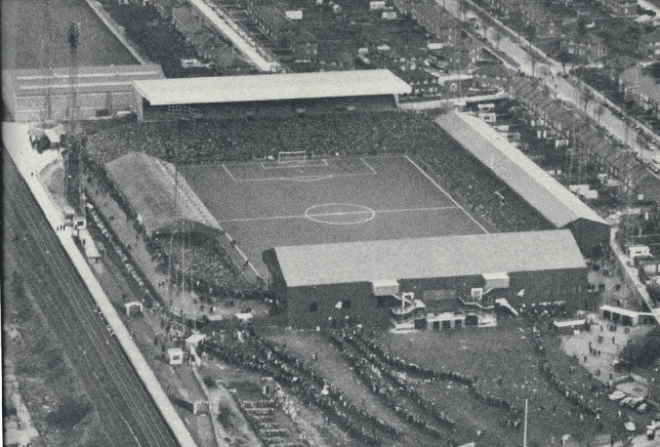
On 31st August 1946, Hull Lord Mayor Herbert Harrison officially opened Hull City AFC’s new stadium, Boothferry Park. The crowd of 25,586 were entertained by the band of the 2ndBattalion East Yorkshire Regiment. The match was against Lincoln City, the result 0-0.
boothferrypk

August 30th


Brid Priory churchOn 30th August 1510, Bridlington tanner Henry Braderig claimed sanctuary at the church of St Cuthbert, Durham, for killing Robert Lelome in the grounds of Bridlington Abbey. With 2 other tanners, Roland Hall and Robert Yong, he had struck Lelome with a dagger, and he died 2 weeks later. The attack happened 11 months earlier, in September.   photo shows Bridlington Abbey church today
On 30th August 1767, James Savage was born in Howden.  Journalist, printer and bookseller, librarian, antiquarian, and newspaper editor. Wrote ‘A History of Howden Church’ 1799 and a history of Wressle in 1805, and a number of other books. (Died  Taunton 19.3.1845). (Suggestion, unverified, that he was Howden town clerk, was accused of claiming excessive expenses, and left Howden 1801 with the parish records, refusing to return them until the town paid him monies due; the books were not recovered).

On 30th August 1854, Robert Wilberforce, rector of Burton Agnes and Archdeacon of the East Riding, resigned after leading a doctrinal controversy which raged in the Hull newspapers for many weeks. Shortly after this, he joined the Catholic church.  He died before he could be ordained. He was a son of William Wilberforce.

On 30th August 1913, Elizabeth Barr, 25, was shot at Watton by former partner and the father of her child, Henry Moore of Kelk, who then shot himself. A letter from Moore to his father indicates his action was premeditated. Barr died 2 days later, and Moore the following week. A coroner’s jury found Barr’s death was due to wilful murder.

On 30th August 1940, Abdo Nassa, age 50, fireman, died by enemy action whilst a merchant seaman in Atlantic convoy, on board SS Chelsea of Hull.

August 24th

On 24th August 1399, a schism within the church led to controversy about the post of Meaux Abbot Thomas Burton, and rather than involve the abbey in the costs of litigation, he retired and wrote “The Meaux Chronicle’, the history of the abbey.

On 24th August 1662, on Black Bartholomew’s Day, also known as the Great Ejection, Josiah Holdsworth, curate of Sutton-on-Hull, was dismissed for refusing to conform to the Book of Common Prayer, along with 2,000 other Puritan ministers across the country.  They included Anthony Stephenson at Roos, who stayed in the village as physician, and Stephen Arlush of Howden, who continued to preach in a private house as a Congregationalist, also John Ryther of North Ferriby, who spent some years in prison for illegal preaching. And Mr Robinson at Cottingham, Mr Luddington at Sculcoates, Mr Thos Micklethwaite at Cherry Burton.

On 24th August 1759, William Wilberforce was born in High Street, Hull. The Parliamentary champion of the abolition of slavery, he collaborated for 50 years with Thomas Clarkson. MP for Yorkshire 1812-1825. Buried in Westminster Abbey. (d 29.71833)

On 24th August 1789, the Preston house and shop of William Sanderson were broken into by James Hartley of Manchester. Hartley was hanged at York Castle on 17.4.1790.

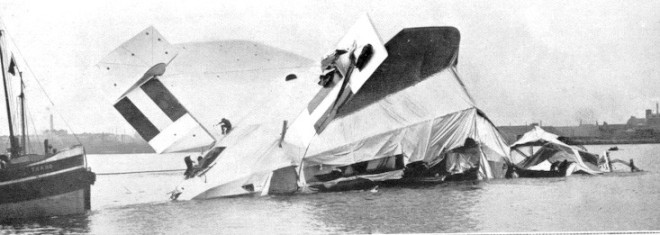
On 24th August 1921, an R38 airship exploded and crashed into the Humber on its last trial flight; 44 members of the crew died. Debris narrowly missed sightseers on Victoria Pier, Hull. photo shows wreckage

On 24th August 1943, Flight Officer Charles Keirl, 23, and 13 other airmen died when 2 Halifax bombers of 78 Squadron collided in fog; one air gunner survived. Keirl is buried in Queensgate Cemetery, Beverley. There is a memorial at Hull Bridge.


R38wreckage1

August 15th

On 15th August 1690, Robert Lumley, ship’s master, was fined 10s by Hull Trinity House for sailing out of the port without supplying the House with a list of men and their wages.

On 15th August 1764, Abraham Clayton, 35, of Howden, was hanged at York Castle for murdering his wife Elizabeth; his body was given to surgeons ‘to be anatomized’.

On 15th August 1808, Robert Pattinson,  grazier and agriculturist, died aged 82, and left 4 acres of land in Skeffling, the rent to be used to educate poor children in Easington.

On 15th August 1924, Harry Blanshard Wood, VC, died aged 42 in Devon, after a traffic accident. Born in Newton-on-Derwent, he was a corporal in the 2ndBattalion, Scots Guards when on 13.10.1918 in St Python, France, he took command when his platoon sergeant was killed, and showed gallant conduct and initiative, for which he was awarded the Victoria Cross.

On the same day, BBC radio station 6KH began broadcasting local items from bishop Lane, Hull, including sport, talks, children’s shows, and music featuring local musicians, e.g. Powolny’s Restaurant Bijou Orchestra. In 1928, the station closed, and there was no local station until Radio Humberside opened in 1971.

On 15th August 1940, 13 military personnel and 1 civilian died, and 16 injured in this daytime air raid on Driffield airfield and Southburn, including Aircraftwoman M. Hudson, the first WRAF fatality.

August 13th

On 13th August 1778, the first recorded cricket match in East Yorkshire took place in Wallingfen, near North Cave, on a Thursday, between a Beverley team and Howden. Howden won (74-138?) The prize was 50 guineas.

On 13th August 1782, James Norrington was killed in a chalk pit at Hutton. He worked for Miles Smith of the Sunderlandwick Estate, who owned the chalk pit in Balk Lane.

On 13th August 1881, Ye White Hart Companie, while renovating and altering the old building, made a number of finds: human bones and Elizabethan period tobacco pipes under the floor, and old swords and a ship’s chart under the roof. They were put in the possession of antiquarian Alderman Symons. The company also seems to be responsible for creating the myth that the Plotting Parlour was the place where it was agreed to exclude King Charles.

Old White Harte

August 9th

Bishop's Palace, Howden

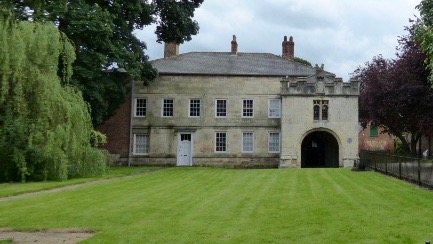
On 9th August 1260, Walter of Kirkham, Bishop of Durham, died at the Bishop’s Palace, Howden. His body was taken to Durham for burial but his viscera were buried in the church. photo shows what remains of Bishop’s Palace.

On 9th August 1516, Sir Ralph Ellerker of Risby confessed to Cardinal Thomas Wolsey, Archbishop of York, that he ordered his servants Henry Norham and Roberte Hunt to kidnap George Millet, keeper of Beverley Parks, and imprison him in Cottingham Park so that he could hunt on the Archbishop’s land. Pleading poverty, he was bound over in the sum of £200.

On 9th August 1769, John Burrill of Skipsea assaulted John Warcup with swords, staves, knives and clubs so that his life was threatened and ‘other wrongs’. Burrill was indicted in September, found guilty on 24.4.1770, and sentenced 2.10.1770 to a fine of £20 and to remain in gaol until the fine was paid.

On 9th August 1785, Rev George Lambert went to see a 24 foot whale killed and displayed at South End, Hull (near modern pier); described by sailors as a young bottlenecked grampus.

On 9th August 1859, Hansard records the 29.4.1859 election in Beverley void; Ralph Walters was declared ‘not a Burgess to serve in this present Parliament for the Borough of Beverley’ and Henry Edwards was declared MP in his place. Joseph Robinson Pease in his diary called Walters ‘an adventurer, arriving 3 days previously’, ‘by open bribery …. carried the day.’

On 9th August 1902, William Day Keyworth junior, sculptor, died aged 59 in Spring Bank, Hull. He produced many statues of civic dignitaries, including Andrew Marvell, Anthony Bannister and William Wilberforce (now outside Wilberforce House). Shot himself in the head at his home, but left no suicide note.

On the same day, Nafferton villagers were celebrating King Edward VII’s coronation with, among other events, a ‘comic’ cricket match, gentlemen vs ladies, which the ladies won. The score is not recorded.

On 9th August 1915, 17 Goole residents, mostly women and children, were killed by a Zeppelin raid on the town and docks.

On 9th August 1916, a Zeppelin raid on Anlaby Road, Hull,  killed John Broadley aged 3 and at least 7 other residents, and injured about 20. 2 people died of shock. Rev A.W. Carter, Assistant Priest of Newington Church, was badly hurt.


August 7th

On 7th August 1385, Joan of Kent (the Fair Maid of Kent), mother of King Richard II, died, it is said, of a broken heart.  She was unable to persuade her son King Richard to pardon another son, Sir John Holland, for the murder of Ralph, son of the Earl of Stafford. Holland was in sanctuary in Beverley Minster, and the murder took place nearby, when Richard’s troops were outside Beverley, on their way to the Scottish wars. Holland was pardoned within the year.

On 7th August 1427, Pope Martin V, in reply to a petition (from the parishioners of both Aughton and Bubwith churches and Peter de la Hay), granted permission that, when they were hindered in winter by floods, snow and hail from reaching their parish churches, they could use the chapel of St James in Spaldington for mass and other offices ‘while the hindrances last’.

On 7th August 1663, Robert Hardy of Hessle was enjoined by the Archbishop of York to do penance in Hessle church for his adultery. photo shows All Saints Church, Hessle

On 7th August 1840, a Serious rail accident took place in Howden, in which 4 passengers were killed, and 9 injured. The Hull and Selby Railway had only opened in full on 1st July. The accident was the subject of the first ever report by the Board of Trade into a railway accident.All Saints, Hessle

July 20th

On 20th July 700 AD, St Osanne (or Osana or Osmanna) died aged 30 (at least, this is her saint’s day). Sister of Osred I, King of Northumbria (or daughter of Aldfrith), she was a nun at Jouarre, France. Her miracles are recorded: when a concubine of the Howden rector was so impious as to sit upon Osana’s tomb, Osana stuck her to it so that she could not be removed.

On 20th July 1332, Edward Balliol gathered a fleet of 88 ships in the Humber, and joined by a number of other Scottish nobles, set off for Fife to claim the Scottish throne from the Bruce family.

On 20th July 1413, Pope John XXI wrote to residents of West Hull villages, solemnly reminding them of the judgements to come if they did not maintain the water courses providing fresh water to Hull.

On 20th July 1495, John Halyday, carrier, of Watton, claimed sanctuary at the church of St John, Beverley, for the murder at Watton of Agnes Lathe.

On 20th July 1631, Henry Lord Clifford made the first payment to Dutch painter Hendrick de Keyser the younger, following a fashion for painting set by Charles I; de Keyser was employed for 7 years, unusual for a great house in the North. No work attributed to de Keyser has survived.

On 20th July 1662, Rev Nicholas Osgodby was reinstated as vicar of St Mary’s after being removed from his post during the Commonwealth.

On 20th July 1798, press gang officer Lieutenant Loten was attacked in the street in Hull by a sailor with a Greenland knife, and escaped to his house. A riot began which took the militia 3 hours to quell.

On 20th July 1934, the crew of Hull tug Autocrat were rescued when she was pulled over and sank near Whitton, in the Humber, while helping the Goole tug Salvage to refloat the SS Ouse. The tug was raised and returned to service.

St Mary's Beverley


July 5th

On 5th July 1532, Henry VIII’s charter was read out in Hull Market Place, and prohibited anyone but Hull burgesses from conducting business in the port; the corporation paid £31 19s4d to obtain the charter, part of which was paid in the form of a sturgeon for Thomas Cromwell.

On 5th July 1657, a major fire in Hedon starting at 1 a.m. resulted in the loss of 42 houses, and others damaged. In August, the Mayor petitioned Parliament for permission to hold a collection to raise money; £4,000 was raised.

On 5th July 1776, John Wesley paid a visit to Howden and preached to a large congregation during a thunderstorm near Station Road, Howden. Wesley’s picture below

On 5th July 1811, Bridlington Collector of Customs Benjamin Milne discovered a tidal spring near the quay, now commemorated by a stone inscription.

On 5th July 1899, Hull Alderman Larard took the controls of the city’s first municipal electric tram (Siemens Bros & Co provided the electrical equipment). A spectator hoping for a good view, climbed on the roof of the public lavatories and fell through.

On 5th July 1930, the annual King’s Cup Air Race took place on this date, and planes had to follow a route of around 800 miles. Hull Aerodrome was a main control station on the route. Tickets were sold for 1s and 2s6d. The winner was Miss Winifred Brown in an Avro Avian III. (N.B. Hull Aerodrome is actually in Preston South.)


john wesley

July 2nd

On 2nd July 1642, the Royalist ship Providence, commissioned by Queen Henrietta Maria, evaded Parliamentary ships by entering Keyingham Creek, which was too narrow for the larger ships, and landed a consignment of arms from Holland for the Royalist army. With help from local people, they unloaded ammunition which was taken to the king at York.

On the same day, the Royalist army secured Hull Bridge, Tickton, on the Beverley side, to prevent attacks from Hull and stop provisions reaching Hull, and evicted constable William Cuthbert and his family at midnight.

On 2nd July 1644, Sir Thomas Metham of Metham near Howden,  died at the Battle of Marston Moor fighting on the Royalist side, captain of the Yorkshire gentlemen volunteers.

On 2nd July 1830, Hull whaler Progress was wrecked in a storm when iced in near the Davis Strait; 19 whalers were wrecked or lost that season, 4 of them from Hull.

On 2nd July 1837, Hull whaler Swan was sighted off Spurn Point as a memorial service was being held in Hull for the crew. They had been away for over a year and had been trapped in ice. 25 of the 48 crew had died.

On 2nd July 1954, Harold Macmillan, Minister of Housing and Local Government, approved the amended Hull Development Plan, regenerating the city after the bomb damage of the war. Hull Georgian Society lamented the loss of buildings such as many on High Street, the whole of Nile Street and houses in Lowgate. Not all of the proposals came about – there was to have been a ‘town park’ open area from Holy Trinity to Princes Dock.