September 12th

On 12th September 1843, a Grand Gala was held at Hull Zoological Gardens, with performances by trained animals, an archery competition, and ‘feats of jugglery’.

On 12th September 1911, 12 schoolboys from St Mary’s Catholic School, Hull, began apparently the first school strike in what became a national movement, following widespread strikes in the docks and other industries.


ZooGdns

September 8th

On 8th September 1069, the Danish king Sweyn Estrithson and a fleet of 240 ships anchored in the Humber accompanied by Edgar of Wessex who claimed England’s throne. They marched on York.

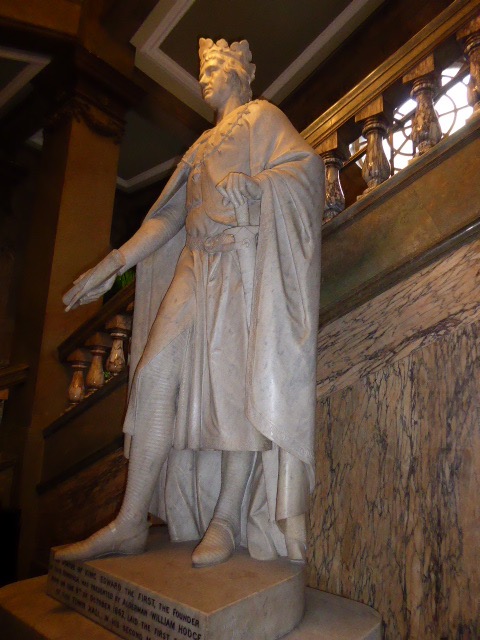
On 8th September 1292, King Edward I stayed in Beverley on his progress through East Yorkshire. photo shows his statue in Hull Guildhall

On 8th September 1402, William Asleby and other rioters from West Hull villages who had rioted as part of Hull’s ‘water wars’ had to do penance every year on the Friday nearest the Feast of the Nativity of Our Lady, by processing through Holy Trinity church naked, bare-headed and with bare feet, through the church during mass, carrying a 3lb burning candle. If they failed to comply, they would be fined £40 – though none of them had any goods of value.

On 8th September 1667, Richard Leeming, Mayor of Grantham, wrote to the Hull Mayor to notify him of the escape of a prisoner committed for murder supposed to be making for Hull.

On 8th September 1730, an accidental fire destroyed the house of John Mason and Richard Dagger, their goods, clothing and hay, making them destitute and entitled to poor relief from the parish.

Edward I
Guildhall


September 7th

On 7th September 1316, King Edward II issued orders to Beverley to arm the whole male population between ages 16 and 60 against the Scottish threat.

On 7th September 1643, Sir John Hotham was taken from the Tower of London to Parliament to be formally ejected from his seat as MP for Yorkshire.

On 7th September 1646, Sir Michael Wharton of Beverley, considered a Royalist (delinquent) for attending a meeting at Heworth Moor addressed by the King, was fined £4,000 in order to recover his goods which had been sequestered by Parliament. His fine was reduced in 1652. photo shows Warton’s Hospital, Keldgate, Beverley.Warton's Hospital.JPG

On 7th September 1854, Robert Isaac Wilberforce, vicar of Burton Agnes and Archdeacon of the East Riding, resigned his Church of England posts and joined the Catholic Church.  Robert was the second son of William Wilberforce. Of William Wilberforce’s 4 sons, 3 converted to Catholicism and Samuel Wilberforce Bishop of Oxford, then Winchester, was an extreme Anglo-Catholic.

On 7th September 1866, Bull lightship in the Humber was struck by the Prussian barque Emma Johanna and damaged, holed below the water-line. It was taken to Victoria Dock, Hull for repairs by Hull Trinity House.

September 3rd

On 3rd September 1292, King Edward I stayed in his royal castle at Burstwick for 2 days, on his way back from Scotland. At some point he visited Wyke, and asked for a survey as part of plans to create a new town.

On 3rd September 1812, Abel Scurr, captain of Hull whaler Comet, left port for a whaling trip in the southern ocean, in the seas off the Galapagos. He was caught up in the Peruvian revolution, detained for a year, and then died before the ship began whaling, returning to port on 3.12.1815.

On 3rd September 1917, former Reckitt’s employee and driver G. Gill died of wounds received on active service with 37thDivision Ammunition Column and is buried in Bailleul Cemetery, France.

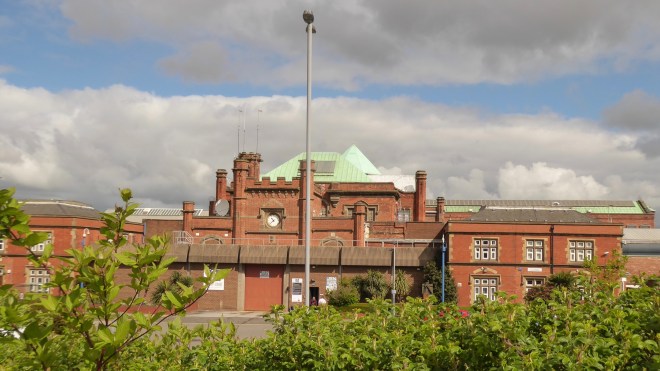
On 3rd September 1976, about 100 prisoners in Hull Prison, Hedon Road, took over 3 of the 4 wings, after a prisoner was beaten up by prison officers, citing grievances about conditions. Held a rooftop protest which lasted 67 hours. Huge amounts of damage were done to the prison, which was closed for a year.


Prison

September 2nd

On 2nd September 1643, the Royalists under the Earl of Newcastle began the second siege of Hull. The Governor, Lord Ferdinand Fairfax, sold silver to the value of £400 4s to Hull Trinity House, in order to pay his soldiers. Trinity House sold the silver the following year at a slight profit.

On 2nd September 1861, the lease on Fishwicks’ Mill, butt Lane, Beverley, had expired, and the mill was demolished. The Council tried to repossess the land, but local people considered it to be common land, and 25-30 rioters destroyed the house and burnt it to the ground.

On 2nd September 1871, William (Billy) Ringrose was born in Ganton, where he became a carpenter, but was coached by a cricket professional employed by the Legard family at the Hall, and became a renowned professional cricketer, playing for 57 games for Yorkshire.

On 2nd September 1922, Hull Kingston Rovers played its first game at its new ground, Craven Park, losing 3-0 to Wakefield. The new grounds also had 14 tennis courts, and meeting rooms. The official opening did not take place until November. This was the club’s 4thground, the first 2 being in West Hull.

On 2nd September 1950, MV Dundalk Bay arrived in Hull from Mombasa, bringing 1,014 people displaced by WW2. After processing, they were dispersed to various camps throughout the UK. Many Poles, Latvians, Lithuanians and others unable to return to their homes came to find work and settle in England; some emigrated again to Canada.

On 2nd September 1967, the Flamborough lifeboat Friendly Forester rescued 6 people cut off by the tide.

Old Craven Park EAW207783

August 30th


Brid Priory churchOn 30th August 1510, Bridlington tanner Henry Braderig claimed sanctuary at the church of St Cuthbert, Durham, for killing Robert Lelome in the grounds of Bridlington Abbey. With 2 other tanners, Roland Hall and Robert Yong, he had struck Lelome with a dagger, and he died 2 weeks later. The attack happened 11 months earlier, in September.   photo shows Bridlington Abbey church today

On 30th August 1767, James Savage was born in Howden.  Journalist, printer and bookseller, librarian, antiquarian, and newspaper editor. Wrote ‘A History of Howden Church’ 1799 and a history of Wressle in 1805, and a number of other books. (Died  Taunton 19.3.1845). (Suggestion, unverified, that he was Howden town clerk, was accused of claiming excessive expenses, and left Howden 1801 with the parish records, refusing to return them until the town paid him monies due; the books were not recovered).

On 30th August 1854, Robert Wilberforce, rector of Burton Agnes and Archdeacon of the East Riding, resigned after leading a doctrinal controversy which raged in the Hull newspapers for many weeks. Shortly after this, he joined the Catholic church.  He died before he could be ordained. He was a son of William Wilberforce.

On 30th August 1913, Elizabeth Barr, 25, was shot at Watton by former partner and the father of her child, Henry Moore of Kelk, who then shot himself. A letter from Moore to his father indicates his action was premeditated. Barr died 2 days later, and Moore the following week. A coroner’s jury found Barr’s death was due to wilful murder.

On 30th August 1940, Abdo Nassa, age 50, fireman, died by enemy action whilst a merchant seaman in Atlantic convoy, on board SS Chelsea of Hull.

August 24th

On 24th August 1399, a schism within the church led to controversy about the post of Meaux Abbot Thomas Burton, and rather than involve the abbey in the costs of litigation, he retired and wrote “The Meaux Chronicle’, the history of the abbey.

On 24th August 1662, on Black Bartholomew’s Day, also known as the Great Ejection, Josiah Holdsworth, curate of Sutton-on-Hull, was dismissed for refusing to conform to the Book of Common Prayer, along with 2,000 other Puritan ministers across the country.  They included Anthony Stephenson at Roos, who stayed in the village as physician, and Stephen Arlush of Howden, who continued to preach in a private house as a Congregationalist, also John Ryther of North Ferriby, who spent some years in prison for illegal preaching. And Mr Robinson at Cottingham, Mr Luddington at Sculcoates, Mr Thos Micklethwaite at Cherry Burton.

On 24th August 1759, William Wilberforce was born in High Street, Hull. The Parliamentary champion of the abolition of slavery, he collaborated for 50 years with Thomas Clarkson. MP for Yorkshire 1812-1825. Buried in Westminster Abbey. (d 29.71833)

On 24th August 1789, the Preston house and shop of William Sanderson were broken into by James Hartley of Manchester. Hartley was hanged at York Castle on 17.4.1790.

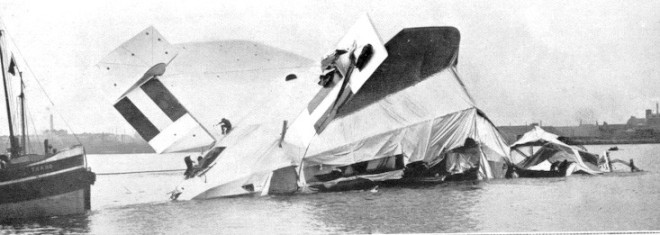
On 24th August 1921, an R38 airship exploded and crashed into the Humber on its last trial flight; 44 members of the crew died. Debris narrowly missed sightseers on Victoria Pier, Hull. photo shows wreckage

On 24th August 1943, Flight Officer Charles Keirl, 23, and 13 other airmen died when 2 Halifax bombers of 78 Squadron collided in fog; one air gunner survived. Keirl is buried in Queensgate Cemetery, Beverley. There is a memorial at Hull Bridge.


R38wreckage1

August 23rd

On 23rd August 1326, Richard Furnewes, barber to the Archbishop of York, was appointed to keep the park at Bishop Burton and the deer, at a salary of 2d per day.

On 23rd August 1601, Lord Burley, Queen’s Lieutenant and President of the Council of the North, visited Hull. His visit was marked with a firework display in the Market Place. Tragically, the cannon misfired, and at least 4 died, and several others were injured.

On 23rd August 1619, a woman bonesetter from South Dalton attended Londesborough House to treat Earl Francis’s shoulder, dislocated in a fall while out hawking. She was paid £1 5s for the treatment, which included 2 visits. (A physician might charge £2 a visit).

On 23rd August 1653, Robert Acklam was fined £5 by Hull Trinity House for taking the ship Blessing from Hull to London and from there crossing to Holland without the correct licence.

On 23rd August 1830, 60 farm workers rioted in Burton Pidsea, armed with clubs, scythes and stones, and visited every farmhouse where there were known to be Irish labourers, aiming to drive them out of the neighbourhood. 6 of them attacked Irish men working in a field belonging to Mr Baxter. The Hull Packet reported on 10.9. 1830 that the 6 ringleaders had been arrested and would be tried at the next Quarter Sessions in Beverley.

On 23rd August 1886, former Hull Trinity House pupil John Lester, aged 20, was killed by a fall from aloft on the Schooner Welsh Belle travelling from Hull to Newfoundland.

On 23rd August 1934, the Yorkshire Post reported on a cliff collapse along a 100-yard stretch at Aldbrough, which resulted in thousands of tons of material falling onto the beach, destroying the boat slipway. No-one was hurt. photo shows more recent erosion at Ulrome.


erosion Ulrome

August 22nd

On 22nd August, 1138, William le Gros, Earl of Albemarle and Lord of Holderness, was made Earl of York, in recognition of his prowess in the Battle of the Standard at Cowton Moor, Northallerton. The 4 standards of St John of Beverley, St Peter of York, St Cuthbert of Durham, and St Wilfred of Ripon, were used as a rallying point for the English against the Scots. The East Riding contingent included a Percy and a de Stuteville. (and see 20.8)

On 22nd August 1572, Thomas Percy, 7thEarl of Northumberland, was executed at York for treason, as leader of the Rising of the North. He was offered mercy if he renounced Catholicism, and refused.  Beatified by the Catholic church. (b 1528, probably in  Leconfield)

On 22nd August 1711, James Rand left £160 in his will for ‘the poor and needful of Preston’. Rands Estate in the village is named for him.

On 22nd August 1917, a bomb from a German Zeppelin destroyed the Primitive Methodist chapel, Baxtergate, Hedon.

On 22nd August 1918, Alfred Buchanan Cheetham of Bean Street, Hull, was killed when the SS Prunelle was torpedoed in the North Sea by a German U-boat. He took part in 3 Polar expeditions, and spent a total of 6 years in the Antarctic, with both Scott and Shackleton. Awarded the Silver Polar Medal clasp, he claimed to have crossed the Antarctic Circle 14 times. Cape Cheetham is named for him. (b 6.5.1867 Liverpool)

On 22nd August 1925, Robin Skelton died aged 72 in victoria, Canada. Poet, literary editor, professor and author of books on wicca. Born in Easington 12.10.1925


robin skelton

August20th

wm le grosOn 20th August 1179, William le Gros, Count of Aumale, Lord of Holderness, died aged 64 after 50 years as Count. As Earl of York, the most powerful man in the north of England during the Anarchy, a soldier, and founder of religious houses, including Meaux Abbey, and Newton Grange leper hospital.

On 20th August 1526, John Dove, a labourer from Burstwick, and William Bayne, a tallow chandler from Withernwick, separately arrived and claimed sanctuary at the church of St John, Beverley, for debt. On a busy day at the sanctuary, a 3rddebtor arrived from Wakefield.

On 20th August 1535, Richard Browne, vicar of North Cave, confessed to heresy by preaching Lutheranism; he was absolved, after suspension for 2 months.