November 26th

On 26th November 1319, Geoffrey Fitz Hugh and John de Wetewang conveyed property in Lyle Street (Mytongate), Hull,  to Hugh and Ellen Le Taverner.

On 26th November 1525, Richard Haton, gentleman, from Hayton, claimed sanctuary in St Mary’s Church, Hertford, and confessed to the coroner  that in October he had broken into a parish church in Essex and stolen a silver chalice; and in January he had burgled a house in Bucks and stolen jewellery and money. He abjured, i.e. renounced his country, and left through the port of Southampton.

On 26th November 1597, Sir Francis Barrington, Lord of the Manor of Cottingham (and uncle by marriage of Oliver Cromwell) wrote objecting to Hull Corporation’s drainage plan to move surplus water through his clough at Cottingham, which he said would risk flooding in the area.

On 26th November 1831, Joseph Robinson Pease, JP, spent his third consecutive day swearing in Special Constables to deal with anticipated riots; various sources say between 800 and 2,000 were sworn. James Acland had formed the Hull Political Union, and held meetings critical of the Hull Corporation, and said the aldermen were of out of touch and did not live in the town.

On 26th November 1847, Pocklington Canal Company agreed, at the Feathers Hotel, Pocklington, to sell the canal to the York & North Midland Railway, which also purchased the Market Weighton and Leven Canals. The canal had never been a financial success, and the railway company subsequently raised canal tolls so as to drive freight traffic onto the trains.

Pocklington canal
Melbourne lock

October 18th

On 18th October it was the tradition, on St Luke’s Day, to appoint an official dog-whipper to keep dogs out of church, and to whip any dogs found in the streets; the tradition is said to have begun when a dog ate a consecrated wafer in York Minster.

On 18th October 1654, The Petition of the Three Colonels or The Humble Petition of Several Colonels of the Army was published, authored by Alured, John Okey and Thos Saunders. Colonel Matthew Alured, brother of Hedon MP John Alured, lost his commission, and was imprisoned for a year for stirring up dissatisfaction with Parliament among English troops in Ireland.

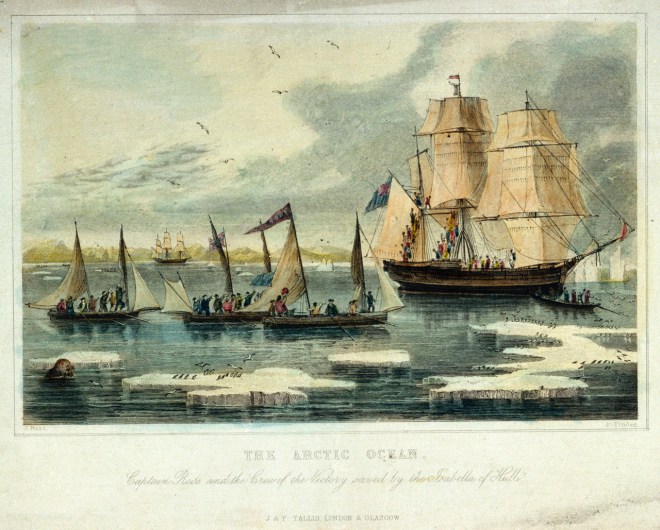
On 18th October 1833, Capt John Ross was granted the Freedom of the Town of Hull. Having returned to Hull on expedition to find the lost Isabella, was then himself thought lost.  (He was also granted the freedoms of London, Liverpool, Bristol and Wicklow)

On 18th October 1850, the Hull Advertiser reported that the ring leaders of a riot which resulted in the deaths of 4 Irish labourers on Sunk Island in July were found guilty of riot and sentenced to 4 months each with hard labour.They were: Robert Smith, John Londsbro, George Bellamy, John Dent, George Bielby and Fewson Towse.


John_Ross_rescued_by_Isabella,_1833

September 8th

On 8th September 1069, the Danish king Sweyn Estrithson and a fleet of 240 ships anchored in the Humber accompanied by Edgar of Wessex who claimed England’s throne. They marched on York.

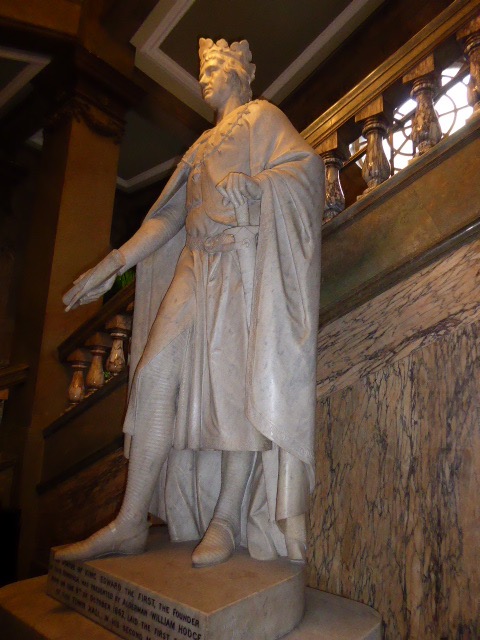
On 8th September 1292, King Edward I stayed in Beverley on his progress through East Yorkshire. photo shows his statue in Hull Guildhall

On 8th September 1402, William Asleby and other rioters from West Hull villages who had rioted as part of Hull’s ‘water wars’ had to do penance every year on the Friday nearest the Feast of the Nativity of Our Lady, by processing through Holy Trinity church naked, bare-headed and with bare feet, through the church during mass, carrying a 3lb burning candle. If they failed to comply, they would be fined £40 – though none of them had any goods of value.

On 8th September 1667, Richard Leeming, Mayor of Grantham, wrote to the Hull Mayor to notify him of the escape of a prisoner committed for murder supposed to be making for Hull.

On 8th September 1730, an accidental fire destroyed the house of John Mason and Richard Dagger, their goods, clothing and hay, making them destitute and entitled to poor relief from the parish.

Edward I
Guildhall


September 2nd

On 2nd September 1643, the Royalists under the Earl of Newcastle began the second siege of Hull. The Governor, Lord Ferdinand Fairfax, sold silver to the value of £400 4s to Hull Trinity House, in order to pay his soldiers. Trinity House sold the silver the following year at a slight profit.

On 2nd September 1861, the lease on Fishwicks’ Mill, butt Lane, Beverley, had expired, and the mill was demolished. The Council tried to repossess the land, but local people considered it to be common land, and 25-30 rioters destroyed the house and burnt it to the ground.

On 2nd September 1871, William (Billy) Ringrose was born in Ganton, where he became a carpenter, but was coached by a cricket professional employed by the Legard family at the Hall, and became a renowned professional cricketer, playing for 57 games for Yorkshire.

On 2nd September 1922, Hull Kingston Rovers played its first game at its new ground, Craven Park, losing 3-0 to Wakefield. The new grounds also had 14 tennis courts, and meeting rooms. The official opening did not take place until November. This was the club’s 4thground, the first 2 being in West Hull.

On 2nd September 1950, MV Dundalk Bay arrived in Hull from Mombasa, bringing 1,014 people displaced by WW2. After processing, they were dispersed to various camps throughout the UK. Many Poles, Latvians, Lithuanians and others unable to return to their homes came to find work and settle in England; some emigrated again to Canada.

On 2nd September 1967, the Flamborough lifeboat Friendly Forester rescued 6 people cut off by the tide.

Old Craven Park EAW207783

August 26th

On 26th August 1310, King Edward II visited Beverley.

On 26th August 1346, Sir John de Sutton fought on the English side at the Battle of Crecy.

On 26th August 1800, Hull surgeon Edward Oxley advertised in the Hull Packet his invention Modena Fossil, as a speedy and effectual cure for ‘hooping-cough, palsy, rheumatism, asthmatic fits, … diseases of the breasts…’ The Medical Observer was very scathing of this product which it described as oil of amber.

On 26th August 1809, Hedon borough constable Edward Hoe received £1 8s wages for transporting Agnes Sharp and her son William to Friskney in Lincolnshire (her husband’s parish), as Hedon parish was not liable to pay her benefit. Her 9 year-old-daughter Rachel was entitled to settle in Hedon, and was left behind.

On 26th August 1824, on the traditional day of Swine Feast, the Feast mainly consisted of dancing and ‘riot’, most residents providing food for their friends on the Sunday before, leading to disorder which the magistrates could not control, reported author Thomas Thompson.

On 26th August 1833, Captain Richard Wallis Humphreys of the whaler Isabella in Baffin Bay picked up explorer Captain John Ross and 19 of the crew of his ship Victory. It had become stuck in ice and been thought lost for 4 years.  Humphreys was awarded a silver cup by the town of Hull at a dinner given at the Vittoria Hotel in January 1834. (The Isabella herself was trapped in ice and sank in 1835.)


John_Ross_rescued_by_Isabella,_1833


August 23rd

On 23rd August 1326, Richard Furnewes, barber to the Archbishop of York, was appointed to keep the park at Bishop Burton and the deer, at a salary of 2d per day.

On 23rd August 1601, Lord Burley, Queen’s Lieutenant and President of the Council of the North, visited Hull. His visit was marked with a firework display in the Market Place. Tragically, the cannon misfired, and at least 4 died, and several others were injured.

On 23rd August 1619, a woman bonesetter from South Dalton attended Londesborough House to treat Earl Francis’s shoulder, dislocated in a fall while out hawking. She was paid £1 5s for the treatment, which included 2 visits. (A physician might charge £2 a visit).

On 23rd August 1653, Robert Acklam was fined £5 by Hull Trinity House for taking the ship Blessing from Hull to London and from there crossing to Holland without the correct licence.

On 23rd August 1830, 60 farm workers rioted in Burton Pidsea, armed with clubs, scythes and stones, and visited every farmhouse where there were known to be Irish labourers, aiming to drive them out of the neighbourhood. 6 of them attacked Irish men working in a field belonging to Mr Baxter. The Hull Packet reported on 10.9. 1830 that the 6 ringleaders had been arrested and would be tried at the next Quarter Sessions in Beverley.

On 23rd August 1886, former Hull Trinity House pupil John Lester, aged 20, was killed by a fall from aloft on the Schooner Welsh Belle travelling from Hull to Newfoundland.

On 23rd August 1934, the Yorkshire Post reported on a cliff collapse along a 100-yard stretch at Aldbrough, which resulted in thousands of tons of material falling onto the beach, destroying the boat slipway. No-one was hurt. photo shows more recent erosion at Ulrome.


erosion Ulrome

August 4th

On 4th August 1511, John Hessey, husbandman of Belby, nr Howden, claimed sanctuary at the church of St John, Beverley, for the murder of William Smyth of Didyngham (anyone know where this is?)

On 4th August 1652, Keyingham manor court fined 18 villagers for allowing their geese and pigs into the fields outside the stipulated times.

On 4th August 1795, Hull residents rioted against inflationary food prices and shortages. Much corn was being taken by the army, (Napoleonic Wars) in a year of poor weather. A few windows broken.

On 4th August 1834, John Venn, was born in Drypool, son of the vicar. Left Hull at age 8. Fellow of the Royal Society, famous mathematician, who introduced the Venn diagram. Commemorated in Hull University by the Venn Building. (d 4.4.1923) and by Drypool Bridge.

On 4th August 1851, G. Hought of Hutton Cranswick was killed by lightning, as he sheltered under a tree during a thunderstorm. He left a wife and 2 children.

On 4th August 1884, all 11 Walgate brothers of Aldbrough formed one cricket team in a match held at Rise Hall; the Walgates won the match by 3 wickets.

On 4th August 1969, HM Queen Elizabeth opened Queen Elizabeth Dock, the last major dock to be opened in Hull, accompanied by HRH Duke of Edinburgh and Princess Anne.


Drypool Bridge

July 25th

On 25th July each year a traditional football match was held on St James Day, between Sutton and Wawne, starting at Foredyke bridge, boundary between the 2 villages, each village trying to get the ball home. Not known dates played or when abandoned.

On 25th July 1328, King Edward III is said to have closed down the Warter annual fair on St James Feast Day because of the number of murders that had been committed at the fair. There is a record that in 1300 certain manslaughters had been committed in the village by the canons’ men from Warter Priory. In 1328, King Edward III issued an order that it was an offence to go armed into any fair or market. Probably not aimed specifically at Warter.

On 25th July 1768, Joseph Hall was hanged at York Castle for coining at Hull. photo shows  medieval coins being made.

On 25th July 1873, William Dunwell, former Hull Trinity House School pupil, lost his life at sea by jumping overboard to save the life of a shipmate.

On 25th July 1911, Father Ottway, superintendant at the Yorkshire Catholic Reformatory at Market Weighton (actually in Holme on Spalding Moor) reported on rebellion from the boys, including threats to knife masters, which resulted in the attendance of 3 police officers and the thrashing of 6 or 7 boys.

coiner, Hanse Day


July 20th

On 20th July 700 AD, St Osanne (or Osana or Osmanna) died aged 30 (at least, this is her saint’s day). Sister of Osred I, King of Northumbria (or daughter of Aldfrith), she was a nun at Jouarre, France. Her miracles are recorded: when a concubine of the Howden rector was so impious as to sit upon Osana’s tomb, Osana stuck her to it so that she could not be removed.

On 20th July 1332, Edward Balliol gathered a fleet of 88 ships in the Humber, and joined by a number of other Scottish nobles, set off for Fife to claim the Scottish throne from the Bruce family.

On 20th July 1413, Pope John XXI wrote to residents of West Hull villages, solemnly reminding them of the judgements to come if they did not maintain the water courses providing fresh water to Hull.

On 20th July 1495, John Halyday, carrier, of Watton, claimed sanctuary at the church of St John, Beverley, for the murder at Watton of Agnes Lathe.

On 20th July 1631, Henry Lord Clifford made the first payment to Dutch painter Hendrick de Keyser the younger, following a fashion for painting set by Charles I; de Keyser was employed for 7 years, unusual for a great house in the North. No work attributed to de Keyser has survived.

On 20th July 1662, Rev Nicholas Osgodby was reinstated as vicar of St Mary’s after being removed from his post during the Commonwealth.

On 20th July 1798, press gang officer Lieutenant Loten was attacked in the street in Hull by a sailor with a Greenland knife, and escaped to his house. A riot began which took the militia 3 hours to quell.

On 20th July 1934, the crew of Hull tug Autocrat were rescued when she was pulled over and sank near Whitton, in the Humber, while helping the Goole tug Salvage to refloat the SS Ouse. The tug was raised and returned to service.

St Mary's Beverley


July 13th

On 13th July 1496, Bartholomew Pereson of Driffield claimed sanctuary at the church of St John, Beverley, for the murder of John Elyot.

On 13th July 1854, 3 men and a boy drowned when they fell off the Dowthorpe as it was being launched. About 300 people had boarded the ship before the launch, and deliberately rocked the boat. Many fell into the water and 4 drowned. A tug “Ann Scarborough’ was capsized by the number of people trying to board her from the water.

On 13th July 1936, Oswald Mosley, leader of British Union of Fascists,  found himself unable to book a hall in Hull. Mosley planned to give a speech in Corporation Fields, to recruit blackshirts to his organisation, but they were met with a large and hostile group of local people, and a riot ensued. Mosley was not able to give his speech.

On 13th July 1951, a fire broke out in No 1 Shed, Humber Dock, Hull, destroying £100,000’s worth of cargo awaiting shipping. The probable cause was said to be a discarded cigarette, and made worse by a gas leak.

Dowthorpe July 1854?