October 6th

site of Haltemprice Priory

On 6th October 1515, the Sheriff of Hull, Mr Mattison and 200 citizens fought the monks of Haltemprice Priory and threatened to pull down the monastery, over a dispute concerning jurisdiction over Wolfreton and Willerby, and fresh water supplies. Peace was restored by the Mayor of Hull, George Mattison and the issue was eventually resolved in the Star Chamber. One of many incidents in Hull’s ‘water wars’. photo shows site of the monastery.

On 6th October 1613, an enquiry determined that a chantry dedicated to St Mary, and a chaplain to celebrate daily services there, had been paid for by 6 1/4 acres of land, 10 messuages and 3 tofts, given to the town of Hedon by John de Burton and Henry Maupas. Chantries were abolished by Edward VI, along with other signs of Catholicism.

On 6th October 1670, Ann Barone was fined in the Patrington manor court for not making bread according to the assize – i.e. not the regulation size, weight etc.

On 6th October 1748, Mary Jackson, tenant farmer of Everingham, lost 36 of her 45 cattle to rinderpest, the cattle plague then affecting much of the East Riding.

On 6th October 1850, Hedon solicitor James Iveson, died after a long career controlling the political life of Hedon, a Rotten Borough described as ‘Lawyer-ridden’. He was also Town clerk, Mayor, land agent, and steward on behalf of the Constables of the Holderness Seigniory. The Iveson dynasty was involved in land enclosures, surveying and other profitable work. James was renowned for rudeness. Part of an ultra conservative council which for years resisted public health improvements. Collector of architectural remains from demolished churches. Engaged for some 20 years of protracted negotiation with Trinity House over Spurn Point.  portrait in Hedon Town Hall

On 6th October 1890, Chas Collier, aged 17 years, former pupil of Hull Trinity House School, died of typhoid fever in the Barque Miltiades off the west coast of Africa.

James Iveson, Hedon Town Clerk

September 29th

On 29th September 1541, King Henry VIII stayed overnight with the Earl of Northumberland at Leconfield.

On 29th September 1638, the Council in the North wrote to the East Riding Commissioner for Sewers at Hedon complaining of the ruinous condition of the banks of the Humber in Drypool.

On 29th September 1829, some postboys were watering the Archbishop of York’s horses at Bar Dyke, Beverley (next to North Bar) after a trip to Rise; one fell in and was saved from drowning by 2 young men. One of the horses dropped dead, whether from exertion or from drinking the dirty water, the Hull Advertiser did not say.

On 29th September 1947, interpreter Sergeant Wadey, and Sgt Cramer were both killed, together with 7 German prisoners of war, when the Army truck they were driving crashed through the railway crossing gates, and stopped on the track in the path of a train heading for Bridlington. 19 other POWs were injured. They were being transported from POW camp 250 at Thorpe Hall, Rudston.

b.agnes level crossing

September 26th

On 26th September 1480, Elizabeth Beauwmont, gentlewoman of Hedon, and Robert Beauwmont, clerk of Almondbury, sought sanctuary in the church of St John, Beverley,  for the death of Thomas Aldirlay of Almondbury, killed by them on 5 Oct 1479. (We do not know the relationship between the 2 )

On 26th September 1643, Col Oliver Cromwell and Lord Willoughby crossed the Humber to view the defence of Hull for themselves, and took some of the cavalry back with them, horses being of limited use in the besieged town.

On 26th September 1649, Marmaduke Richardson of Pocklington was hanged at York Castle for praying publicly before his sermon for Charles II, King of Scotland and heir apparent. (Prince of Wales).

On 26th September 1794, John Magnus, a Dane, was buried at Blacktoft after drowning in the Humber and washing up at Thornton Land.

On 26th September 1917, L/Cpl Thomas Edgar Borrill, 20, former Reckitt’s employee,  died on active service with the Sherwood Foresters. He has no known grave.

Oliver Cromwell


August 27th

On 27th August 1473, John Warter’s ship Nicholas left Hedon with exports belonging to 14 different merchants, mostly wool and sheepskins. The tax record does not indicate where the ship travelled to. photo shows the Hedon ship design, found in St Augustine’s church.

On 27th August 1586, Daniell Morton was arrested for attempting to travel overseas against government order, and was retained in custody in Hull until further order.

On 27th August 1643, Lord Ferdinando Fairfax, Governor of Hull, ordered that Royalist sympathisers (termed malignants) have their property seized to support Parliament’s cause.

On 27th August 1902, Trooper H.B. Adamson, and Sergeant T. Burn were soldiers returning home to Hornsea from the Boer War. They were greeted by large crowds, the Town Band and a detachment of the Artillery Volunteers, and paraded round the town in a carriage. Sadly, Trooper E. Dabb arrived 4 days later unexpectedly and without ceremony.

On 27th August 1940, Mrs Spetch’s cottage at Mappleton was severely damaged by an enemy bomb, which also destroyed several windows in the church. The cottage site is now occupied by the Maple Garage.

Hedon ship, St Augustine's

August 26th

On 26th August 1310, King Edward II visited Beverley.

On 26th August 1346, Sir John de Sutton fought on the English side at the Battle of Crecy.

On 26th August 1800, Hull surgeon Edward Oxley advertised in the Hull Packet his invention Modena Fossil, as a speedy and effectual cure for ‘hooping-cough, palsy, rheumatism, asthmatic fits, … diseases of the breasts…’ The Medical Observer was very scathing of this product which it described as oil of amber.

On 26th August 1809, Hedon borough constable Edward Hoe received £1 8s wages for transporting Agnes Sharp and her son William to Friskney in Lincolnshire (her husband’s parish), as Hedon parish was not liable to pay her benefit. Her 9 year-old-daughter Rachel was entitled to settle in Hedon, and was left behind.

On 26th August 1824, on the traditional day of Swine Feast, the Feast mainly consisted of dancing and ‘riot’, most residents providing food for their friends on the Sunday before, leading to disorder which the magistrates could not control, reported author Thomas Thompson.

On 26th August 1833, Captain Richard Wallis Humphreys of the whaler Isabella in Baffin Bay picked up explorer Captain John Ross and 19 of the crew of his ship Victory. It had become stuck in ice and been thought lost for 4 years.  Humphreys was awarded a silver cup by the town of Hull at a dinner given at the Vittoria Hotel in January 1834. (The Isabella herself was trapped in ice and sank in 1835.)


John_Ross_rescued_by_Isabella,_1833


August 22nd

On 22nd August, 1138, William le Gros, Earl of Albemarle and Lord of Holderness, was made Earl of York, in recognition of his prowess in the Battle of the Standard at Cowton Moor, Northallerton. The 4 standards of St John of Beverley, St Peter of York, St Cuthbert of Durham, and St Wilfred of Ripon, were used as a rallying point for the English against the Scots. The East Riding contingent included a Percy and a de Stuteville. (and see 20.8)

On 22nd August 1572, Thomas Percy, 7thEarl of Northumberland, was executed at York for treason, as leader of the Rising of the North. He was offered mercy if he renounced Catholicism, and refused.  Beatified by the Catholic church. (b 1528, probably in  Leconfield)

On 22nd August 1711, James Rand left £160 in his will for ‘the poor and needful of Preston’. Rands Estate in the village is named for him.

On 22nd August 1917, a bomb from a German Zeppelin destroyed the Primitive Methodist chapel, Baxtergate, Hedon.

On 22nd August 1918, Alfred Buchanan Cheetham of Bean Street, Hull, was killed when the SS Prunelle was torpedoed in the North Sea by a German U-boat. He took part in 3 Polar expeditions, and spent a total of 6 years in the Antarctic, with both Scott and Shackleton. Awarded the Silver Polar Medal clasp, he claimed to have crossed the Antarctic Circle 14 times. Cape Cheetham is named for him. (b 6.5.1867 Liverpool)

On 22nd August 1925, Robin Skelton died aged 72 in victoria, Canada. Poet, literary editor, professor and author of books on wicca. Born in Easington 12.10.1925


robin skelton

August 11th

On 11th August 1916, former Reckitt’s employee Private James Blain, 41, died of his wounds while serving with the East Yorkshire Regiment (3rdHull Pals) at the Somme; he had also served in Egypt. Buried at St Vaast Post Military Cemetery, France.

On 11th August 1930, Amy Johnson landed Jason at Hedon Aerodrome to a civic reception, then went to Hull in a motorcade for a reception and banquet at the City Hall. http://www.yorkshirefilmarchive.com/film/amy-johnson-hedon

On 11th August 2012, Hull’s Luke Campbell, 24, boxer, won Olympic gold bantamweight boxing medal.


August 2nd

On 2nd August 1806, Capt Welburn, James Simon, ship’s surgeon, and crew of Hull whaler Blenheim were returning from the Davis Straits when the ship was taken by 2 French frigates, L’Syrene and Le Revenge. The Blenheim was burnt, its crew landed at Pampoule near St Malo, and conveyed to Arras where they were imprisoned. They were later moved to other prisons, and only released in 1814, after years of privation and misery, when the allies entered Paris. Dr Simon was subsequently in practice in Aldborough, Holderness where he died in 1845.

On 2nd August 1860, Hedon Magdalen Fair was finally abolished; in the latter years the owner of the field had to persuade, or bribe, those who wished to attend the fair not to meet there. The event had included a market, music, games, sports, juggling, fire-eaters, and badger baiting.

On 2nd August 1913, Charles William Loten and Terence Charles Carroll, 18, died at Hornsea whilst trying to save a child from drowning. A memorial brass in Hornsea church was paid for by public subscription.

On 2nd August 1916, Joseph Bennett, 17,  died in Hull from bubonic plague. photo shows his memorial in the columbarium, Hedon Road.

plague victim.JPG

July 19th

On 19th July 1692, Elizabeth Howe, nee Jackson, aged 57,  was hanged for witchcraft at Salem, Massachusetts with 4 other women; at the age of 3, she was among the Puritans who emigrated from Rowley to found Rowley, Massachusetts.

On 19th July 1750, Hull soldier John Hasselbe made a sworn statement to John Wood, Deputy Mayor, that when he was on duty at Beverley Gate between 1.00 and 3.00, his musket went missing, and he suspected it had been stolen and concealed.

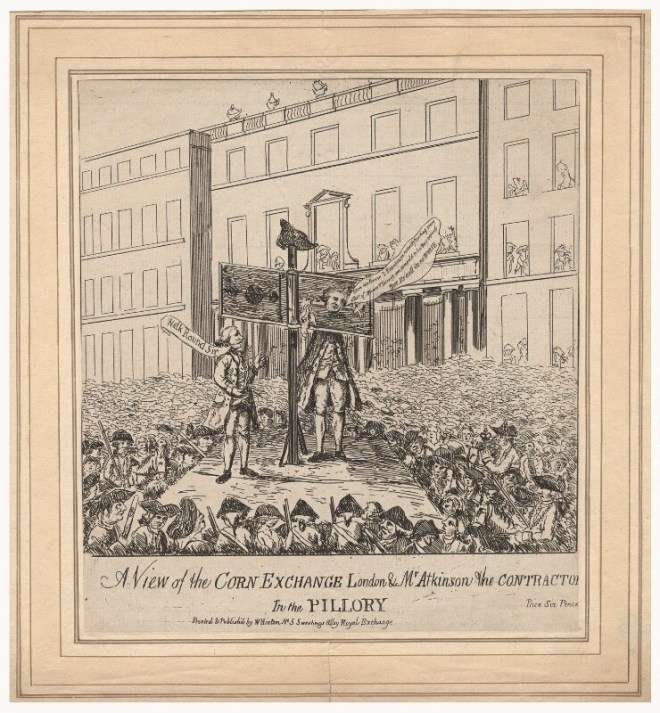
On 19th July 1783, Christopher Atkinson, MP for Hedon & corn factor, was tried in London for perjury, found guilty and committed to prison for 12 months, , first being pilloried at the Corn Exchange, London, and expelled from the House of Commons.  He resigned from his commercial post, but stood again as MP for Hedon in 1796 and 1802 and was elected. He later changed his name to Saville. picture shows Atkinson at the pillory

On 19th July 1786, Hull’s Rev George Lambert visited several sick parishioners, and commented on the contemporary habit of family and friends crowding into the room with the minister, so that the sick person was unable to speak openly.

On 19th July 1794, Edward Bogg, carpenter’s mate,  was shot and killed on board Hull fishing vessel Sarah and Elizabeth Off St Abb’s Head by the crew of a naval press gang on the frigate Aurora; 3 other crew were injured; the coroner’s court returned a verdict of wilful murder by Captain Essington; the captain was sent to the East Indies for several years and never stood trial.

On 19th July 1849, an All England Eleven cricket team played a 30-day match against a Hull amateur side at the Hull Athenaeum Club ground, Anlaby Road. Despite funding from the Hull Sheriff and both MPs, the entrance fee was 1s a day. The professionals won by an innings and 82 runs.

On 19th July 1919, 368 children living at Newland Homes, Cottingham Road, Hull, took part in official peace celebrations included games and setting fire to an effigy of the ex-Kaiser.chrisatkinson MP

July 16th

On 16th July 1796, 10 days after the introduction of the Dog Tax of 5s per dog per year, the Hull Advertiser reported a considerable number of rotting dog carcases, after owners killed their dogs and threw them in the street.

On 16th July 1802, Dorothy Wordsworth, sister of poet William, visited Beverley with friends, commenting on the beauty of the town and the minster.

On 16th July 1807, a Bastardy examination of Ann Linwood, single woman of Hedon
revealed that the father of her son, born on 28 Jun 1807 in Hull was gunsmith Owen Probin. Owen Probin was murdered 7 years later (the events are probably not related).

On 16th July 1885, Hull & Barnsley Railway and the Alexandra Dock officially opened.

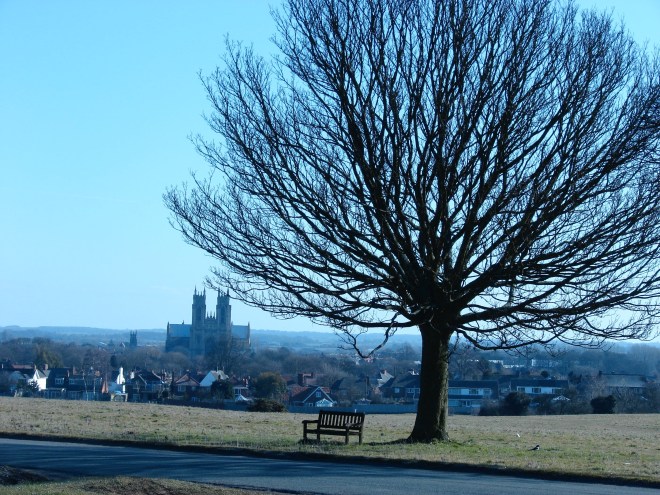
On 16th July 1904, the Beverley Guardian reported a new phenomenon, ‘the hatless brigade’, when pedestriansof both sexes had been seen in Hornsea without any head covering whatsoever.minster beverley.JPG