November 28th

On 28th November 1427, Richard Reedbarowe received royal assent to erect a lighted beacon at Ravensporne (Spurn Point) to prevent shipwrecks, and to maintain it by charging vessels a fee.

On 28th November 1901, Sarah Hebden of Hodgson Street, Hull, was battered to death by her nephew, Arthur Richardson. He was the first person to be hanged in Hull Prison, Hedon Road on 25.3.1902.

On 28th November 1904, Hull’s first telephone exchange opened at the former Trippett Street Baths.  In 1913, Hull’s became the only municipally owned telephone service, after all other services were bought by the Post Office.

On 28th November 1955, Mr John Davies, of J. Arthur Rank Organisation, officially opened the new Cecil Cinema, replacing the building destroyed in the blitz on 8.5.1941. Architects Gelder & Kitchen. Davies was accompanied by his wife, film star Dinah Sheridan. https://www.youtube.com/watch?v=7P3–fkaeP8

Cecil cinema


November 27th

On 27th November 1642, Royalist soldiers claiming to be Danish sailors, were in Hull as spies. Their aim was to open the gates when they saw a signal from a troop of Cavaliers coming from York. They opened the gates, but the lantern belonged to a miller returning home. Their cover had been blown; the Cavaliers had been routed and did not arrive. 2 of the Royalists were killed and the rest taken prisoner. N.B. I have not been able to verify this story.

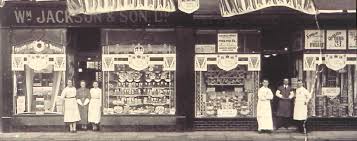
On 27th November 1948, William Jackson & Son Ltd opened the first self-service grocery store in the area (beating Cusson’s by only 10 days). The experiment failed, requiring an extra employee to be taken on, and the store reverted to normal service within a year. photo shows an early Jackson’s store.

On 27th November 1969, the tug Hullman capsized in the River Humber off Grimsby whilst towing the Conoco Arrow, and 3 of her 10 crew died. The tug was recovered and returned to service. On 23.10.1971, she was lost in the North Sea while towing a crane barge.

Wm Jackson & Co

November 21st

On 21st November 1798, Elizabeth Darling, of Scale Lane, Hull, on the death of her father, continued to run his business as apothecary, although as a woman she was unable to train formally.

On 21st November 1823, Joseph R. Pease reported in his diary a fire in their oil windmill; due to thick walls, adjoining warehouses were not affected. 3 fire engines attended. Pease blamed the carelessness of 2 workers.

On 21st November 1940, Sidney Hall, aged 17, mess boy, of Hull, was lost by enemy action with all 45 crew of SS Cree of London; the Merchant Navy  ship, returning to UK from Sierra Leone, was torpedoed by a German submarine.


November 20th

On 20th November 1893, the steamship Amcott was wrecked off Aldbrough with the loss of all 15 hands; a rider went 7 miles to Hornsea to bring the lifeboat, but too late to save the crew. One man tried to swim to shore, but was drowned before locals could reach him with a life-buoy.

On 20th November 1940, Hull PC Charles Christopher Winterbottom died aged 45, fatally injured when his cycle collided with a car at night in the blackout.

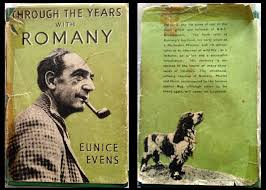
On 20th November 1943, Rev George Bramwell Evens, aka Romany, died aged 59.  Methodist preacher, author and radio presenter, broadcasting on BBC from 1933 until 1943. (Born 1884 at 3 Argyll St, Hull to a romani mother)


'Romany'

November 14th

On 14th November 1067, William the Conqueror knighted Sir Lionel Saltmarshe of Saltmarsh and gave him the manor of Saltmarsh (needs verification)

On 14th November 1504, Richard Squier, tailor, of Catton, claimed sanctuary at the church of St John, Beverley, for the theft of cloth, and for breaking out of the King’s gaol in York.

On 14th November 1906, Thomas Anderton, 44, of 53 Francis St, Hull, deckhand on steam trawler Canada, drowned along with the ship’s cook, in the River Thames at Gravesend when the ship’s boat capsized.

On 14th November 1913, Dan Billany was born in Essex Street, Hull. An active socialist, he was a teacher, and author. His novel ‘The Trap’ was highly respected. As an officer in the EY Regiment, he was captured in 1942 and a Prisoner of War in Italy until released in 1943. Last seen 20.11.1943, fate unknown.

Dan Billany The Trap

November 11th

Lister's Hospital, S Church Side


On 11th November 1642, the building work at the new William Lister’s Hospital in South Church Side, Hull, was inspected. They were surprised to find Mr Gough, Reader at Holy Trinity church, living there, in rooms allocated to the Assistant Preacher, which post was vacant at the time. Eventually, agreement was reached with the Mayor and Aldermen whereby Gough was allowed to remain, and given the post on a temporary basis.  He appears to have still been in post 20 years later. A dispute arose in 1749 over the same rooms, and post, when the trustees decided that the Mayor and aldermen had no power to ‘intermeddle’ this time. photo shows the Hospital

On 11th November 1899, the Evan Fraser Hospital opened at West Carr, Sutton-on-Hull as an isolation hospital for smallpox patients, named after a surgeon and Hull alderman (d.8.4.1906). The hospital replaced the Garrison Hospital on Sammy’s Point. Police were posted outside to prevent access, and the city banned religious services and the loan of library books.

On 11th November 1920, Mr Arthur B. Reckitt unveiled memorial tablets at Reckitt’s Institute, Dansom Lane, Hull, to staff who had died in World War 1. 159 Reckitts employees died.

On 11th November 1942, Abdul Rahman, aged 22, seaman, was lost to enemy action whilst in Merchant Navy on board SS City of Ripon of Hull, in Atlantic convoy.


November 10th

On 10th November 1274, Aveline de Forz, aged 10, was married to Edmund Crouchback, 2nd son of Henry III.  Countess of Aumale and Lord of Holderness in her own right, and Countess of Lancaster by marriage.  She died childless at age 15 and is buried in Westminster Abbey. The Lordship of Holderness passed to the Crown. Born Burstwick 20.1.1259

On 10th November 1293, Countess Isabella de Forz, widow of William de Forz III died, having outlived her husband and all her children, including Aveline above. A legend relates that she came across a poor man carrying a basket containing what he said were puppies, but which turned out to be seven of his children that he was going to drown because he could not afford to keep them. After severely upbraiding him for his lack of morality, Isabella adopted the children and ensured that they were looked after and well educated until their adulthood when she found employment for all of them.

On 10th November 1518, Sir Marmaduke Constable of Flamborough (known as Little Sir Marmaduke). Died after swallowing a frog (some say toad) while drinking a glass of water. Knighted for military service including Flodden a letter of thanks from Henry VIII is displayed, in Wassand Hall. photo shows his tomb in Flambrough church. & see 9.9

On 10th November 1609, Sir George Wharton, who was raised at Londesborough, died in a duel in Islington with his good friend Sir James Stuart, the King’s godson, who also died. The event was commemorated by Sir Walter Scott in his ‘Minstrelsy of the Scottish borders’. (b1583)

On 10th November 1678, Capt Towes (or Towers or Towle) of the Hull ship Shield landed settlers at Burlington, New Jersey. Many were Quakers, who settled at Burlington, Salem and other places. One of the passengers was Mr Barnes, a merchant from Hull.

Little Sir Maramaduke Constable's tomb

November 7th

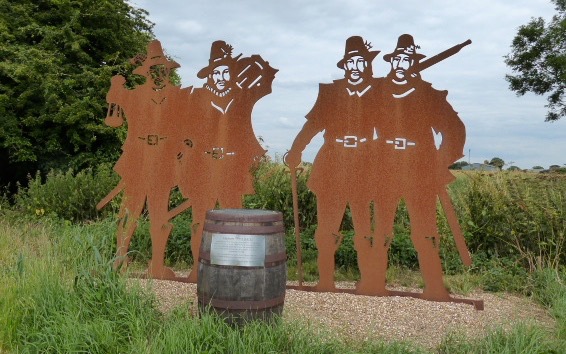
Gunpowder Plot memorial
Welwick

On 7th November 1605, Sir John Ferne, secretary to the Council in the North, sent confidential news to the Hull Mayor of the Gunpowder Plot, and orders to arrest Thomas Percy of Leconfield. An arrest warrant was issued the following day to the Bailiff, Chief Constable and constables of the county of Hull. However, Percy and the other conspirators were heading for Staffordshire.

On 7th November 1646, Sir Francis Cobbe of Ottringham was fined £72 as a Lieutenant-Colonel in the Royalist army (a delinquent) in order to recover his goods which had been sequestered by Parliament. He had been a member of King Charles’ Bodyguard.

On 7th November 1887, the crew of sailing ship Earl of Beaconsfield were rescued after the ship ran aground on sands off Aldbrough; the figurehead, representing Benjamin Disraeli, the Earl of Beaconsfield, can be seen in Hull Maritime Museum.

November 5th

On 5th November  1605, Sir Thomas Knyvet of Escrick, as Gentleman of the Bedchamber to King James I, he went to the House of Lords cellar to investigate a rumour and discovered Guy Fawkes and some gunpowder …

On 5th November 1740, Elizabeth Johnson’s charity distributed money to the 4 poorest families in Cherry Burton every year on this date.  Daughter of Dr Hodgson Johnson, she left £40 to be invested, adding to the 40s left by her father 16 years before.

On 5th November 1804, 7 of the 8 crew of the Cecilia Margaretha of the Duchy of Holstein died when the ship was driven ashore at Mappleton and wrecked on a trip from Liepaja, Russia, to Lisbon. photo shows Mappleton today

On 5th November 1854, James Elliott, private in the Coldstream Guards, died aged 22 at the Battle of Inkerman, Crimea; his memorial in Hedon church was ‘erected … to commemorate the event and to show that Hedon contributed its unit in defence of the liberties of Europe’.

mappleton.JPG

October 31st

On 31st October 1640, the gentry of Cottingham, Swanland and other villages petitioned Sir John Conyers to remove his regiment to other quarters, as they were eating up all their cattle fodder and supplies, and many other ‘insupportable damages and dangers’. Many troops had already been removed from Hull into the surrounding villages for similar reasons. The petition was not successful, although the troops did look for other quarters.

On 31st October 1646, Sir Robert Hildyard of Patrington was fined £610 as a Royalist (delinquent) in order to recover his goods which had been sequestered by Parliament. He was a member of the King’s Privy Council.

On the same day, Michael Wharton of Beverley was fined £1,600 for the same reason. He had been a captain in the Royalist army.

On 31st October 1793, John Woodhead, mason, was killed at work on the building site of the Neptune Inn, Whitefriargate. Hull Trinity House gave his widow a gratuity of £5 5s.

On 31st October 1833, the Humber pilots’ work for that day included taking men from Trinity House to relay the Bull buoy.

On 31st October 1929, George Jackson Bentham died suddenly, while boarding a train home, in the company of a young lady not his wife. Hull city councillor, JP, and MP for Gainsborough, he was the son of the founder of Wm Jackson & Son, and the company’s managing director. He changed his name by deed poll to that of his Liberal hero, Jeremy Bentham.


Pilot Office