October 29th

On 29th October 1810, Hull Trinity House delivered the first Spurn lifeboat, arriving at the Point from South Shields towed by the brig Thomas. (and see 15.11)

On 29th October 1889, Daniel Patten, aged 25, died of enteric fever at the Colonial Hospital, Gibraltar; the former pupil of Hull Trinity House School was 2nd officer of the SS Marengo.

On 29th October 1829, Rawcliffe merchant and eccentric Jemmy Hirst, died aged 91.  He travelled in a wicker carriage, driven by sails or by his pet bull, Jupiter. Created a flying machine and other contraptions. Wore a waistcoat of drakes’ feathers, a lambskin hat 3 yards in circumference, harlequin breeches and a red coat with blue sleeves to the races. Went hunting riding his pet bull and used pigs as pointers.

Jemmy Hirst

October 28th


charterhouse.JPGOn 28th October 1451, the Mayor and town of Hull and the Prior and Convent of the Charterhouse reached agreement on 8 areas of dispute between them, chiefly relating to ownership of land and streets between the town walls and the Charterhouse, including the Trippett and the northern part of Pole Street, the rent due for them, and garden fences of the Charterhouse encroaching on the public highway.
On 28th October 1510, William Sedyngton of Flambrough claimed sanctuary at the church of St John, Beverley, for debt.

On 28th October 1880, during a storm, the Saffron, Jabez, and Earl of Derby separately crashed into the piers at Withernsea and Hornsea, 2 at Withernsea and 1 at Hornsea; both piers were substantially damaged. The Hornsea pier had only opened 5 months before, and was completely demolished in 1897. The Withernsea pier had been open 2 years, and was to have several more ships crash into it before being demolished, apart from the 2 remaining towers.

On 28th October 1910, the Aldbrough Rocket Brigade rescued the crew of the trawler Castor of Grimsby, which ran aground on Aldbrough beach, whilst the Hornsea Lifeboat crew took an hour against high winds to row to the site. Later the Secretary of the Hornsea branch of the RNLI said that Hornsea did not have strong men like they had in Bridlington and it was the worst place on the coast to get a lifeboat.

October 27th

On 27th October 1720, Ann Watson, nee Headon, of White House, Stoneferry, left her estate at Stoneferry for a hospital for widows or daughters of clergymen, old maids, and for a school. In Sutton she left 26s p.a. to distribute bread to the poor who attended divine service that day.  She left several other bequests in different parishes; Ann Watson Street is later named for her; she is buried in Hedon, and has memorials there and in St James Church, Sutton.

On 27th October 1849, Hull Trinity House purchased chalkstone to protect the Spurn lifeboat cottages from the sea, as high tides and gravel extraction had greatly damaged the Point.

On 27th October 1907, Charles Henry Wilson died aged 74 at Warter Priory. Son of the founder of the Wilson Line, he was MP for Hull, then Hull West, a JP, and High Sheriff of Hull. He paid for the Seaman’s Mission in Posterngate (now the Mission pub). Deputy Lieutenant of the East Riding, he became the 1stLord Nunburnholme in 1906. photo shows part of his memorial in Warter church.

Chas Wilson Nunburnholme

October 26th

On 26th October 1515, Hull shoemaker William Baker claimed sanctuary at the church of St John, Beverley, for a felony (no details given)

On 26th October 1587, the wife of Dr Vavasour of Hesslewood & her 2 daughters died after being taken prisoner, (presumably in Hull Castle) with her 2 daughters, in 1581. She was questioned in 1576 about her failing to attend church. In 1578 her husband’s goods were seized to pay her fines.

On 26th October 1662, 7 poor residents of North Ferriby parish received money from the Poor Rate of between 1s and 2s every 4 weeks (presumably dependent on the number of children they had); of the 7, three were widows, one a single woman, and three men. Those 83 ratepayers who could afford to contribute paid between 2d and 15s a year.

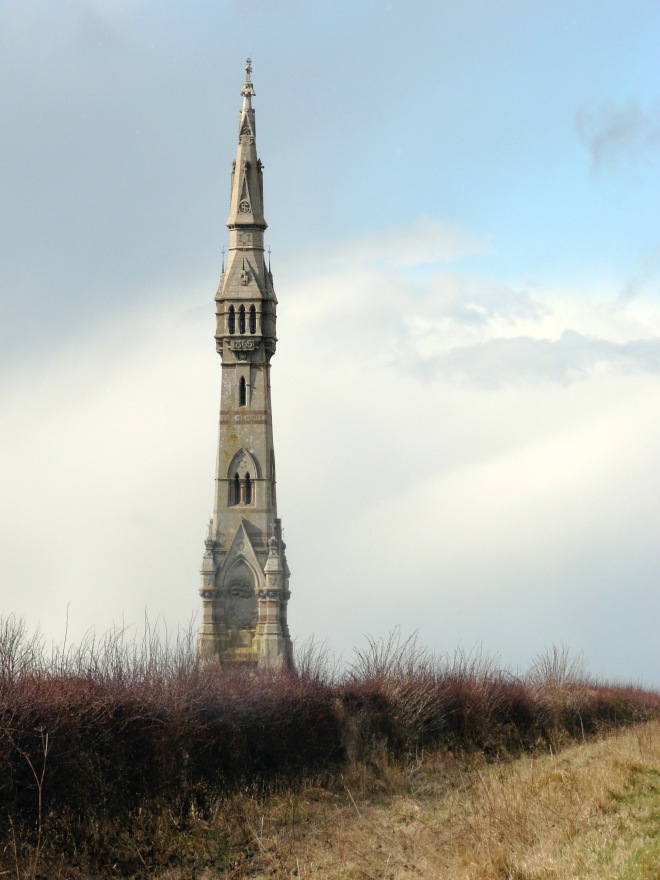
On 26th October 1866, Lord Hotham officially opened the Sykes Monument, as a memorial to Sir Tatton Sykes (d 1863), the money being raised by subscription by local people. The monument is a local landmark, on Garton Hill, near Sledmere, and can be seen from many miles away.

On 26th October 1950, Garden Village (Hull) Ltd was dissolved after the death of Sir Philip Reckitt; rents had been held at 1914 levels.


Sledmere


October 25th

On 25th October 1037, Aelfric, Archbishop of York, placed the relics of the recently canonised St John of Beverley in a new shrine of gold and silver, ornamented with precious stones in the Collegiate Church of St John the Evangelist, Beverley.

On 25th October 1415, Michael de la Pole, 3rdEarl of Suffolk, died in battle, with 2 of his brothers. His brother William succeeded as Earl.

On 25th October 1841, Private Stephen Bennington, of Lockington, 20, batman to vet surgeon John Gloag, rode into the Russian guns at the Charge of the Light Brigade, Balaclava, and survived.  He was awarded the Crimea Medal with clasps. Also served at Inkerman and Sebastopol and was discharged from the service in 1859 with long service and good conduct medals. Gloag did not take part in the charge.

Light Brigade


October 24th

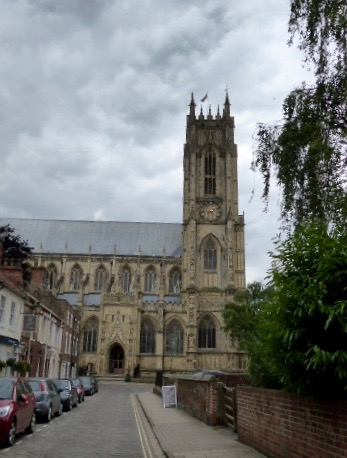
Beverley Minster


On 24th October 1530, at a Coroner’s inquest in Hutton Cranswick over the body of William Aunderson, the jurors reported that John Adayll, a labourer from Driffield, had on 23.10.1530 around 4p.m. assaulted him, with precogitated malice, with an iron fork, killing him instantly. Adayll immediately fled, with the townspeople of Hutton Cranswick pursuing him from town to town, but he escaped to ‘the privilege of Beverley’. Adayll does not appear in the sanctuary register for Beverley, though.

On 24th October 1850, John Branton, lifeboatman, drowned when the lifeboat overturned during the rescue of the brig Cumberland in the Humber near Kilnsea; John Welburn, the mate, was injured and died in 1852 from his injuries. The 9 members of the brig’s crew were rescued. An appeal raised £37 11s 6d for Branton’s widow and 6 children, and the RNLI added £5.

October 23rd

On 23rd October 1667, Richard Sterne, Archbishop of York, excommunicated a number of people, both male and female, at Beverley, and required them to make public penances, for crimes including adultery, fornication, and incest.

On 23rd October 1908, Wm Jackson & Son Ltd, Hull grocers & bakers, bought the company’s first motor vehicle (having previously used only horse-drawn transport and hand carts); by 1933 they had a fleet of 30 motor vehicles.

On 23rd October 1909, Rev Canon Joseph Malet Lambert, Hull philanthropist  and his wife Rose were charged at Dollgellau Magistrates Court, while at their holiday home in Barmouth, with cruelty against Mary Rose Inman, 11 years, whom they had adopted to save her from the workhouse and to train for domestic service. The girl had been starved (weighed 48lb) and beaten, and hidden from visitors. It appears that Mrs Lambert was convicted and sentenced. photo shows the school named after the Canon.

Malet_lambert


October 22nd

On 22nd October 1517, John Cook, yeoman of Sewerby, claimed sanctuary after assaulting labourer Thomas Stowpes and fled to Flambrough church.  This was not a registered place of sanctuary, but was called ‘taking church’. At a Coroner’s inquest at Sewerby on 5.11.1517, the jurors reported that Cook assaulted Stowpes on 22 Oct, giving him a wound from which he died 3 days later.

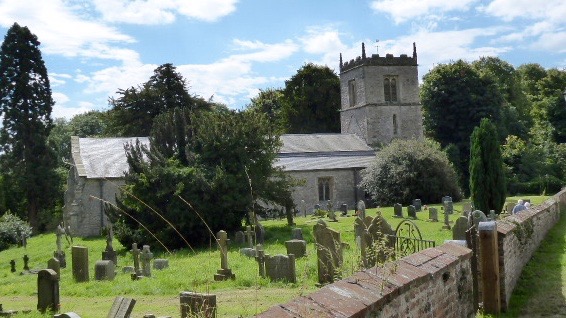
On 22nd October 1611, Lady Margaret Clifford, daughter of the Earl of Cumberland and Thomas Wentworth, future baronet, were married at All Saints, Londesborough. The Earl’s finances were not healthy, due to a protracted legal dispute with Lady Anne Clifford over his inheritance, so the celebrations were low-key, with only 40 in attendance, and a simple dinner of pasties, mince pies and turkey, a speciality of the estate. The artist Augustine Harrison was present, so that the Earl could present his 2 daughters with identical portraits of himself. photo shows Londesbrough church

On 22nd October 1882, William Butler, 16, 4thhand, was lost overboard from Hull trawler Sportsman in the North Sea.

On 22nd October 1972, the new Queen Elizabeth Dock container terminal was opened.


Londesborough


October 21st

On 21st October 1823, Mr Gleadow, commander of the customs cutter Bee, seized 31,324 barrels of contraband, including 250 lbs of tea, 720 lbs of tobacco, and 976 gallons of spirits, mostly gin, from the Lunatic asylum, Brandesburton Moor.

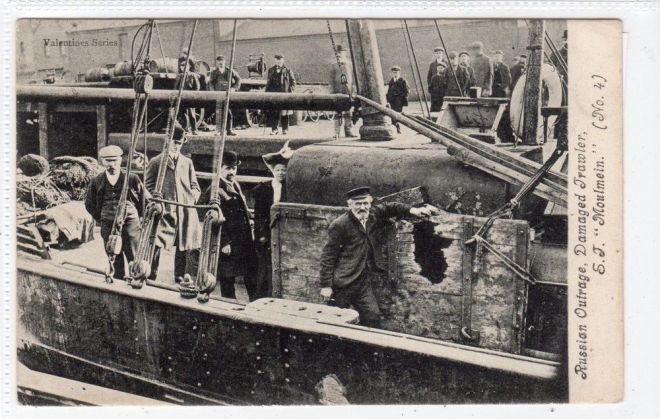
On 21st October 1904, the Gamecock trawler fleet from Hull was fired on by the Russian Baltic fleet, claiming they mistook them for the Japanese Navy. The trawler Crane was sunk and her captain and second mate killed; 30 others were injured. There is a memorial statue to the ‘Russian Outrage’ at the corner of Boulevard/Hessle Road.

On 21st October 1905, Ellen Borrill, of William’s Terrace, Hull, was murdered at Danthorpe by Peter Williams, her partner. He cut her throat in a field, walked to Burton Pidsea, and then gave himself up to the police at Roos. He claimed she had tried to kill herself, and asked him to finish her off. On 2nd December, Williams was sentenced to death, but was reprieved.

On 21st October 1921, Jim Graham and Cam Connor, out of work shipwrights from South Shields, bought a 14-seater Model T. Ford and set up Easington’s first bus service, just 2 years after East Yorkshire’s first bus service was set up in Elloughton by E.J. Lee, also using a 14-seater Model T.

Russian Outrage


October 20th

On 20th October 1536, Sir Robert Constable of Flamborough took command of Hull after a siege lasting 5 days, by the East Riding rebels of the Pilgrimage of Grace. The only condition the inhabitants made was that no-one would be forced to take the pilgrims’ oath.

On 20th October 1580, Rowlande Burton was called before the Hull mayor and aldermen to answer a charge of dealing in hops without paying a customs charge. They agreed that he would pay the charges due.

On 20th October 1586, Luke Fox (or Foxe) was born in Hull. He explored much of the Hudson Bay in search of the Northwest Passage. Later became a brother of Hull Trinity House and in 1635 published ‘North-west Fox, or Fox from the Northwest Passage’. Died approx 15.7.1635.

On 20th October 1749, a ’sudden and dreadful’ fire broke out at night when the Stamford Bridge Mills machinery overheated.

On 20th October 1890, Withernsea pier was damaged for a third time since its opening 12 years before, when an unmanned Grimsby fishing smack, the Genesta, smashed into it, and destroyed half of the remaining pier (see 19.10). Another boat, the Henry Parr, smashed into it in 1893, leaving only 50 feet, which remnant was removed in 1903 during work on the sea wall.

On 20th October 1958, the Malton to Driffield Railway closed to freight traffic, passenger traffic having ceased in 1950.


W'sea pier