December 24th

Coat_of_arms_of_the_baron_de_Ros_-_Premier_baron_of_England

On 24th December 1264, Robert de Ros of Roos and Helmsley was created Baron de Ros, probably the first English Barony created, and the title holder is styled the Premier Baron of England.

On 24th December 1510, Welwick labourer James Martynson claimed sanctuary at the church of St John for the murder of John Lewes of Welwickthorpe, labourer.

On 24th December 1592, the Council in the North ordered that no merchants carry goods or merchandise up the river or trade with other parts of the north except through the port of Hull.

On 24th December 1911, James Adamson, 34, deckhand, was lost overboard from Hull trawler Eldorado, 250 miles ENE of Spurn.


December 23rd

On 23rd December 1226, Robert ‘Furfan’ de Ros, of Roos, died, aged about 54. 1stLord of Helmsley, son-in-law of the Scottish king William the Lion, a Knight Templar and one of the barons enforcing the Magna Carta. His tomb is in the Temple church, London.

On 23rd December 1510, Peter Swake and Roland Dale of Catton claimed sanctuary at the church of St Cuthbert, Durham, as accessories to homicide. About 25.11.1510, they were present when Richard Horsley of Catton was taken from his mother’s house in Catton to a field, where he received several wounds, from which he died about a month later. They feared being  indicted as accessories. On 5.7.1511, another Catton man, William Ratcliff, entered the sanctuary with the same story, although he had taken sanctuary in Beverley for the homicide the previous year.

On 23rd December 1535, Austin Tennant of Hull claimed sanctuary at the church of St John, Beverley, for homicide and felony (details not recorded).  On the same day, the sanctuary received another 4 fugitives, from Leeds, Wakefield, and Thornton and Tealby in Lincs, 3 for felony and 1 for debt.

On 23rd December 1640, Sir John Lister died in Hull, aged 53. He left land at Thorngumbald to provide income for the poor, and money to set up the almshouses known as Lister’s Hospital. Twice Mayor of Hull, and MP, he built the house now known as Wilberforce House. He is commemorated in Holy Trinity church, where he also left money for repairs.

On 23rd December 1689, Johannes Frederick Bellow, a Danish trooper, was executed in Beverley Market Place for killing fellow soldier Daniel Straker, in a duel. Both are buried in St Mary’s churchyard.

On 23rd December 1732, a hurricane removed the roof and steeple of Hornsea church, destroyed 24 houses and overturned a windmill, and interrupted the parish clerk in the act of concealing smuggled goods in the crypt of the church.
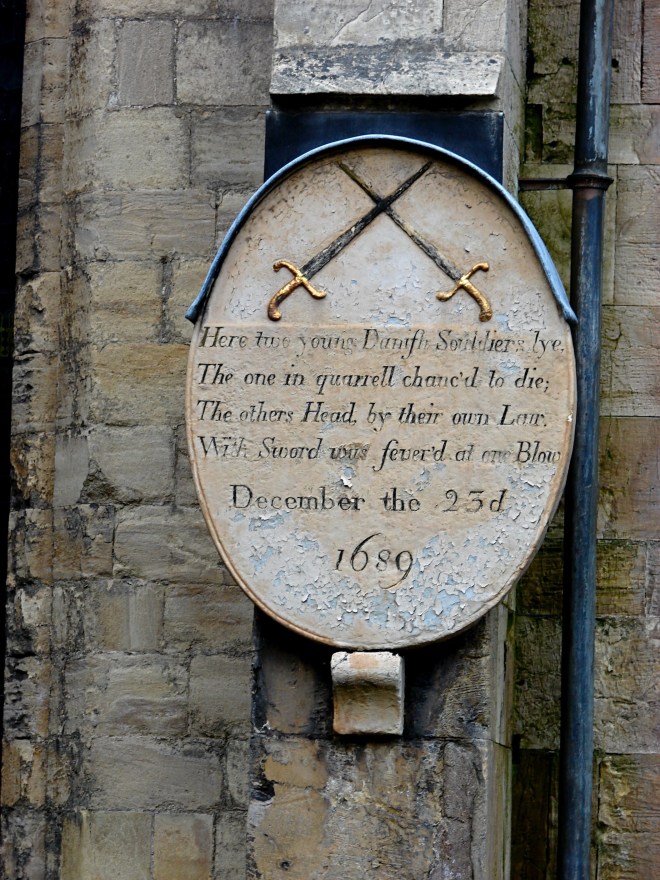
danish soldiers st mary's.JPG

December 16th

On 16th December 1512, William Crag of Cave claimed sanctuary at the church of St Cuthbert, Durham, for ‘asportation’; along with others, he had stolen 25 horses and mares, near Cave; in addition, in a certain park near Airton by York, he stole 3 other horses.

On 16th December 1586, the Earl of Huntingdon, on behalf of the Council in the North, wrote to the Hull Corporation to ask them to prevent merchants profiteering from the corn shortage by purchasing stocks for poor relief at a reasonable rate.

On 16th December 1645, Hull draper Robert Cartwright was fined £47 as a former Captain in the Royalist army (a ‘delinquent’) in order to recover his goods which had been sequestered by Parliament.

On 16th December 1689, a number of Danish soldiers were in William of Orange’s army, and 2 of them quarrelled and settled their dispute by a sword duel at Beverley. The survivor was beheaded in Saturday Market. (see 23.12)

On 16th December 1929, the R100 airship, the largest airship ever designed, made by a team led by Sir Barnes Neville Wallis, and including novelist Neville Shute Norway, took its maiden voyage from Spaldington Air Station.

On 16th December 2010, Easington tithe barn was offered for sale at an auction with a guide price of £125,000 and failed to sell. The 14thC building is the last remaining tithe barn in the county, and a Grade II listed building.

Easington tithe barn

November 19th

On 19th November 1484, Thomas Squirry, husbandman of Leven, claimed sanctuary at the church of St John, Beverley, for killing John Hewlyn.

On 19th November 1855, Henry Holmes and John Combes, crew members of the Spurn lifeboat, drowned in stormy weather attempting to rescue the schooner Zabina on the Binks, River Humber.

spurn boats.JPG

November 15th

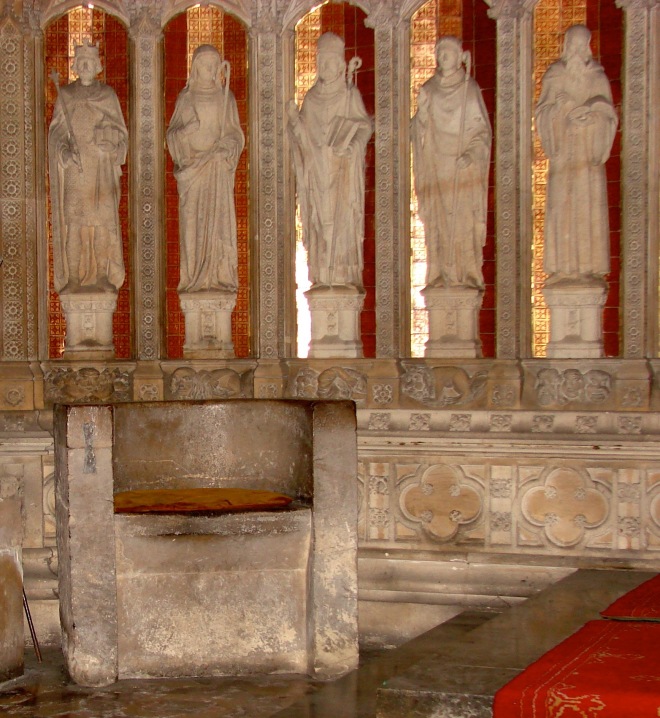
minster - frith stool.JPG


On 15th November 1482, William Weton, yeoman of North Ferriby, claimed sanctuary in the church of St John, Beverley, for killing John Atkynson of North Ferriby on 19th September. photo shows the sanctuary chair, or Frith Stool

On 15th November 1810, Robert Richardson, master of the Spurn lifeboat, and crew, performed the first rescue by the new lifeboat, to assist the John and Charlotte off Trinity Sand, River Humber, where she had been driven in a gale.

On 15th November 1915, Walter Beech, 47 of 25 Scarboro St, Hull, chief engineer/ Christopher Hall, 2ndengineer of Allison Tce, Hull, were lost with all other 8 crew of the steam trawler Edward B. Cargill when it struck a mine off Spurn Head.


November 14th

On 14th November 1067, William the Conqueror knighted Sir Lionel Saltmarshe of Saltmarsh and gave him the manor of Saltmarsh (needs verification)

On 14th November 1504, Richard Squier, tailor, of Catton, claimed sanctuary at the church of St John, Beverley, for the theft of cloth, and for breaking out of the King’s gaol in York.

On 14th November 1906, Thomas Anderton, 44, of 53 Francis St, Hull, deckhand on steam trawler Canada, drowned along with the ship’s cook, in the River Thames at Gravesend when the ship’s boat capsized.

On 14th November 1913, Dan Billany was born in Essex Street, Hull. An active socialist, he was a teacher, and author. His novel ‘The Trap’ was highly respected. As an officer in the EY Regiment, he was captured in 1942 and a Prisoner of War in Italy until released in 1943. Last seen 20.11.1943, fate unknown.

Dan Billany The Trap

November 9th

On 9th November 1309, King Edward II visited his Royal park in Burstwick, his main residence in the north.  Piers Gaveston was Lord of Holderness.

On 9th November 1487, John de la Pole senior, Duke of Suffolk, was stripped of most of his property and estates as a result of his son’s rebellion (the Earl of Lincoln) in support of Lambert Simnel.

On 9th November 1488, John Fernell, yeoman, of Asselby, killed Thomas Rodley with a staff, and then made his way to Beverley, where on 17.11 he claimed the sanctuary of the church of St John, and admitted the homicide.

On 9th November 1906, Capt Stensen and 5 crew of a Norwegian schooner carrying timber stranded at Withernsea in a gale. There were no casualties.

On 9th November 1916, Private Herbert Neal, 24, former Reckitt’s employee in the lead mill was killed in action with the East Yorkshire Regiment and is buried in Bazentin-le-petit, Somme, France. 2 of his brothers also served in the war, and only 1 survived to return home to Church St, Hull.

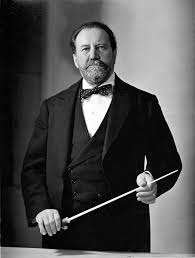
On 9th November 1923, Sir Henry Wood, originator of the Proms, made his first appearance as conductor of the Hull Philharmonic Orchestra, originally for one concert only. He stayed for 15 years, travelling from London to work with amateur musicians for a considerably reduced fee. An earlier contact with Hull was 1906 when Ethel Leginska performed for him in London.

Sir Henry Wood

November 8th


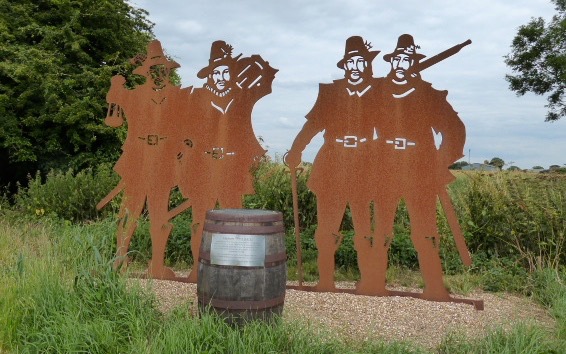
Gunpowder Plot memorial
Welwick

On 8th November 1481, Thomas Nevyll, yeoman of Skirlaugh, sought sanctuary in Durham Cathedral for killing John Hewlins of Rise on 1stNovember.

On 8th November 1500, William Thorpp of Welwick, John Dorand and a man named Nicholas were in Winestead when their dog entered the park; they asked the parkers to return the dog, but they refused, and were abusive. Nicholas shot one of the parkers named March, in the neck with an arrow; he died about 10 days later. Thorpp travelled to Durham, where on 10.12 he claimed sanctuary, fearing he would be indicted as an accessory to murder.

On 8th November 1605, Jack and Kit Wright of Welwick, and brother-in-law Thomas Percy were fatally wounded at Holbeche House, Staffordshire, by the posse of 200 men led by the Sheriff of Warwick, Sir Richard Walsh. 9 of the 13 Gunpowder Plotters were at Holbeche, and they all died there; the other 4 were all executed.

On 8th November 1637, the Mayor of Hull petitioned the Privy Council that 1) the town was so poor as a result of the recent plague that it be let off the requirement to provide 2 warships for the Navy; 2) that the county’s funds help to support Hull’s poor and; 3) that Hull’s merchants be allowed to sell their goods elsewhere in the country again, now that the town was free of the plague. It was estimated that 2,000 people died in Hull, and perhaps as many left town.

October 28th


charterhouse.JPGOn 28th October 1451, the Mayor and town of Hull and the Prior and Convent of the Charterhouse reached agreement on 8 areas of dispute between them, chiefly relating to ownership of land and streets between the town walls and the Charterhouse, including the Trippett and the northern part of Pole Street, the rent due for them, and garden fences of the Charterhouse encroaching on the public highway.
On 28th October 1510, William Sedyngton of Flambrough claimed sanctuary at the church of St John, Beverley, for debt.

On 28th October 1880, during a storm, the Saffron, Jabez, and Earl of Derby separately crashed into the piers at Withernsea and Hornsea, 2 at Withernsea and 1 at Hornsea; both piers were substantially damaged. The Hornsea pier had only opened 5 months before, and was completely demolished in 1897. The Withernsea pier had been open 2 years, and was to have several more ships crash into it before being demolished, apart from the 2 remaining towers.

On 28th October 1910, the Aldbrough Rocket Brigade rescued the crew of the trawler Castor of Grimsby, which ran aground on Aldbrough beach, whilst the Hornsea Lifeboat crew took an hour against high winds to row to the site. Later the Secretary of the Hornsea branch of the RNLI said that Hornsea did not have strong men like they had in Bridlington and it was the worst place on the coast to get a lifeboat.

October 26th

On 26th October 1515, Hull shoemaker William Baker claimed sanctuary at the church of St John, Beverley, for a felony (no details given)

On 26th October 1587, the wife of Dr Vavasour of Hesslewood & her 2 daughters died after being taken prisoner, (presumably in Hull Castle) with her 2 daughters, in 1581. She was questioned in 1576 about her failing to attend church. In 1578 her husband’s goods were seized to pay her fines.

On 26th October 1662, 7 poor residents of North Ferriby parish received money from the Poor Rate of between 1s and 2s every 4 weeks (presumably dependent on the number of children they had); of the 7, three were widows, one a single woman, and three men. Those 83 ratepayers who could afford to contribute paid between 2d and 15s a year.

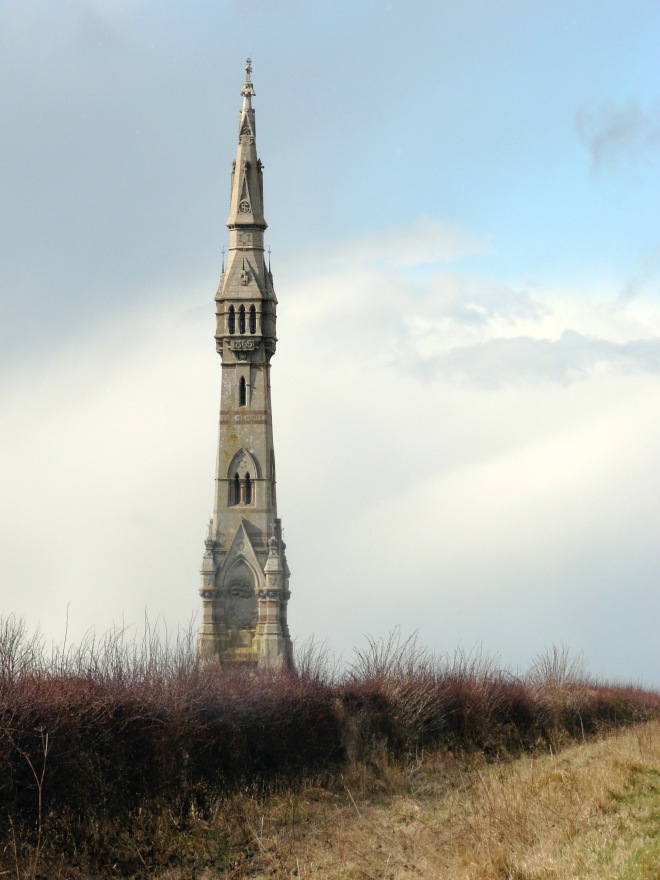
On 26th October 1866, Lord Hotham officially opened the Sykes Monument, as a memorial to Sir Tatton Sykes (d 1863), the money being raised by subscription by local people. The monument is a local landmark, on Garton Hill, near Sledmere, and can be seen from many miles away.

On 26th October 1950, Garden Village (Hull) Ltd was dissolved after the death of Sir Philip Reckitt; rents had been held at 1914 levels.


Sledmere