September 9th

On 9th September 1513, Marmaduke Constable, of Flamborough was knighted for his role in the Battleof Flodden Field, and a letter of thanks from Henry VIII is displayed in Wassand Hall. Ralph Ellerker, senior of Risby and his son Ralph were also both knighted. This causes some confusion in the historical record, as there were 2 Sir Ralph Ellerkers alive at the same time.

On 9th September 1643, Rev James Sibree reported that on Sunday he had preached twice, visited the cemetery 3 times, and interred 43 bodies of his fellow citizens. During the cholera outbreak, many church services were held outdoors in the Market Place, by ministers of different denominations, and attended by more than 3,000 people. photo shows Cholera Memorial in Western Geneeral Cemetery.

On 9th September 1878, George Carr, aged 45 and Joseph Carr, aged 26, accidentally drowned in Hornsea.

On 9th September 1956, Captain Erik Ohsman, and Chief Steward V. Stenros, of SS Lona, were rescued by firemen when they were found unconscious after fire was discoveredon their Swedish ship, loaded with over 3k tons of pit props. Both recovered. The fire, which started in the engine room, spread to the cargo, and after several hours the ship had to be scuttled in the dock to prevent greater damage. She was raised on 11 October and repaired. Cholera memorial

September 5th


delapolearmscharterhouse.JPG
Hull’s first blue plaque? On the wall of the Charterhouse.

On 5th September 1389, Sir Michael de la Pole died aged 59. 1stBaron de la Pole, later 1stEarl of Suffolk. Appointed English Lord Chancellor in 1383. He founded the Carthusian Monastery which became Hull Charterhouse. Disgraced, he fled to Paris in 1388.

On 5th September 1811, Benjamin Byron (or Byrom) MD died in Hull; as physician he had chambers at Mr Frith’s, plumber, Silver Street, where ‘consultations were free to the poor on Tuesdays and Fridays 10a.m. to 3p.m.’

August 26th

On 26th August 1310, King Edward II visited Beverley.

On 26th August 1346, Sir John de Sutton fought on the English side at the Battle of Crecy.

On 26th August 1800, Hull surgeon Edward Oxley advertised in the Hull Packet his invention Modena Fossil, as a speedy and effectual cure for ‘hooping-cough, palsy, rheumatism, asthmatic fits, … diseases of the breasts…’ The Medical Observer was very scathing of this product which it described as oil of amber.

On 26th August 1809, Hedon borough constable Edward Hoe received £1 8s wages for transporting Agnes Sharp and her son William to Friskney in Lincolnshire (her husband’s parish), as Hedon parish was not liable to pay her benefit. Her 9 year-old-daughter Rachel was entitled to settle in Hedon, and was left behind.

On 26th August 1824, on the traditional day of Swine Feast, the Feast mainly consisted of dancing and ‘riot’, most residents providing food for their friends on the Sunday before, leading to disorder which the magistrates could not control, reported author Thomas Thompson.

On 26th August 1833, Captain Richard Wallis Humphreys of the whaler Isabella in Baffin Bay picked up explorer Captain John Ross and 19 of the crew of his ship Victory. It had become stuck in ice and been thought lost for 4 years.  Humphreys was awarded a silver cup by the town of Hull at a dinner given at the Vittoria Hotel in January 1834. (The Isabella herself was trapped in ice and sank in 1835.)


John_Ross_rescued_by_Isabella,_1833


August 23rd

On 23rd August 1326, Richard Furnewes, barber to the Archbishop of York, was appointed to keep the park at Bishop Burton and the deer, at a salary of 2d per day.

On 23rd August 1601, Lord Burley, Queen’s Lieutenant and President of the Council of the North, visited Hull. His visit was marked with a firework display in the Market Place. Tragically, the cannon misfired, and at least 4 died, and several others were injured.

On 23rd August 1619, a woman bonesetter from South Dalton attended Londesborough House to treat Earl Francis’s shoulder, dislocated in a fall while out hawking. She was paid £1 5s for the treatment, which included 2 visits. (A physician might charge £2 a visit).

On 23rd August 1653, Robert Acklam was fined £5 by Hull Trinity House for taking the ship Blessing from Hull to London and from there crossing to Holland without the correct licence.

On 23rd August 1830, 60 farm workers rioted in Burton Pidsea, armed with clubs, scythes and stones, and visited every farmhouse where there were known to be Irish labourers, aiming to drive them out of the neighbourhood. 6 of them attacked Irish men working in a field belonging to Mr Baxter. The Hull Packet reported on 10.9. 1830 that the 6 ringleaders had been arrested and would be tried at the next Quarter Sessions in Beverley.

On 23rd August 1886, former Hull Trinity House pupil John Lester, aged 20, was killed by a fall from aloft on the Schooner Welsh Belle travelling from Hull to Newfoundland.

On 23rd August 1934, the Yorkshire Post reported on a cliff collapse along a 100-yard stretch at Aldbrough, which resulted in thousands of tons of material falling onto the beach, destroying the boat slipway. No-one was hurt. photo shows more recent erosion at Ulrome.


erosion Ulrome

August20th

wm le grosOn 20th August 1179, William le Gros, Count of Aumale, Lord of Holderness, died aged 64 after 50 years as Count. As Earl of York, the most powerful man in the north of England during the Anarchy, a soldier, and founder of religious houses, including Meaux Abbey, and Newton Grange leper hospital.

On 20th August 1526, John Dove, a labourer from Burstwick, and William Bayne, a tallow chandler from Withernwick, separately arrived and claimed sanctuary at the church of St John, Beverley, for debt. On a busy day at the sanctuary, a 3rddebtor arrived from Wakefield.

On 20th August 1535, Richard Browne, vicar of North Cave, confessed to heresy by preaching Lutheranism; he was absolved, after suspension for 2 months.


August 17th

On 17th August 1377, King Richard II issued a charter allowing the town of Hull to ensure the town walls and moats were kept in good repair, and to compel every householder to contribute to the cost of repair.

On 17th August 1427, Thomas Brygman, vicar of Foston, asked the Pope to relax the penances paid by those who did not visit church on holy days or give alms, because the church buildings were ruinous, and lacking a bell tower to call parishioners to prayer, and because the parishioners were too poor to repair the church. Their poverty was caused by ‘divers burdens’ imposed by King Henry to fight wars, and also because of the high mortality level in the area.

On 17th August 1863, Dr T.T. Pierson of Bridlington Quay apologised for signing a certificate at The Retreat asylum, Kilham, to declare a woman insane (whom he had known since they were at school) at the request of her husband; she turned out to be suffering only from the effects of alcohol.

On 17th August 1905, Hull merchant Frederick Harker was fined £2 plus costs for speeding at Harpham – travelling at 28 miles per hour in a 20mph zone. It was reported that the method used, of 3 police officers timing him over a measured distance, had not been used before.

On 17th August 1920, Sir Luke White, MP, died at Driffield, aged 75. Liberal MP for Buckrose since 1900, he died a pauper and under investigation for bankruptcy, having covered his political expenses by using money entrusted to him by the clients of his business as a solicitor.

On 17th August 1954, workers at King George Dock, Hull, began a strike against unsafe working conditions called the ‘Filling Strike’; within hours, 4,000 dockers were on strike and 60 ships lay idle. The strike ended after 11 days.


1954 dock strike

August 2nd

On 2nd August 1806, Capt Welburn, James Simon, ship’s surgeon, and crew of Hull whaler Blenheim were returning from the Davis Straits when the ship was taken by 2 French frigates, L’Syrene and Le Revenge. The Blenheim was burnt, its crew landed at Pampoule near St Malo, and conveyed to Arras where they were imprisoned. They were later moved to other prisons, and only released in 1814, after years of privation and misery, when the allies entered Paris. Dr Simon was subsequently in practice in Aldborough, Holderness where he died in 1845.

On 2nd August 1860, Hedon Magdalen Fair was finally abolished; in the latter years the owner of the field had to persuade, or bribe, those who wished to attend the fair not to meet there. The event had included a market, music, games, sports, juggling, fire-eaters, and badger baiting.

On 2nd August 1913, Charles William Loten and Terence Charles Carroll, 18, died at Hornsea whilst trying to save a child from drowning. A memorial brass in Hornsea church was paid for by public subscription.

On 2nd August 1916, Joseph Bennett, 17,  died in Hull from bubonic plague. photo shows his memorial in the columbarium, Hedon Road.

plague victim.JPG

July 19th

On 19th July 1692, Elizabeth Howe, nee Jackson, aged 57,  was hanged for witchcraft at Salem, Massachusetts with 4 other women; at the age of 3, she was among the Puritans who emigrated from Rowley to found Rowley, Massachusetts.

On 19th July 1750, Hull soldier John Hasselbe made a sworn statement to John Wood, Deputy Mayor, that when he was on duty at Beverley Gate between 1.00 and 3.00, his musket went missing, and he suspected it had been stolen and concealed.

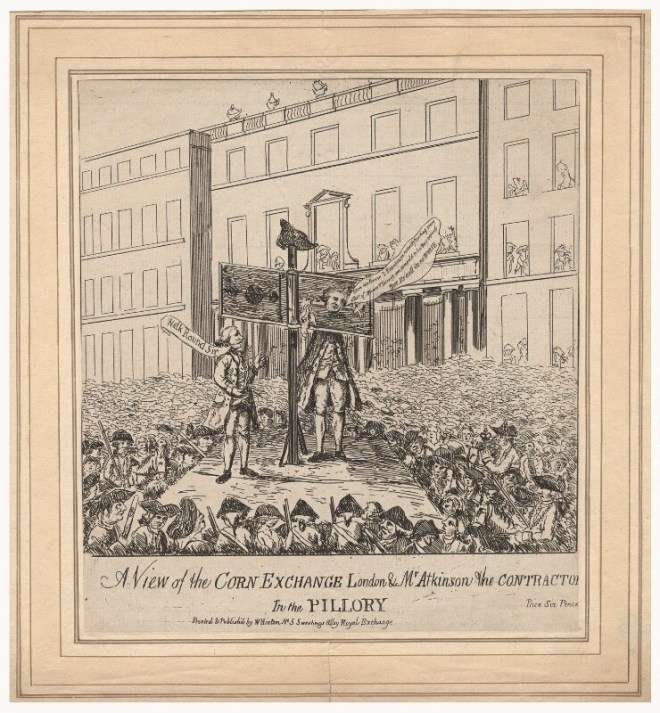
On 19th July 1783, Christopher Atkinson, MP for Hedon & corn factor, was tried in London for perjury, found guilty and committed to prison for 12 months, , first being pilloried at the Corn Exchange, London, and expelled from the House of Commons.  He resigned from his commercial post, but stood again as MP for Hedon in 1796 and 1802 and was elected. He later changed his name to Saville. picture shows Atkinson at the pillory

On 19th July 1786, Hull’s Rev George Lambert visited several sick parishioners, and commented on the contemporary habit of family and friends crowding into the room with the minister, so that the sick person was unable to speak openly.

On 19th July 1794, Edward Bogg, carpenter’s mate,  was shot and killed on board Hull fishing vessel Sarah and Elizabeth Off St Abb’s Head by the crew of a naval press gang on the frigate Aurora; 3 other crew were injured; the coroner’s court returned a verdict of wilful murder by Captain Essington; the captain was sent to the East Indies for several years and never stood trial.

On 19th July 1849, an All England Eleven cricket team played a 30-day match against a Hull amateur side at the Hull Athenaeum Club ground, Anlaby Road. Despite funding from the Hull Sheriff and both MPs, the entrance fee was 1s a day. The professionals won by an innings and 82 runs.

On 19th July 1919, 368 children living at Newland Homes, Cottingham Road, Hull, took part in official peace celebrations included games and setting fire to an effigy of the ex-Kaiser.chrisatkinson MP

July 1st

On 1st July 1643, cannoneer John Stevenson was buried in St Mary’s Beverley, having died in the town in a ‘great scrimmage’ in the Civil War (possibly the day before).

On 1st July 1801, Hull Subscription Mill Ltd opened to provide cheap flour to the poor of Hull, 3 years or so after the opening of Hull Anti-Mill, one of the first co-operatives in the country.

On 1st July 1830, the Hull whaler Eagle had been stuck in the ice of Baffin Bay for 5 days.   With the help of 200 men from nearby ships, Captain Matthew Wright and crew, were finally able to repair the keel and heave the ship upright again.

On 1st July 1903, Amy Johnson was born in St George’s Road, Hull. She went on to become the first woman to fly solo to Australia, and to break many aviation records. (d5.1.1941)

On 1st July 1918, Hull coroner Colonel Alfred Thorney held inquests on 2 early cases in the flu epidemic: Kate Denman, aged 11, daughter of a labourer of Hodgson Street, and Elsie Barton, aged 9, daughter of a soldier, of Arthur’s Terrace Courtney Street. Both died within 24 hours of being taken ill, of influenza followed by pneumonia.

On 1st July 1940, the first-ever daylight air-raid on the British mainland attacked Saltend oil terminal.  Between 16.40 and 17.00, bombs caused a 2,500-ton tank of oil to explode, and threatened to spread to other tanks. For preventing even greater damage, the following were all awarded the George Medal: Clifford Turner, leading fireman; William Sigsworth, Manager, Anglo-American Oil Co Ltd; George Samuel Sewell, engineer, Shell-Mex & BP Ltd; Jack Owen, fireman; George Archibald Howe, Manager, Shell-Mex & BP Ltd. No loss of life.

On 1st July 1976, Withernsea Lighthouse ceased operating, after 82 years, having been superseded by modern navigational aids. It is now open to the public as a museum to Kay Kendall, to local history and the lifeboat service.Withernsea

June 29th

On 29th June 1643, Captain Hotham was arrested in Hull, but Sir John escaped and tried to cross the river to make his way to his fortified house at Scorborough. Not being able to cross at Stoneferry or Wawne, he rode to Beverley, where he found a troop of Parliamentary soldiers. He put himself at their head and ordered them to follow him.  Their commander, Matthew Boynton, countermanded the order and Hotham tried to escape through the streets, but was knocked off his horse and arrested. The Mayor, aldermen and other burgesses met to appoint a temporary Governor and committee, until Parliament could give directions.

On 29th June 1840, John Tasker was convicted of larceny at Beverley Sessions Court, and sentenced to 7 years’ transportation. At the same sessions, Joshua Needham was sentenced to 14 year’s transportation for receiving stolen goods.

On 29th June 1870, Frederick William Elwell was born in Beverley.  Painter and member of the Royal Academy, he painted portraits of King George V and TR Ferens, amongst others. His wife Mary was also an accomplished artist. (d 3.1.1958)

On 29th June 1939, the body of Thomas Smith, 27, spare hand, washed up at Paull, and was identified as one of the crew of the Lady Jeanette, which sank on 8.3.1939.

elwell