November 8th


Gunpowder Plot memorial
Welwick

On 8th November 1481, Thomas Nevyll, yeoman of Skirlaugh, sought sanctuary in Durham Cathedral for killing John Hewlins of Rise on 1stNovember.

On 8th November 1500, William Thorpp of Welwick, John Dorand and a man named Nicholas were in Winestead when their dog entered the park; they asked the parkers to return the dog, but they refused, and were abusive. Nicholas shot one of the parkers named March, in the neck with an arrow; he died about 10 days later. Thorpp travelled to Durham, where on 10.12 he claimed sanctuary, fearing he would be indicted as an accessory to murder.

On 8th November 1605, Jack and Kit Wright of Welwick, and brother-in-law Thomas Percy were fatally wounded at Holbeche House, Staffordshire, by the posse of 200 men led by the Sheriff of Warwick, Sir Richard Walsh. 9 of the 13 Gunpowder Plotters were at Holbeche, and they all died there; the other 4 were all executed.

On 8th November 1637, the Mayor of Hull petitioned the Privy Council that 1) the town was so poor as a result of the recent plague that it be let off the requirement to provide 2 warships for the Navy; 2) that the county’s funds help to support Hull’s poor and; 3) that Hull’s merchants be allowed to sell their goods elsewhere in the country again, now that the town was free of the plague. It was estimated that 2,000 people died in Hull, and perhaps as many left town.
November 7th

Gunpowder Plot memorial
Welwick

On 7th November 1605, Sir John Ferne, secretary to the Council in the North, sent confidential news to the Hull Mayor of the Gunpowder Plot, and orders to arrest Thomas Percy of Leconfield. An arrest warrant was issued the following day to the Bailiff, Chief Constable and constables of the county of Hull. However, Percy and the other conspirators were heading for Staffordshire.

On 7th November 1646, Sir Francis Cobbe of Ottringham was fined £72 as a Lieutenant-Colonel in the Royalist army (a delinquent) in order to recover his goods which had been sequestered by Parliament. He had been a member of King Charles’ Bodyguard.

On 7th November 1887, the crew of sailing ship Earl of Beaconsfield were rescued after the ship ran aground on sands off Aldbrough; the figurehead, representing Benjamin Disraeli, the Earl of Beaconsfield, can be seen in Hull Maritime Museum.

November 6th

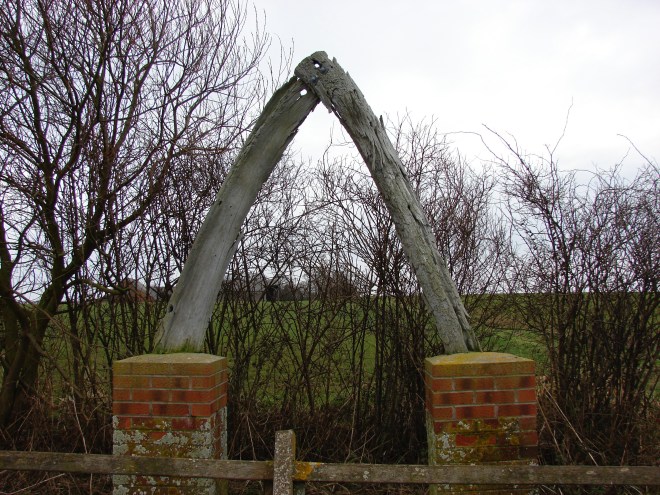
whalebone arch Pat.JPG

On 6th November 1584, Rowlande Wilkingson was awarded a pension of 10shillings a year by Hull town on account of his age and poverty, and the good service he had done the town.

On 6th November 1822, Hull Literary and Philosophical Society was formed to promote self education; one of its first actions was to create a museum in the Assembly Rooms, Kingston Square.  This is mentioned in Herman Melville’s ‘Moby Dick’, as it contained whale skeletons, as well as an Eskimo kayak and natural history materials. Photo shows whale jawbones at Patrington

On 6th November 1829, Robert Sharp of South Cave reported in his diary on the usual celebration of 5thNovember, with bonfires, bellringing and hare feasts in the pubs.

On 6th November 1850, Samuel Davis was saved from drowning in Hull Harbour by John Ellerthorpe, named ‘The Hero of the Humber’ for his many rescues, and awarded the Royal Humane Society’s Silver Medal.

On 6th November 1914, Herbert St Quintin presided over the last meeting of the Court Leet and Court Baron, as lord of the manor of Nafferton. Changes in the law left them with no effective jurisdiction, and later meetings were attended mainly for the Rent Dinners provided for his tenants.

November 5th

On 5th November  1605, Sir Thomas Knyvet of Escrick, as Gentleman of the Bedchamber to King James I, he went to the House of Lords cellar to investigate a rumour and discovered Guy Fawkes and some gunpowder …

On 5th November 1740, Elizabeth Johnson’s charity distributed money to the 4 poorest families in Cherry Burton every year on this date.  Daughter of Dr Hodgson Johnson, she left £40 to be invested, adding to the 40s left by her father 16 years before.

On 5th November 1804, 7 of the 8 crew of the Cecilia Margaretha of the Duchy of Holstein died when the ship was driven ashore at Mappleton and wrecked on a trip from Liepaja, Russia, to Lisbon. photo shows Mappleton today

On 5th November 1854, James Elliott, private in the Coldstream Guards, died aged 22 at the Battle of Inkerman, Crimea; his memorial in Hedon church was ‘erected … to commemorate the event and to show that Hedon contributed its unit in defence of the liberties of Europe’.

mappleton.JPG

November 4th

On 4th November 1217, Eustace de Fauconberg of Rise was appointed Lord High Treasurer of England, and held the post until he died; in 1221 he was elected Bishop of London (d October 1228)

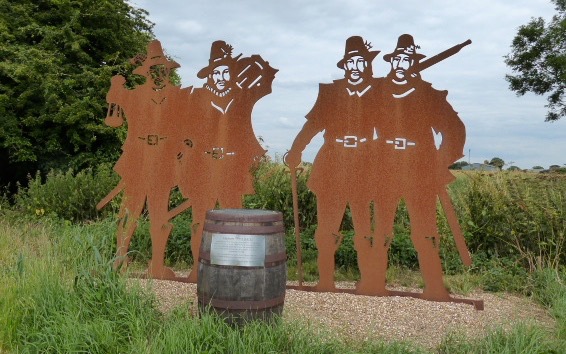
On 4th November 1605, Robin Catesby with Welwick’s Jack Wright left London to prepare for an armed uprising after Parliament was destroyed, which they expected to be carried out the next day. photo shows statue outside Welwick

Gunpowder Plot memorial


November 3rd

On 3rd November 1451, Richard Anson was enrolled in post as Hull Collector of Customs, joining existing staff Richard Bille (Collector) and Richard Alanson (Controller).

On 3rd November 1947, George Cornelius (Con) O’Kelly died aged 61. He achieved gold for Great Britain in the 1908 Olympics in men’s freestyle wrestling. 12,000 people turned out to meet him when he returned to Hull.  His son, Con jnr, competed in the 1924 Olympic heavyweight boxing.

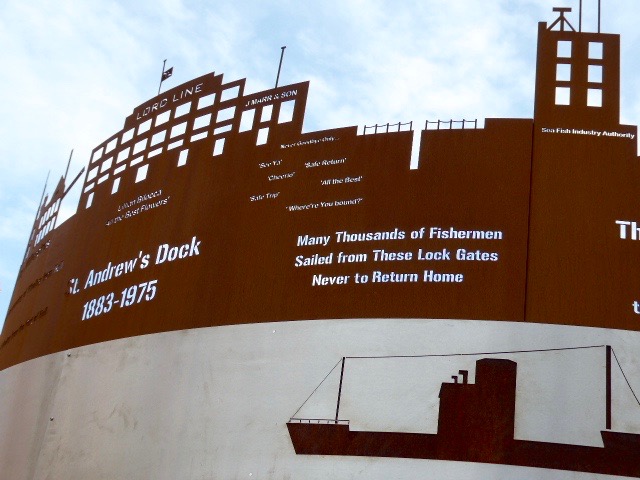
On 3rd November 1975, trawler owners ceased to use St Andrew’s Dock, Hull, which was closed to shipping after the collapse of Hull’s fishing industry.

St Andrews Dock memorial
Zebedee’s Yard

November 2nd

On 2nd November 1304, Lord Walter de Fauconberg, first Baron Fauconberg, of Rise, died aged about 80 at Rise (or Withernwick) and was buried at Nunkeeling. He had a long military career, and supported Simon de Montfort in his rebellion against King Henry III, for which he lost his lands for several years to Robert Bruce, but redeemed them in 1268.  Married Agnes de Brus.

On 2nd November 1595, John Thorgey left 5s per year for ever, to be distributed by Patrington church wardens to the poor. photo shows Patrington church

On 2nd November 1988, one of the worst industrial fires in Hull killed employee Jennifer Powley, 17, and left Janine Gilfillan with serious burns when a fire led to explosions and evacuation of nearby houses.

Pat church

November 1st

On 1st November 1151, Adam, a monk from Fountains Abbey, is reported to have led a colony from the older abbey to found the new house of Meaux Abbey.

On 1st November 1831, the Scholfield and Clough Bank was the first bank in Howden declared bankrupt after 14 years. Partner Barnard Clarkson had to sell estates in Kirkham Abbey, Holme on Spalding Moor and Foggathorpe.

On 1st November 1834, Beverley youths lit a bonfire early, rolled lit tar barrels and threw fireballs into shops in Beverley marketplace.

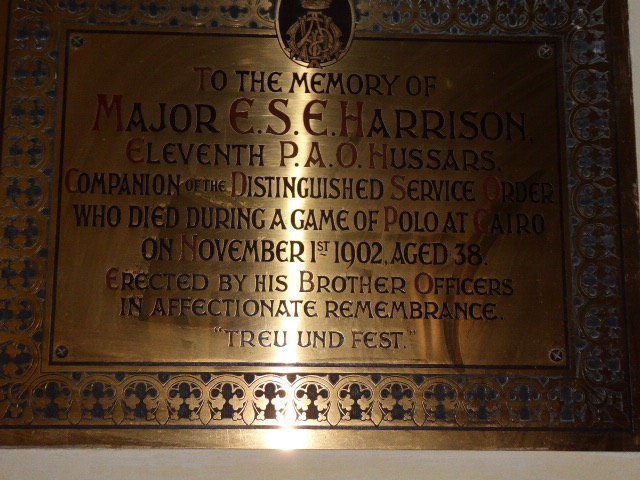
On 1st November 1902, Major E.S.E. Harrison, aged 38, Adjutant, 11thHussars (of the Broadley Harrison family of Welton House) died from a fall during a polo match at Ghezireh, Egypt. He served with distinction in the Boer War (DSO) and bequeathed to the Regiment the Bhurtpoor Sword, now in the Royal Hussars Museum, Winchester.

Major ESE Harrison

October 31st

On 31st October 1640, the gentry of Cottingham, Swanland and other villages petitioned Sir John Conyers to remove his regiment to other quarters, as they were eating up all their cattle fodder and supplies, and many other ‘insupportable damages and dangers’. Many troops had already been removed from Hull into the surrounding villages for similar reasons. The petition was not successful, although the troops did look for other quarters.

On 31st October 1646, Sir Robert Hildyard of Patrington was fined £610 as a Royalist (delinquent) in order to recover his goods which had been sequestered by Parliament. He was a member of the King’s Privy Council.

On the same day, Michael Wharton of Beverley was fined £1,600 for the same reason. He had been a captain in the Royalist army.

On 31st October 1793, John Woodhead, mason, was killed at work on the building site of the Neptune Inn, Whitefriargate. Hull Trinity House gave his widow a gratuity of £5 5s.

On 31st October 1833, the Humber pilots’ work for that day included taking men from Trinity House to relay the Bull buoy.

On 31st October 1929, George Jackson Bentham died suddenly, while boarding a train home, in the company of a young lady not his wife. Hull city councillor, JP, and MP for Gainsborough, he was the son of the founder of Wm Jackson & Son, and the company’s managing director. He changed his name by deed poll to that of his Liberal hero, Jeremy Bentham.


Pilot Office

October 30th

de Ros arms

On 30th October 1472, an inquisition post mortem was called to verify the date of birth of Eleanor de Roos, of Breighton, daughter of Sir Robert Roos, in relation to inherited lands. George Layburn confirmed that she was born 55 years earlier, on 30thSeptember, a date he remembered because on the day of her birth one John Forder, fisherman, at Bryghton, in the water of Derwent, netted a big fish, of great length, with a head like a dog’s. 

On 30th October 1833, John Brown, 35, died in a field near Withernwick, during a prize fight against William Hackney, oyster vendor of Hull.  Brown, 18 lbs lighter than Hackney and 11 years older, fell after 1 hour and 36 minutes, in the 65thround, before 4p.m., and died at 10p.m. Hackney, his second Thomas Wilkinson, and Brown’s second, William Thompson, were found guilty at the inquest of wilful murder. A court had earlier found Thompson not guilty, and Hackney and Wilkinson guilty of manslaughter, and both were sentenced to 4 month’s hard labour at Beverley House of Correction.

On 30th October 2017, the Trustees of the Nafferton Feoffees Charities Trust submitted their annual report on a charity which originated with a bequest to the local poor from Thomas Robinson in 1698, and continued since that time, with additional bequests as recent as 1950.