January 31st

Thos Ferres memorial

On 31st January 1631, Thomas Ferres died, aged 63. Mayor of Hull, Sheriff, and alderman, warden of Hull Trinity House. He left the Whitefriargate estate to Hull Trinity House, the rents to be used for the poor of the House. He also left bequests of over £1,000 to the poor. His memorial by local sculptor Earle is in Hull Minster.

On 31st January 1918, former Reckitt’s employee George William Trowell, 27, private with the East Yorkshire Regiment, win action on 23.4.17. No known grave. Was posted as missing, believed killed.  He was wounded in September 1916, discharged from hospital and returned to France.  He died in action on 23.4.17. He has no known grave.


January 30th

Mary Ward

On 30th January 1499, Robert Colstone of Hull and Marmaduke Pateson of  Flambrough claimed sanctuary at the church of St John, Beverley – Colstone for debt and Pateson for the murder at Flambrough of John Mottows.

On 30th January 1645, Mary Ward died aged 60. A cousin of the Wright brothers of Welwick, she spent 5 years living there with her grandmother and spent a further 6 years at Osgodby. She founded the Institute of the Blessed Virgin Mary and championed women’s education. She was declared Venerable in 2009. (b23.1.1585 Mulwith Yorks) see photo

On 30th January 1901, Beverley Mayor Elwell proclaimed the accession of King Edward VII to a large crowd at the Market Cross, despite bitterly cold weather and a snow storm.

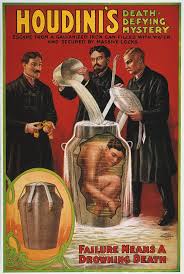
On 30th January 1913, Harry Houdini, escapologist, performed at the Palace Theatre, Hull. He escaped from a canvas sea bag and straps; the challenge was signed by seamen Dan Morris, Tom Carr and Robert Mason.

On 30th January 1983, Captain Derek Wharton of North Sea Ferry Norland spent the day sailing back and forth in Bridlington Bay, having arrived back from service in the Falklands War a little too early for the homecoming celebration planned for 1stFebruary.

Houdini copy


January 2nd

On 2nd January 1645, Sir John Hotham was executed for treason. He was buried, with his son John, in the Church of All Hallows, Barking. His lands passed to his grandson, aged about 10.

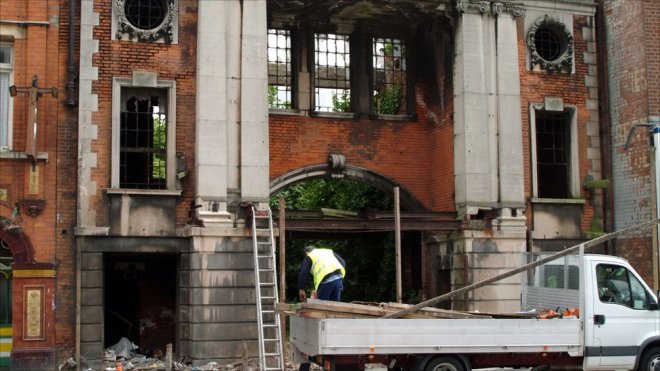
On 2nd January 2007, Historic England listed the former National Picture Theatre on Beverley Road, Hull, Grade II for its special architectural or historic interest. It is believed to be the only civilian WW2 bombed–out building, other than churches, remaining on its site.

nationalpicturetheatre


December 30th

wars-of-the-roses

On 30th December 1460, Richard Hanson, mayor of Hull, died at the battle of Wakefield, in the Wars of the Roses, fighting on the Lancastrian side. image copyright threetwoone.org

On 30th December 1872, David Tong, apprentice blacksmith, was charged at Roos Petty Sessions with absconding from his employer’s service. He had worked for James Blenkin of Roos, blacksmith and machine maker, for 5 years, and his labour was worth £1 per week. Tong made no complaint of any kind against his master, and was ordered by JPs Sir Talbot C. Constable and Rev C.J. Wall to return and pay costs.

December 26th

On 26th December 1220, William de Forz II, Count of Aumale and Lord of Holderness was with King Henry III at the Royal court at Oxford; the King made an appointment William hoped to get; disappointed, he left Oxford for Lincolnshire, and began a rebellion, known as the war of Bytham.

On 26th December 1489, George Gusterd, weaver of Bishop Burton, claimed sanctuary at Beverley for the murder of a servant of Edward Barnaby, a gentleman. He did not know the servant’s name.

On 26th December 1495, William Middleton was threatened with a pole-axe by John of Cottingham, John of Wawne, Thomas Warde, Robert Bate, and (- ) Mykill, and was so afraid for his life that he took sanctuary in Wawne church and stayed there for 10 hours, afterwards leaving the area. He applied to the Chancery Court for leave to prosecute his attackers, but the outcome is not recorded.

On 26th December 1645, Rev Nicholas Osgodby was reported to be using the forbidden Prayer Book in secret.

On 26th December 1750, the chapter house roof of Howden church collapsed, to join the rubble of the chancel which had collapsed in 1696.

On 26th December 1890, residents of Hornsea had a fair on the frozen surface of the Mere, and a sheep was roasted on the ice.

On 26th December 1955, Roy Francis played his last game after 6 years with Hull FC, and became UK’s first black professional sporting coach, and team manager 1971 to 1973.
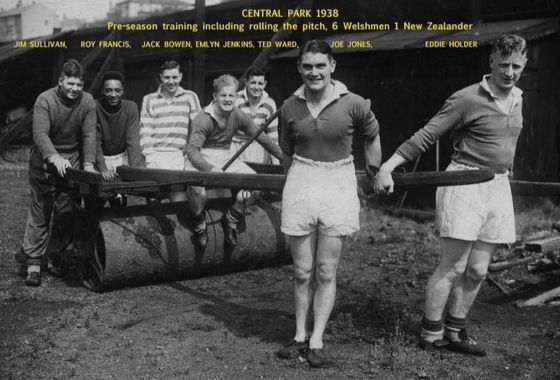
roy-francis

December 22nd

On 22nd December 1530, Beverley draper William Leryfax wrote his will, and appointed as guardians for his son Robert the priors of Watton Abbey and Meaux Abbey. In 1539, both abbeys were dissolved, and the subprior of Watton had been hanged in chains in 1537 for his part in the Pilgrimage of Grace.

On 22nd December 1580, the Hull Mayor and aldermen set the price of ale at a penny for a quart and a pint outsales, and a penny a quart and a gill in the alehouse.

On 22nd December 1802, George Knowsley of Cottingham Grange held a meeting at the Duke of Cumberland, Cottingham, to propose the building of a canal from Cottingham to Hull; the aim was to reduce transport costs and establish a local grain market. The Napoleonic Wars caused the project to be shelved, and it was never revived.

December 19th

Dame Ann Percy (Percehay)

On 19th December 1511, Ann Percy died in Hessle, the wife of Sir Henry Percy (or Percehay) and mother of 17 children. Although she is not of the Northumberland Percies, the Duke of Northumberland in 1862 arranged for a transcription of the original brass in Hessle Church, presumably under the assumption that she was of his line.

On 19th December 1656, the second of 2 boy twins of Philip Ellerker died at Ellerker, 2 days after the death of the first, at the age of 3 days.

On 19th December 1939, it was reported that of the 1,774 children evacuated from Hull  in September and October, 900 had returned home, during the ‘phoney war’.


December 16th

On 16th December 1512, William Crag of Cave claimed sanctuary at the church of St Cuthbert, Durham, for ‘asportation’; along with others, he had stolen 25 horses and mares, near Cave; in addition, in a certain park near Airton by York, he stole 3 other horses.

On 16th December 1586, the Earl of Huntingdon, on behalf of the Council in the North, wrote to the Hull Corporation to ask them to prevent merchants profiteering from the corn shortage by purchasing stocks for poor relief at a reasonable rate.

On 16th December 1645, Hull draper Robert Cartwright was fined £47 as a former Captain in the Royalist army (a ‘delinquent’) in order to recover his goods which had been sequestered by Parliament.

On 16th December 1689, a number of Danish soldiers were in William of Orange’s army, and 2 of them quarrelled and settled their dispute by a sword duel at Beverley. The survivor was beheaded in Saturday Market. (see 23.12)

On 16th December 1929, the R100 airship, the largest airship ever designed, made by a team led by Sir Barnes Neville Wallis, and including novelist Neville Shute Norway, took its maiden voyage from Spaldington Air Station.

On 16th December 2010, Easington tithe barn was offered for sale at an auction with a guide price of £125,000 and failed to sell. The 14thC building is the last remaining tithe barn in the county, and a Grade II listed building.

Easington tithe barn

December 11th

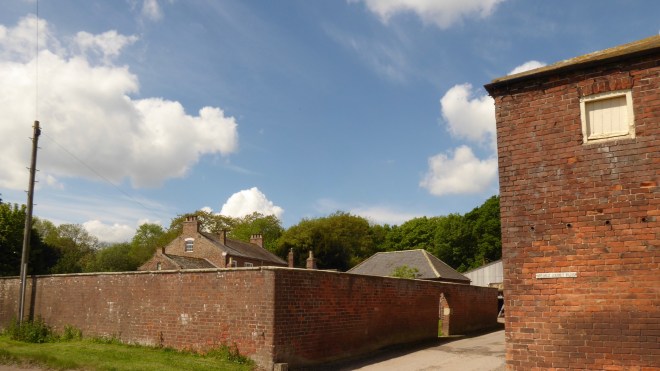
Meaux Abbey Farm


On 11th December 1538, Ellerton Gilbertine Priory was dissolved and the monks pensioned off. Sir John Aske of Aughton was granted the monastic lands, part of which became the parish church and graveyard. I have no record of the fate of the 13 poor elderly men whom the priory hospital was created to house.

On 11th December 1539, the Abbot and monks of Meaux Abbey were pensioned off when the monastery was dissolved. The abbot retired to Skerne, and some of monks took up posts as curates in Welwick, Keyingham and Beeford. photo shows farm near the site

On 11th December 1647, priest John Saltmarsh, MA, died. Author, theologian, rector, deacon and Chaplain in the Parliamentary Army during the Civil War. Argued for religious toleration and liberty of conscience. Told Cromwell and Fairfax that God was angry with them for their treatment of the Levellers, and resigned his post with the Army. (b Saltmarsh date?)

On 11th December 1915, former Reckitt’s employee Private Edgar Winson was killed in action, serving with 10thBtn West Yorkshire Regiment. Born Spurn. No known grave.


December 4th

On 4th December 1688, Capt Lionel Copley, vice-governor of Hull, in support of William of Orange, arrested Lord Langdale, governor of Hull, and Catholic officers supporting James II. Mobs attacked, ransacked and demolished Catholic houses and the ‘mass-house’, and the events of Town-Taking Day were celebrated into 20thC. It is believed that this is the event which was plotted in the parlour of the Olde White Harte.

On 4th December 1841, Joseph Davey, 28, became the new master of the Spurn lifeboat, and master of the tavern, replacing Robert Richardson, the first master, who had served in post for 31 years. Davey did not last so long – he was dismissed in February 1842 when the lifeboat failed to respond to a vessel run aground on the Stony Binks. Fortunately, the crew of the Elizabeth managed to refloat her, and there were no casualties.

On 4th December 1857, William Watson of Seaton Ross, maker of maps and sundials,  died. (b 17.5.1784) photo shows Dial Cottage, Seaton Ross.

On 4th December 1894, Robert Butterfield was elected first Chair of the Nafferton Parish Council; earlier in the year, parish councils had been introduced by the Local Government Act, replacing a number of parish and manor courts dealing with minor local issues. This process was happening across the country. One of the PC’s first acts in Nafferton was to clean the beck, and appoint a beck-watcher to look after the 2 swans donated by Mr Butterfield.

seaton ross.JPG copy