October 28th


charterhouse.JPGOn 28th October 1451, the Mayor and town of Hull and the Prior and Convent of the Charterhouse reached agreement on 8 areas of dispute between them, chiefly relating to ownership of land and streets between the town walls and the Charterhouse, including the Trippett and the northern part of Pole Street, the rent due for them, and garden fences of the Charterhouse encroaching on the public highway.

On 28th October 1510, William Sedyngton of Flambrough claimed sanctuary at the church of St John, Beverley, for debt.

On 28th October 1880, during a storm, the Saffron, Jabez, and Earl of Derby separately crashed into the piers at Withernsea and Hornsea, 2 at Withernsea and 1 at Hornsea; both piers were substantially damaged. The Hornsea pier had only opened 5 months before, and was completely demolished in 1897. The Withernsea pier had been open 2 years, and was to have several more ships crash into it before being demolished, apart from the 2 remaining towers.

On 28th October 1910, the Aldbrough Rocket Brigade rescued the crew of the trawler Castor of Grimsby, which ran aground on Aldbrough beach, whilst the Hornsea Lifeboat crew took an hour against high winds to row to the site. Later the Secretary of the Hornsea branch of the RNLI said that Hornsea did not have strong men like they had in Bridlington and it was the worst place on the coast to get a lifeboat.
October 22nd

On 22nd October 1517, John Cook, yeoman of Sewerby, claimed sanctuary after assaulting labourer Thomas Stowpes and fled to Flambrough church.  This was not a registered place of sanctuary, but was called ‘taking church’. At a Coroner’s inquest at Sewerby on 5.11.1517, the jurors reported that Cook assaulted Stowpes on 22 Oct, giving him a wound from which he died 3 days later.

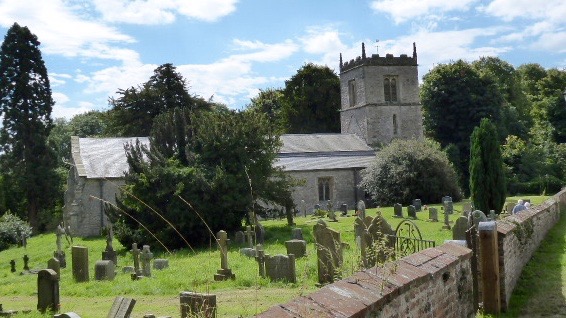
On 22nd October 1611, Lady Margaret Clifford, daughter of the Earl of Cumberland and Thomas Wentworth, future baronet, were married at All Saints, Londesborough. The Earl’s finances were not healthy, due to a protracted legal dispute with Lady Anne Clifford over his inheritance, so the celebrations were low-key, with only 40 in attendance, and a simple dinner of pasties, mince pies and turkey, a speciality of the estate. The artist Augustine Harrison was present, so that the Earl could present his 2 daughters with identical portraits of himself. photo shows Londesbrough church

On 22nd October 1882, William Butler, 16, 4thhand, was lost overboard from Hull trawler Sportsman in the North Sea.

On 22nd October 1972, the new Queen Elizabeth Dock container terminal was opened.


Londesborough


October 21st

On 21st October 1823, Mr Gleadow, commander of the customs cutter Bee, seized 31,324 barrels of contraband, including 250 lbs of tea, 720 lbs of tobacco, and 976 gallons of spirits, mostly gin, from the Lunatic asylum, Brandesburton Moor.

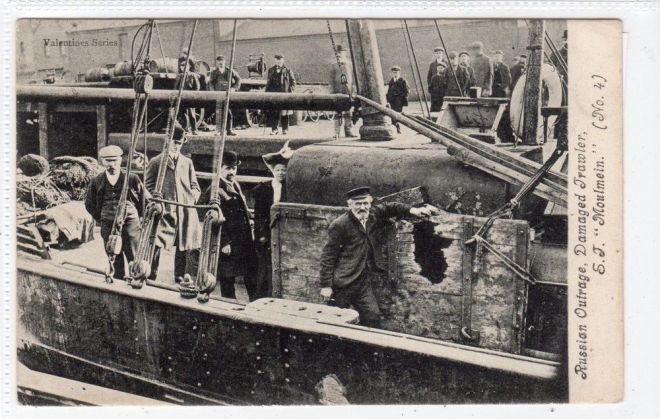
On 21st October 1904, the Gamecock trawler fleet from Hull was fired on by the Russian Baltic fleet, claiming they mistook them for the Japanese Navy. The trawler Crane was sunk and her captain and second mate killed; 30 others were injured. There is a memorial statue to the ‘Russian Outrage’ at the corner of Boulevard/Hessle Road.

On 21st October 1905, Ellen Borrill, of William’s Terrace, Hull, was murdered at Danthorpe by Peter Williams, her partner. He cut her throat in a field, walked to Burton Pidsea, and then gave himself up to the police at Roos. He claimed she had tried to kill herself, and asked him to finish her off. On 2nd December, Williams was sentenced to death, but was reprieved.

On 21st October 1921, Jim Graham and Cam Connor, out of work shipwrights from South Shields, bought a 14-seater Model T. Ford and set up Easington’s first bus service, just 2 years after East Yorkshire’s first bus service was set up in Elloughton by E.J. Lee, also using a 14-seater Model T.

Russian Outrage


October 5th

On 5th October 1643, Sir John Meldrum was sent by Parliament with troops and supplies to help in the defence of Hull from attack by the Royalists.

On 5th October 1801, the residents and business people of Pocklington resolved, at a meeting in the Black Bull Inn, to create a canal to serve the town. The war with the French may have delayed matters, as it was 14 years before a Bill was presented to Parliament and passed. photo shows the canal today

On 5th October 1931, Matthew Stirling died, aged 74 in Hull. Mechanical engineer, designer of locomotives for Hull & Barnsley Railway, many of his designs including his powerful H&BR Class A(LNER Class Q10) 0-8-0freight locomotives were heavily used during World War I. (Born 27.11.1856, Kilmarnock)

On 5th October 1945, Frederick Bryan, 50, 3rd hand,  was lost with 8 shipmates when Hull trawler Grenada struck a mine (at 51 11N 8 10W).

Pocklington canal

October 4th

On 4th October 1253, heavy flooding in Holderness resulted from a dry year and heavy rain. The River Hull changed its course.

On 4th October 1541, the Privy Council of England again sat in Hull.

On 4th October 1642, Capt John Hotham, after the Yorkshire Treaty of Neutrality was signed, began to return from Doncaster to Hull. The treaty was rejected by Parliament, and he detoured and captured Cawood Castle for Parliament, the Archbishop having fled.

On 4th October 1643, 400 Parliamentary soldiers went out of the besieged town of Hull and destroyed the Royalist forts in Sculcoates and Derringham Bank.

On 4th October 1785, Thomas Jackson of Blackfriargate, Hull, complained to the Mayor and corporation about nuisance caused by one of the town waites (official musicians) holding dancing lessons in Hales Entry.

On 4th October 1909, Hornsea Urban District Council conducted a poll of ratepayers, who voted to allow the council to enclose the Promenade Gardens and charge for admission.

On 4th October 1952, ship’s cook Cyril Brown, 44, and 19 shipmates were lost when Hull trawler Norman was wrecked. The sole survivor was Norman Spencer, 19. see Pathe news https://www.britishpathe.com/video/one-survivor-aka-trawler-disaster


August 25th

On 25th August 1929, 4 boys were on the dockside on a Sunday evening when fire broke out. They helped to save equipment and rescued a cat from one of the trawlers. The fire destroyed the recently refurbished No 2 Market, 100 offices, 105 railway wagons, and set alight 7 trawlers, 3 of which were totally burnt out. Damage was variously valued at £250,000 and £750,000. The cause was probably an electrical fault.

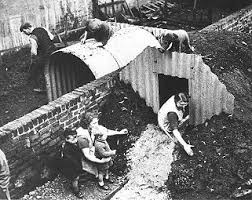
On 25th August 1940, 6 residents of Rustenburg Street, Hull, in their Anderson shelter, were the first fatalities due to Hull air raids. photo shows an Anderson shelter in construction.

On 25th August, 1956, A train of empty coaches hit the buffers at speed and went up onto the platform at Filey Holiday Camp Rail Station.  An enquiry found that the brakes were not properly coupled. Driver Goforth,  Fireman Bentley and Guard Wharam were slightly injured.

On 25th August 1972, the crew of the Flamborough lifeboat Friendly Forester rescued 2 people cut off by the tide at Flamborough.


Anderson shelter

July 31st

Hull-trawler-memories-1900 steam trawlerOn 31st July 1332, King Edward III sailed from Ravenspurn to battle in Scotland. He also visited Hull, and was reported to be pleased with the progress of the fortifications there.
On 31st July 1899, Hull steam trawler Opal collided with trawler Toronto and was wrecked 160 miles NE of Spurn. photo shows a typical steam trawler of the period.


July 27th

On 27th July 1643, Hull widow Ann Stevenson, whose husband died at Beverley in Parliament’s service as a cannoneer, petitioned the town of Hull to pay her the 35 shillings wages due to him; the committee agreed, in view of her poverty, to let her have 20s.

On 27th July 1782, Rev George Lambert of Fish Street, Hull reported in his diary on a violent thunderstorm in the evening, and lightning killed a cow very near their house, and scorched the hedges.

On 27th July 1796, jockey George Heron was thrown by his horse at Hull racecourse, Newington, and killed.

On 27th July 1855, James McLoughlin, aged 13, asked Hull Magistrates Court for the protection of the court on account of his mother having beaten him severely with a stick and a fire poker because he would not go out stealing for her.

On 27th July 1996, HMS Rose visited Hull’s Albert Dock; this was an exact replica of a frigate built in Hull by the Blaydes yard in 1757 and sunk in Savannah, Georgia in 1779. The only difference from the original ship was that the sails were made from recycled plastic bottles.

HMS Rose replica

July 19th

On 19th July 1692, Elizabeth Howe, nee Jackson, aged 57,  was hanged for witchcraft at Salem, Massachusetts with 4 other women; at the age of 3, she was among the Puritans who emigrated from Rowley to found Rowley, Massachusetts.

On 19th July 1750, Hull soldier John Hasselbe made a sworn statement to John Wood, Deputy Mayor, that when he was on duty at Beverley Gate between 1.00 and 3.00, his musket went missing, and he suspected it had been stolen and concealed.

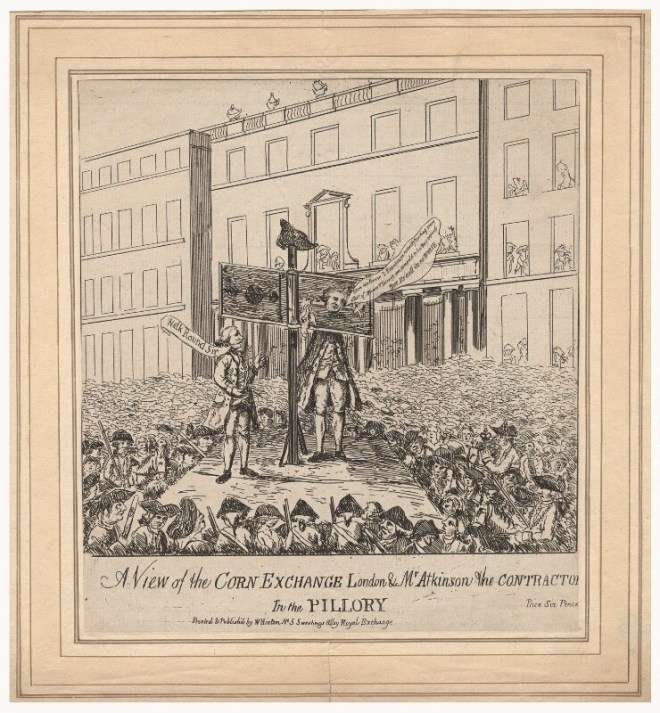
On 19th July 1783, Christopher Atkinson, MP for Hedon & corn factor, was tried in London for perjury, found guilty and committed to prison for 12 months, , first being pilloried at the Corn Exchange, London, and expelled from the House of Commons.  He resigned from his commercial post, but stood again as MP for Hedon in 1796 and 1802 and was elected. He later changed his name to Saville. picture shows Atkinson at the pillory

On 19th July 1786, Hull’s Rev George Lambert visited several sick parishioners, and commented on the contemporary habit of family and friends crowding into the room with the minister, so that the sick person was unable to speak openly.

On 19th July 1794, Edward Bogg, carpenter’s mate,  was shot and killed on board Hull fishing vessel Sarah and Elizabeth Off St Abb’s Head by the crew of a naval press gang on the frigate Aurora; 3 other crew were injured; the coroner’s court returned a verdict of wilful murder by Captain Essington; the captain was sent to the East Indies for several years and never stood trial.

On 19th July 1849, an All England Eleven cricket team played a 30-day match against a Hull amateur side at the Hull Athenaeum Club ground, Anlaby Road. Despite funding from the Hull Sheriff and both MPs, the entrance fee was 1s a day. The professionals won by an innings and 82 runs.

On 19th July 1919, 368 children living at Newland Homes, Cottingham Road, Hull, took part in official peace celebrations included games and setting fire to an effigy of the ex-Kaiser.chrisatkinson MP

July 18th

On 18th July 1509, Lockington labourer Christopher Wylton claimed sanctuary at the church of St John, Beverley, for theft.

On 18th July 1511, Tailor Thomas Mateson, of Stamford Bridge, claimed sanctuary at Beverley for the homicide of John Pott, also of Stamford Bridge, labourer.

On 18th July 1642, the first Hull siege ended after 17 days; as the Royalists withdrew to Beverley, they destroyed the sluice at Hull Bank, causing flooding in Newland, and probably set fire to St Andrew’s Church at Paull.

On 18th July 1833, the work of the Humber Pilots involved more than directing ships into harbour; the day’s work included: relaying 14 buoys; taking carpenters to Bull Float and relaying Transport buoy (at the entrance of the River Hull).

On 18th July 1878, Anthony Bannister JP died at Hessle aged 61; twice Sheriff and twice Mayor of Hull, Vice commodore of the Royal Yorkshire Yacht Club. Promoted the Hull to Withernsea rail line; he is commemorated by a street in Withernsea, by a statue in Hull, and an effigy in Hessle.

On 18th July 1929, Boothferry Bridge opened to traffic across the River Ouse, replacing the ferry which had operated there since the 14thcentury.

On 18th July 1941, Ernest Dean Hodgson of Deepdale Grove, Hull, member of the Rescue Service, was commended for the rescue of Mrs Pounder and her 3 children from a damaged air raid shelter in rustenburg St. For their actions on the same night, John Joseph McHugh of Lilly Grove, and Arthur George Dixon were both awarded the British Empire Medal.  The same raid caused major damage to Reckitt’s Dansom Lane HQ, about 75% of the buildings being destroyed.

On 18th July 1969, Barry Francis, 22, decky learner, was lost overboard from Hull trawler Arctic Vandal off the North Cape.