November 15th

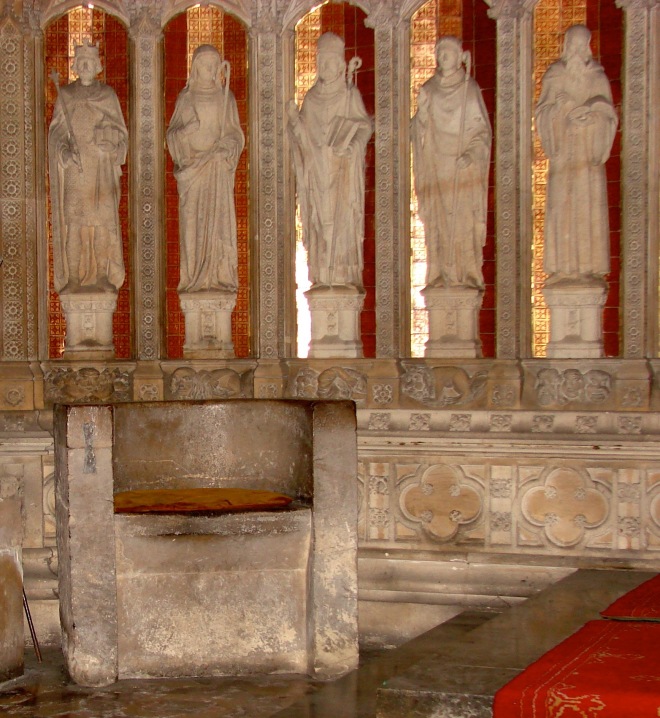
minster - frith stool.JPG


On 15th November 1482, William Weton, yeoman of North Ferriby, claimed sanctuary in the church of St John, Beverley, for killing John Atkynson of North Ferriby on 19th September. photo shows the sanctuary chair, or Frith Stool

On 15th November 1810, Robert Richardson, master of the Spurn lifeboat, and crew, performed the first rescue by the new lifeboat, to assist the John and Charlotte off Trinity Sand, River Humber, where she had been driven in a gale.

On 15th November 1915, Walter Beech, 47 of 25 Scarboro St, Hull, chief engineer/ Christopher Hall, 2ndengineer of Allison Tce, Hull, were lost with all other 8 crew of the steam trawler Edward B. Cargill when it struck a mine off Spurn Head.
 

November 13th

On 13th November 1002, English King Ethelred ordered the massacre of all the Danish in England on St Brice’s Day. East Yorkshire being in the Danelaw, where Danish and English were well integrated, the order appears to have been ignored here.

On 13th November 1684, John Largeman of Patrington married for the 3rdtime; he married his second wife Elizabeth Dunn on 31stJuly, and she died in September; his first wife had died in April of the same year. It is not known what killed his 3 wives, although plague is recorded in parts of Yorkshire in that year.

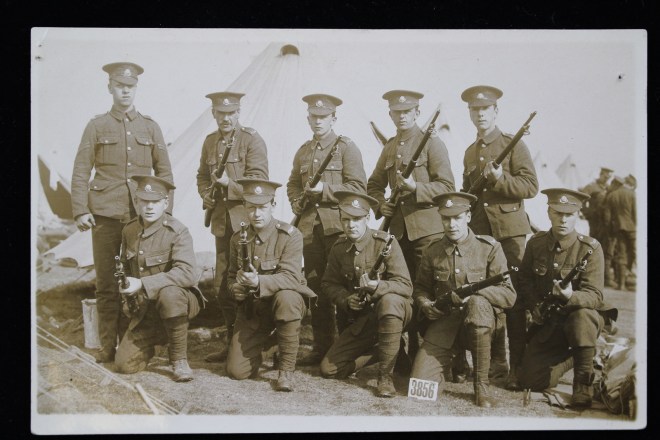
On 13th November 1916, was a private in the Hull Sportsmen’s Pals Battalion, East Yorkshire Regiment, at the Battle of the Ancre, WW1. His heroism in seizing German positions alone was rewarded with a Victoria Cross (for valour). (b 28.6.1897 died 21.2.1941) photo shows members of the 13th Battalion (Hull Sportsmen)

Hull PALS 13Btn sportsmen

November 9th

On 9th November 1309, King Edward II visited his Royal park in Burstwick, his main residence in the north.  Piers Gaveston was Lord of Holderness.

On 9th November 1487, John de la Pole senior, Duke of Suffolk, was stripped of most of his property and estates as a result of his son’s rebellion (the Earl of Lincoln) in support of Lambert Simnel.

On 9th November 1488, John Fernell, yeoman, of Asselby, killed Thomas Rodley with a staff, and then made his way to Beverley, where on 17.11 he claimed the sanctuary of the church of St John, and admitted the homicide.

On 9th November 1906, Capt Stensen and 5 crew of a Norwegian schooner carrying timber stranded at Withernsea in a gale. There were no casualties.

On 9th November 1916, Private Herbert Neal, 24, former Reckitt’s employee in the lead mill was killed in action with the East Yorkshire Regiment and is buried in Bazentin-le-petit, Somme, France. 2 of his brothers also served in the war, and only 1 survived to return home to Church St, Hull.

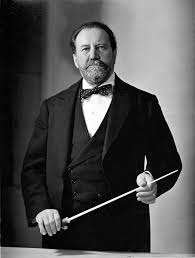
On 9th November 1923, Sir Henry Wood, originator of the Proms, made his first appearance as conductor of the Hull Philharmonic Orchestra, originally for one concert only. He stayed for 15 years, travelling from London to work with amateur musicians for a considerably reduced fee. An earlier contact with Hull was 1906 when Ethel Leginska performed for him in London.

Sir Henry Wood

November 8th


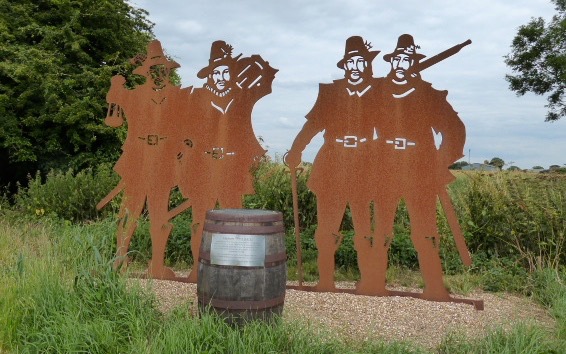
Gunpowder Plot memorial
Welwick

On 8th November 1481, Thomas Nevyll, yeoman of Skirlaugh, sought sanctuary in Durham Cathedral for killing John Hewlins of Rise on 1stNovember.

On 8th November 1500, William Thorpp of Welwick, John Dorand and a man named Nicholas were in Winestead when their dog entered the park; they asked the parkers to return the dog, but they refused, and were abusive. Nicholas shot one of the parkers named March, in the neck with an arrow; he died about 10 days later. Thorpp travelled to Durham, where on 10.12 he claimed sanctuary, fearing he would be indicted as an accessory to murder.

On 8th November 1605, Jack and Kit Wright of Welwick, and brother-in-law Thomas Percy were fatally wounded at Holbeche House, Staffordshire, by the posse of 200 men led by the Sheriff of Warwick, Sir Richard Walsh. 9 of the 13 Gunpowder Plotters were at Holbeche, and they all died there; the other 4 were all executed.

On 8th November 1637, the Mayor of Hull petitioned the Privy Council that 1) the town was so poor as a result of the recent plague that it be let off the requirement to provide 2 warships for the Navy; 2) that the county’s funds help to support Hull’s poor and; 3) that Hull’s merchants be allowed to sell their goods elsewhere in the country again, now that the town was free of the plague. It was estimated that 2,000 people died in Hull, and perhaps as many left town.

November 3rd

On 3rd November 1451, Richard Anson was enrolled in post as Hull Collector of Customs, joining existing staff Richard Bille (Collector) and Richard Alanson (Controller).

On 3rd November 1947, George Cornelius (Con) O’Kelly died aged 61. He achieved gold for Great Britain in the 1908 Olympics in men’s freestyle wrestling. 12,000 people turned out to meet him when he returned to Hull.  His son, Con jnr, competed in the 1924 Olympic heavyweight boxing.

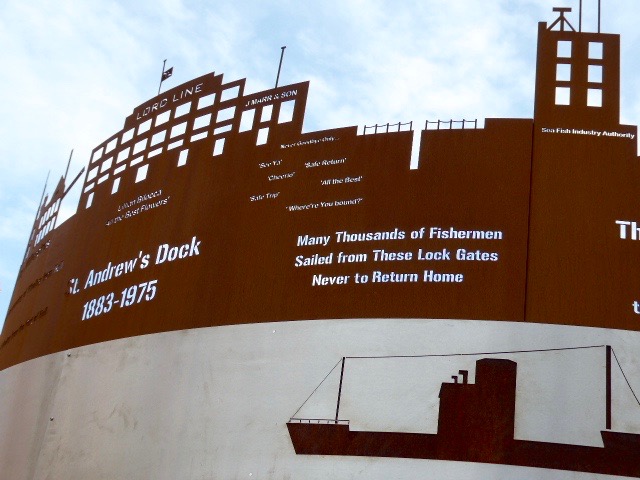
On 3rd November 1975, trawler owners ceased to use St Andrew’s Dock, Hull, which was closed to shipping after the collapse of Hull’s fishing industry.

St Andrews Dock memorial
Zebedee’s Yard

October 30th

de Ros arms

On 30th October 1472, an inquisition post mortem was called to verify the date of birth of Eleanor de Roos, of Breighton, daughter of Sir Robert Roos, in relation to inherited lands. George Layburn confirmed that she was born 55 years earlier, on 30thSeptember, a date he remembered because on the day of her birth one John Forder, fisherman, at Bryghton, in the water of Derwent, netted a big fish, of great length, with a head like a dog’s. 

On 30th October 1833, John Brown, 35, died in a field near Withernwick, during a prize fight against William Hackney, oyster vendor of Hull.  Brown, 18 lbs lighter than Hackney and 11 years older, fell after 1 hour and 36 minutes, in the 65thround, before 4p.m., and died at 10p.m. Hackney, his second Thomas Wilkinson, and Brown’s second, William Thompson, were found guilty at the inquest of wilful murder. A court had earlier found Thompson not guilty, and Hackney and Wilkinson guilty of manslaughter, and both were sentenced to 4 month’s hard labour at Beverley House of Correction.

On 30th October 2017, the Trustees of the Nafferton Feoffees Charities Trust submitted their annual report on a charity which originated with a bequest to the local poor from Thomas Robinson in 1698, and continued since that time, with additional bequests as recent as 1950.


October 25th

On 25th October 1037, Aelfric, Archbishop of York, placed the relics of the recently canonised St John of Beverley in a new shrine of gold and silver, ornamented with precious stones in the Collegiate Church of St John the Evangelist, Beverley.

On 25th October 1415, Michael de la Pole, 3rdEarl of Suffolk, died in battle, with 2 of his brothers. His brother William succeeded as Earl.

On 25th October 1841, Private Stephen Bennington, of Lockington, 20, batman to vet surgeon John Gloag, rode into the Russian guns at the Charge of the Light Brigade, Balaclava, and survived.  He was awarded the Crimea Medal with clasps. Also served at Inkerman and Sebastopol and was discharged from the service in 1859 with long service and good conduct medals. Gloag did not take part in the charge.

Light Brigade


October 24th

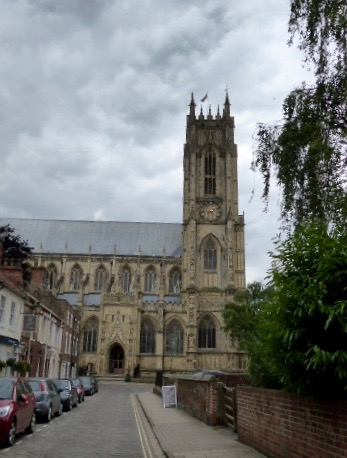
Beverley Minster


On 24th October 1530, at a Coroner’s inquest in Hutton Cranswick over the body of William Aunderson, the jurors reported that John Adayll, a labourer from Driffield, had on 23.10.1530 around 4p.m. assaulted him, with precogitated malice, with an iron fork, killing him instantly. Adayll immediately fled, with the townspeople of Hutton Cranswick pursuing him from town to town, but he escaped to ‘the privilege of Beverley’. Adayll does not appear in the sanctuary register for Beverley, though.

On 24th October 1850, John Branton, lifeboatman, drowned when the lifeboat overturned during the rescue of the brig Cumberland in the Humber near Kilnsea; John Welburn, the mate, was injured and died in 1852 from his injuries. The 9 members of the brig’s crew were rescued. An appeal raised £37 11s 6d for Branton’s widow and 6 children, and the RNLI added £5.

October 22nd

On 22nd October 1517, John Cook, yeoman of Sewerby, claimed sanctuary after assaulting labourer Thomas Stowpes and fled to Flambrough church.  This was not a registered place of sanctuary, but was called ‘taking church’. At a Coroner’s inquest at Sewerby on 5.11.1517, the jurors reported that Cook assaulted Stowpes on 22 Oct, giving him a wound from which he died 3 days later.

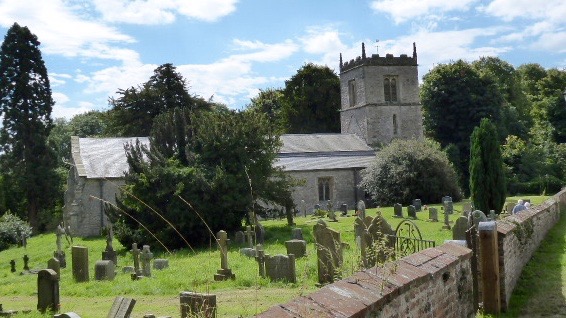
On 22nd October 1611, Lady Margaret Clifford, daughter of the Earl of Cumberland and Thomas Wentworth, future baronet, were married at All Saints, Londesborough. The Earl’s finances were not healthy, due to a protracted legal dispute with Lady Anne Clifford over his inheritance, so the celebrations were low-key, with only 40 in attendance, and a simple dinner of pasties, mince pies and turkey, a speciality of the estate. The artist Augustine Harrison was present, so that the Earl could present his 2 daughters with identical portraits of himself. photo shows Londesbrough church

On 22nd October 1882, William Butler, 16, 4thhand, was lost overboard from Hull trawler Sportsman in the North Sea.

On 22nd October 1972, the new Queen Elizabeth Dock container terminal was opened.


Londesborough


October 21st

On 21st October 1823, Mr Gleadow, commander of the customs cutter Bee, seized 31,324 barrels of contraband, including 250 lbs of tea, 720 lbs of tobacco, and 976 gallons of spirits, mostly gin, from the Lunatic asylum, Brandesburton Moor.

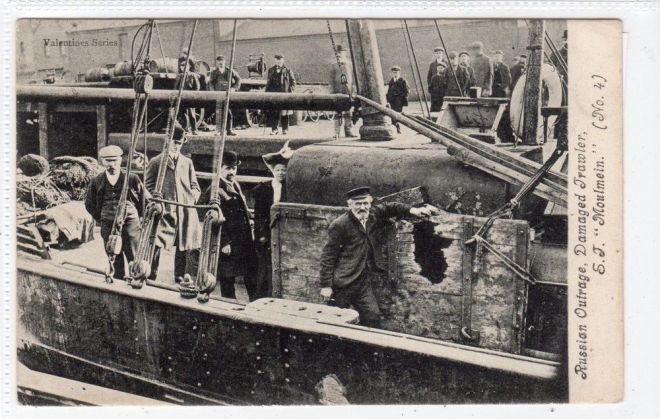
On 21st October 1904, the Gamecock trawler fleet from Hull was fired on by the Russian Baltic fleet, claiming they mistook them for the Japanese Navy. The trawler Crane was sunk and her captain and second mate killed; 30 others were injured. There is a memorial statue to the ‘Russian Outrage’ at the corner of Boulevard/Hessle Road.

On 21st October 1905, Ellen Borrill, of William’s Terrace, Hull, was murdered at Danthorpe by Peter Williams, her partner. He cut her throat in a field, walked to Burton Pidsea, and then gave himself up to the police at Roos. He claimed she had tried to kill herself, and asked him to finish her off. On 2nd December, Williams was sentenced to death, but was reprieved.

On 21st October 1921, Jim Graham and Cam Connor, out of work shipwrights from South Shields, bought a 14-seater Model T. Ford and set up Easington’s first bus service, just 2 years after East Yorkshire’s first bus service was set up in Elloughton by E.J. Lee, also using a 14-seater Model T.

Russian Outrage