December 25th

On 25th December 1703, Mrs Frances Maister of Penzance, born in Patrington, she left £10, the interest of which was to be given to the poor of Patrington every Christmas Day.

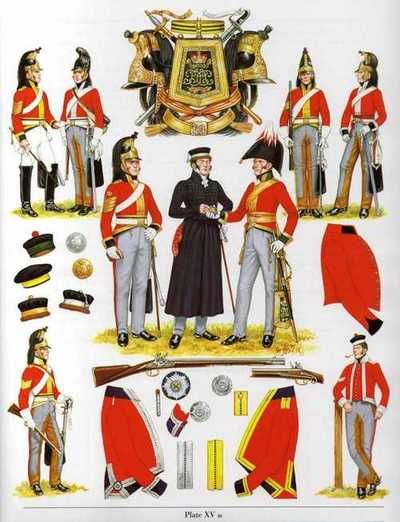
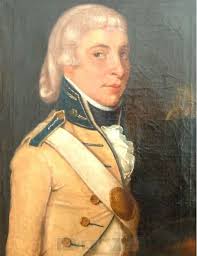
On 25th December 1794, fearing an invasion from France, the Beverley volunteers militia was uniformed and drilled for the first time in Saturday Market. The uniform was probably similar to the image below.

On 25th December 1876, during the rescue of the Grace Darling of Goole, sunk on Middle Bank, River Humber, Spurn lifeboatman Edward Weldrake had to jump into the sea and climb the rigging of the ship, and to prise the captain’s frozen fingers from the rigging. Awarded the RNLI silver medal for bravery.

EY Militia

December 16th

On 16th December 1512, William Crag of Cave claimed sanctuary at the church of St Cuthbert, Durham, for ‘asportation’; along with others, he had stolen 25 horses and mares, near Cave; in addition, in a certain park near Airton by York, he stole 3 other horses.

On 16th December 1586, the Earl of Huntingdon, on behalf of the Council in the North, wrote to the Hull Corporation to ask them to prevent merchants profiteering from the corn shortage by purchasing stocks for poor relief at a reasonable rate.

On 16th December 1645, Hull draper Robert Cartwright was fined £47 as a former Captain in the Royalist army (a ‘delinquent’) in order to recover his goods which had been sequestered by Parliament.

On 16th December 1689, a number of Danish soldiers were in William of Orange’s army, and 2 of them quarrelled and settled their dispute by a sword duel at Beverley. The survivor was beheaded in Saturday Market. (see 23.12)

On 16th December 1929, the R100 airship, the largest airship ever designed, made by a team led by Sir Barnes Neville Wallis, and including novelist Neville Shute Norway, took its maiden voyage from Spaldington Air Station.

On 16th December 2010, Easington tithe barn was offered for sale at an auction with a guide price of £125,000 and failed to sell. The 14thC building is the last remaining tithe barn in the county, and a Grade II listed building.

Easington tithe barn

December 1st

john-hotham-1-sized


On 1st December 1644, Sir John Hotham and Captain John Hotham, his son, were tried for treason at the Guildhall, London; both were convicted and condemned to beheading.

On 1st December 1800, Agnes Sharp, aged 24, was interviewed by the Hedon Mayor and one of the Bailiffs to confirm that she was pregnant, that the child (or children) was likely to be born a bastard, in order to claim payment from the parish. The father was a soldier from Sussex whose unit had left Hedon. Eventually, she received 2s6d a week.

On 1st December 1832, Thomas King and William Duesberry stole 3 chickens from John Carter’s farm, Howden. They were arrested and sentenced at Beverley on 14 Oct 1833, Duesberry getting a prison sentence, but King, who had previous form and did not admit the offence, was transported for 7 years. He was given his freedom in 1846 and seems to have died in Hobart in 1859.

On 1st December 1950, The Port of Hull Society’s Sailor’s Orphan Homes changed its name to The Sailors’ Children’s Society and celebrated with a lunch at the Guildhall.  The Society began as a Christian mission to seamen, and began to house ‘orphans’ (children whose father had died) in the 1860s, opening the Newland Homes in the 1890s.


November 23rd

On 23rd November 1599, the Council in the North made an order that John Gregory should serve as Hull Sheriff, although he had held the office 32 years before in 1567, and had asked to be released. He appears to have been successful in spite of the order.

On 23rd November 1796, John Taylor jnr, member of the Hull Troop of Gentlemen and Yeomanry Cavalry, was unanimously expelled and voted to Coventry for improper conduct. The record does not state what he did. photo shows cavalry of the time.

On 23rd November 1863, at the Howden Martinmas hiring fair, 700 men and 800 women attended, the largest number of any ER town; fairs were also held in Beverley, Bridlington, Driffield, Hedon, Patrington, where farmers and people seeking employment gathered. The church was concerned about the moral issues involved when single women had to parade themselves in public. Traditionally, farmworkers had a week’s holiday, annual wages paid, and there were pleasure fairs.

cavalry1796

November 16th

On 16th November 1503, Elizabeth of York, Duchess of Suffolk, died, aged 58. She was married to John de la Pole, 2ndDuke of Suffolk. The lands she held in Hull and Myton reverted to the Crown, and in 1514 Henry VIII gave them to William Sidney, buying them back in 1539 to build his fortifications in the town. She held 1,000 acres of land, including meadow, pasture, 100 dwelling houses, a mansion and gardens and the patronage of the Charterhouse.

On 16th November 1857, ‘A Dissenter’ issued a campaign leaflet encouraging religious dissenters to oppose plans by the Church of England to close down the school run by the Leonard Chamberlain Charity, the trustees of which were all dissenters. The writer estimated that 1/3 of Hessle people were not CofE members. The school remained open for a further 45 years.

On 16th November 1918, PC244 Harry Burgess filed a statement at Hull Central Police Station, reporting on 3 US sailors and 1 American soldier being followed by a large crowd. The Americans used obscene language, threatened to fight, and refused to go to their billets. Police escorted them to the Grosvenor Hotel, guarded the gate and dispersed the crowd, who accused the Americans of attacking British and Canadian soldiers.  The US commander later ordered his men, based at Killingholme US Naval Air Station, not to visit Hull without orders.

On 16th November 2017, Queen Elizabeth II visited Hull and met some of the City of Culture volunteers, had lunch with the Bee Lady among others, visited Siemens, and the new Allam Medical Centre at Hull University.


royal visit 2017

November 14th

On 14th November 1067, William the Conqueror knighted Sir Lionel Saltmarshe of Saltmarsh and gave him the manor of Saltmarsh (needs verification)

On 14th November 1504, Richard Squier, tailor, of Catton, claimed sanctuary at the church of St John, Beverley, for the theft of cloth, and for breaking out of the King’s gaol in York.

On 14th November 1906, Thomas Anderton, 44, of 53 Francis St, Hull, deckhand on steam trawler Canada, drowned along with the ship’s cook, in the River Thames at Gravesend when the ship’s boat capsized.

On 14th November 1913, Dan Billany was born in Essex Street, Hull. An active socialist, he was a teacher, and author. His novel ‘The Trap’ was highly respected. As an officer in the EY Regiment, he was captured in 1942 and a Prisoner of War in Italy until released in 1943. Last seen 20.11.1943, fate unknown.

Dan Billany The Trap

November 13th

On 13th November 1002, English King Ethelred ordered the massacre of all the Danish in England on St Brice’s Day. East Yorkshire being in the Danelaw, where Danish and English were well integrated, the order appears to have been ignored here.

On 13th November 1684, John Largeman of Patrington married for the 3rdtime; he married his second wife Elizabeth Dunn on 31stJuly, and she died in September; his first wife had died in April of the same year. It is not known what killed his 3 wives, although plague is recorded in parts of Yorkshire in that year.

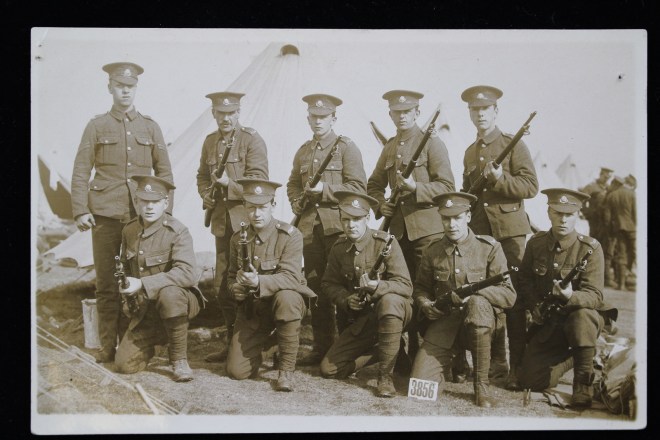
On 13th November 1916, was a private in the Hull Sportsmen’s Pals Battalion, East Yorkshire Regiment, at the Battle of the Ancre, WW1. His heroism in seizing German positions alone was rewarded with a Victoria Cross (for valour). (b 28.6.1897 died 21.2.1941) photo shows members of the 13th Battalion (Hull Sportsmen)

Hull PALS 13Btn sportsmen

November 9th

On 9th November 1309, King Edward II visited his Royal park in Burstwick, his main residence in the north.  Piers Gaveston was Lord of Holderness.

On 9th November 1487, John de la Pole senior, Duke of Suffolk, was stripped of most of his property and estates as a result of his son’s rebellion (the Earl of Lincoln) in support of Lambert Simnel.

On 9th November 1488, John Fernell, yeoman, of Asselby, killed Thomas Rodley with a staff, and then made his way to Beverley, where on 17.11 he claimed the sanctuary of the church of St John, and admitted the homicide.

On 9th November 1906, Capt Stensen and 5 crew of a Norwegian schooner carrying timber stranded at Withernsea in a gale. There were no casualties.

On 9th November 1916, Private Herbert Neal, 24, former Reckitt’s employee in the lead mill was killed in action with the East Yorkshire Regiment and is buried in Bazentin-le-petit, Somme, France. 2 of his brothers also served in the war, and only 1 survived to return home to Church St, Hull.

On 9th November 1923, Sir Henry Wood, originator of the Proms, made his first appearance as conductor of the Hull Philharmonic Orchestra, originally for one concert only. He stayed for 15 years, travelling from London to work with amateur musicians for a considerably reduced fee. An earlier contact with Hull was 1906 when Ethel Leginska performed for him in London.
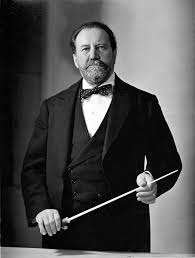
Sir Henry Wood

November 7th

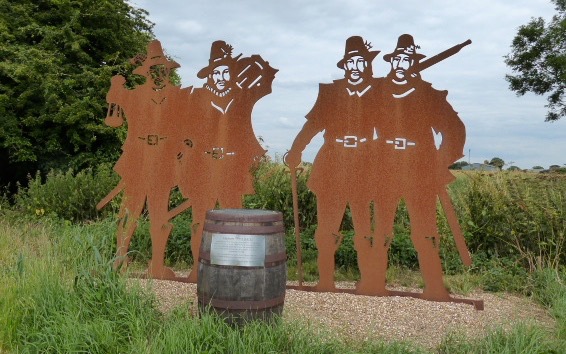
Gunpowder Plot memorial
Welwick

On 7th November 1605, Sir John Ferne, secretary to the Council in the North, sent confidential news to the Hull Mayor of the Gunpowder Plot, and orders to arrest Thomas Percy of Leconfield. An arrest warrant was issued the following day to the Bailiff, Chief Constable and constables of the county of Hull. However, Percy and the other conspirators were heading for Staffordshire.

On 7th November 1646, Sir Francis Cobbe of Ottringham was fined £72 as a Lieutenant-Colonel in the Royalist army (a delinquent) in order to recover his goods which had been sequestered by Parliament. He had been a member of King Charles’ Bodyguard.

On 7th November 1887, the crew of sailing ship Earl of Beaconsfield were rescued after the ship ran aground on sands off Aldbrough; the figurehead, representing Benjamin Disraeli, the Earl of Beaconsfield, can be seen in Hull Maritime Museum.

November 5th

On 5th November  1605, Sir Thomas Knyvet of Escrick, as Gentleman of the Bedchamber to King James I, he went to the House of Lords cellar to investigate a rumour and discovered Guy Fawkes and some gunpowder …

On 5th November 1740, Elizabeth Johnson’s charity distributed money to the 4 poorest families in Cherry Burton every year on this date.  Daughter of Dr Hodgson Johnson, she left £40 to be invested, adding to the 40s left by her father 16 years before.

On 5th November 1804, 7 of the 8 crew of the Cecilia Margaretha of the Duchy of Holstein died when the ship was driven ashore at Mappleton and wrecked on a trip from Liepaja, Russia, to Lisbon. photo shows Mappleton today

On 5th November 1854, James Elliott, private in the Coldstream Guards, died aged 22 at the Battle of Inkerman, Crimea; his memorial in Hedon church was ‘erected … to commemorate the event and to show that Hedon contributed its unit in defence of the liberties of Europe’.

mappleton.JPG