March 10th

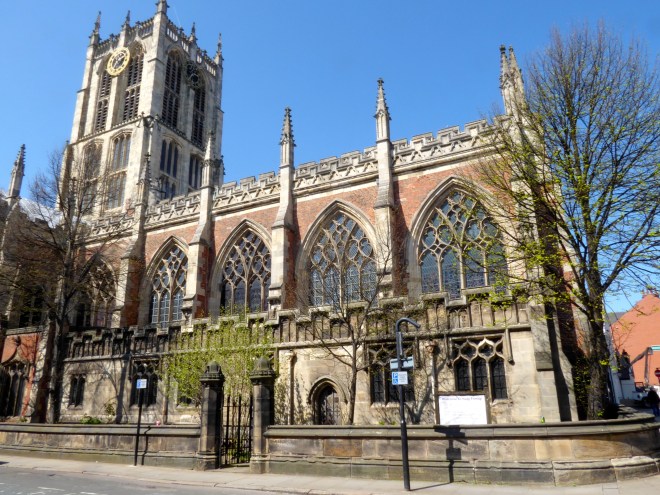
Holy Trinity

On 10th March 1425, Hull Holy Trinity Church, was consecrated; building began in 1291 and was interrupted by the Black Death.

On 10th March 1447, Henry VI issued a charter enlarging the county of Hull to include Hessle, North Ferriby, Swanland, West Ella, Kirk Ella, Tranby, Willerby, Wolfreton, Anlaby, the site of Haltemprice Priory and Derringham Dike.

On 10th March 1623, George Tummond, butcher, of Patrington, was found dying at sunrise in Winestead, after starting to walk home from the alehouse in Ottringham. Holderness was notorious for its floods.

On 10th March 1800, George Hudson, the “Railway King’, was born in Howsham.  He  made a great business and political career from sharp practice and bribery (was MP for Sunderland, and Lord Mayor of York). He became hugely rich, but was disgraced, and imprisoned for debt, though released when his debts were paid by public subscription. In 1845, he bought the Londesborough Estate for £470,000. D14.12.1871

On 10th March 1823, John Bacchus Dykes was born in Hull. By the age of 10, was assistant organist at St John’s Church, Myton. Became a vicar, and composed over 300 hymn tunes, including ‘Eternal Father, Strong to Save’ and ‘We plough the fields and scatter’. (d 22.1.1876)

On 10th March 1921, Mr J.H. Tate proposed a motion at Hornsea Golf Club that ’Old Jack be shot’! It is assumed Old Jack was the horse used to pull mowers and rollers on the course.

On 10th March 1954, Alex May, master of the tug Fenman, died in hospital after the tug was overrun by the ship she was towing, the Rudolf, and sank, on the way into Hull’s Alexandra Dock. 2 of the crew were swept away. There was 1 survivor.
March 5th

On 5th March 1514, John Taillour of Beverley claimed sanctuary at the church of St John, Beverley, for ‘the security of his body’, but the register does not state who was threatening him, or why.

On 5th March 1642, Queen Henrietta Maria stopped one night at the Manor House, Burton Fleming. She was still on her way to York to join her husband, Charles I, with arms from Holland. She is then said to have stayed 2 weeks at Boynton with the Stricklands. Luckily, Sir William, Parliamentary MP for Hedon, was away in London.

On 5th March 1646, Hull merchant Leonard Scott was fined £74 10s as a member of the Royalist army (a ‘delinquent’) in order to recover his goods which had been sequestered by Parliament.

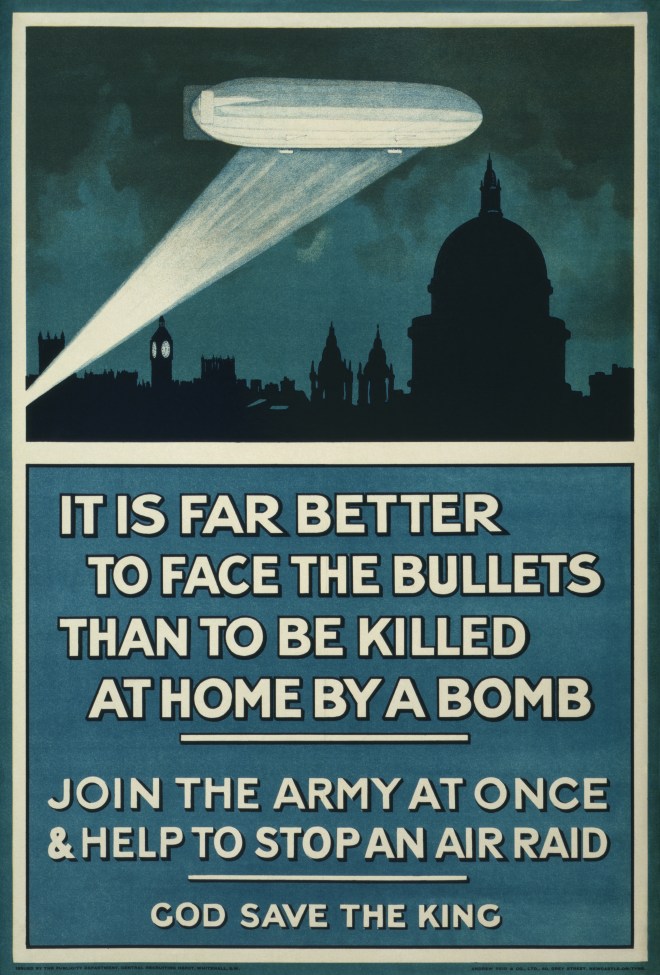
On 5th March 1916, Martha, Ethel and Mira Ingamells of Linnaeus St, Hull, were among the 18 people who died in the 2ndZeppelin raid on Hull; 60 people were injured. Queen Street was hit, as were Linnaeus St., Porter St., Church St and Selby St, and Earle’s shipyard. A mob afterwards smashed up a vehicle belonging to the Royal Flying Corps, presumably in anger at their failure to defend the town, resulting in hasty installation of 7 guns, and the general strengthening of defences around the Humber. Bombs were also dropped on Gembling and Woodmansey.

WWI Zeppelin

March 2nd


Flambro 'Danish tower'

On 2nd March 1406, James, Duke of Rothesay, son of Robert III of Scotland, was on his way to sanctuary in France, when he was captured by pirates, held in the Danish Tower in Flamborough for a time, then handed over to English King Henry IV. photo shows the Danish Tower

On 2nd March 1829, Rev John Scott, vicar of St Mary’s Lowgate, with many others, spoke at a public meeting in Hull Market Place to consider petitioning Parliament against Catholic Emancipation. Daniel Sykes, Whig MP for Hull, did not believe these vocal agitators were representative of the majority in Hull.

On 2nd March 1905, Cuthbert Brodrick died in Jersey aged 83. Nationally renowned architect of Leeds Town Hall, Scarborough’s Grand Hotel, Hull Town Hall (demolished 1912) and Hull’ s Royal Institution. (b Hull 1.12.1821)


February 23rd

On 23rd February 1643, Queen Henrietta Maria was woken at 4a.m. in Bridlington Quay by a bombardment of the house by Parliamentary ships; she sheltered in a ditch until the ebb tide moved the ships out of range.

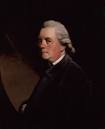
On 23rd February 1724, William Mason was born at Holy Trinity vicarage, Hull. A poet, biographer, composer and garden designer, in 1785 he was  William Pitt the Younger’s  choice as Poet Laureate,  but he refused the post. He is commemorated in Poets’ Corner, Westminster Abbey, and in Hull with a cream plaque. (d 7.4.1797) see picture below

On 23rd February 1830, a report in the Hull Packet said that Revd John Earle’s boarding school at Driffield had been relocated to Watton Abbey, the stately home of the Legard family. It remained there for 10 years, and Earle took on the living at Watton church.

On 23rd February 1919, Company Sgt Major Kelly died of flu in Hull Royal Infirmary. He had been discharged from the East Yorkshires a week before, after serving in WW1 from September 1914. He is buried in Hedon Road cemetery.

Wm Mason

February 18th

Pilgr Grace

On 18th February 1537, Sir Francis Bigod entered Beverley with 3-400 men on the renewed Pilgrimage of Grace.

On 18th February 1620, The King’s Players performed 5 plays at Londesborough House over a 4-day period at Shrovetide, for the Earl and Countess of Cumberland. The Cliffords regularly had entertainment at the house, hosting 13 different companies of players, and many musicians. Shakespeare had been the company’s leading playwright (he died in 1613).

On 18th February 1657, Sir Henry Slingsby, a Royalist prisoner in the Hull blockhouse, attempted to bribe Captain John Overton and incite the soldiers to go over to the King. Ralph Waterhouse, commander of the South Blockhouse, was also approached by Slingsby, who said that King Charles had offered him a commission, and said 600 men were at Paull ready to march into Hull. Slingsby was executed in 1658.

On 18th February 1786,  Elizabeth Dearing, aged 20, died in Fitling, cause unknown. She was the 3rdgeneration of the Dearing family to be recorded in the Humbleton parish register as Papist. Later generations who died there are not so described.

On 18th February 1945, Thomas Sheppard died aged 68 in Hull. He was a self-taught geologist, archaeologist and prolific author. He devoted 40 years of his life to Hull’s museums, abolished admission charges in 1902 and increased visitors to 2,000 per week. (born 2.10.1876 in South Ferriby) see photo

Thomas Sheppard Monster Footprint

February 11th

On 11th February 1346, William de la Pole agreed to resume lending money to King Edward III, in return for the return of all his goods that were in the hands of the sheriff. Relations between the king and his banker were precarious, but he remained in favour for the time being…

On 11th February 1657, Thomas Cowlam, labourer, and Jane Millington were married in a private alehouse at Spaldington by Robert Browne, vicar of Eastrington.

On 11th February 1941 at 5.30p.m., an anti-aircraft shell fell in Jalland Street, Hull, with no casualties. The blitz on Hull reached its peak in May that year.

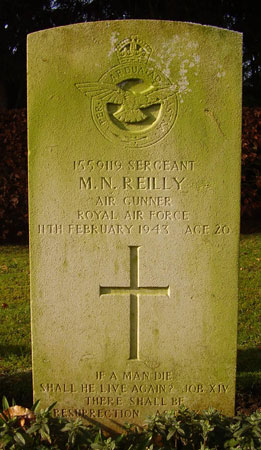
On 11th February 1943, Flt Sgt 785073 Harold E.R. Saunders died with 6 other crew (1 survived) when mechanical problems caused his Halifax bomber to crash near North Dalton, shortly after taking off from Pocklington. 6 of them are buried in Barmby Moor churchyard.

Halifax crash Feb 43


February 5th

On 5th February 1538, widow Mabel Brygge, 32, servant of Holmpton, was examined by an enquiry headed by Sir Ralph Ellerker the younger. She was alleged to have carried out a ‘black fast’ with the aim of injuring King Henry VIII and the Duke of Norfolk, in relation to the King’s divorce and the Reformation. She was executed at York, along with John Dobson, vicar of Muston, and John Ainsworth, priest, who had also spoken out against the royal supremacy and Act of Succession.

On 5th February 1856, Humphry Sandwith, junior, MD, aged 34, had a public breakfast given in his honour as a war hero at Royal Station Hotel Hull.  He gained the Orders of St Stanislaus, Nishan Iftahar and Mejidie, and French Legion of Honour in the Crimean War. He was head surgeon at Hull General Infirmary 1847-48. Author of a number of memoirs, as well as 3-volume novel “Minsterborough’ about his upbringing in Beverley.

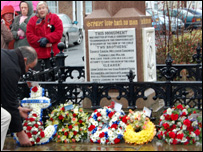
On 5th February 1909, George Gibbon, Melchoir Chadwick and Thomas Leng Major, fishermen, lost their lives attempting to rescue the crew of the coble Gleaner when it capsized. Their own boat also capsized, and all 6 lives were lost. A monument to this ‘Conspicuous Act of Bravery’ is in the village centre.


flambro

February 2nd

On 2nd February 1141, during the Anarchy, William of Aumale, Lord of Holderness and Earl of York led part of the cavalry protecting King Stephen, but were overrun by the Welsh and fled. The King was captured, and Matilda took the throne for a time. William remained loyal to Stephen.

On 2nd February 1786, Revd T.O. Rogers Hull opened the new Trinity House School with 36 pupils.

On 2nd February 1799, Capt Henry Gunter RN was in charge of HMS Nautilus when she was wrecked in a storm Off Flamborough Head; all the crew survived. She was leading a convoy of 22 merchantmen returning from the Baltic; one of the other ships was also wrecked.

On 2nd February 1801, Hull Trinity House paid relief of £1 1s to 4 seamen who had escaped from captivity in Russia.

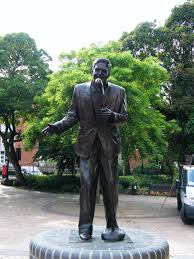
On 2nd February 1925, David Whitfield was born in Hull. A popular singer, he was the first UK male vocalist to earn a gold disc, and the first British artiste to reach No 1 simultaneously in the US and the UK. Commemorated by a statue outside the New Theatre. d 16.1.1980

David Whitfield


February 1st

On 1st February 1639, King Charles I issued an order to enclose Hull and improve its fortifications.

On 1st February 1714, a great wind caused damage in several places, and blew down Richard Stevenson’s house in Kilpin, then the fire in the hearth destroyed the remains.

On 1st February 1884, at the Hull Sanitary Congress, Hull City Hall, Rev Joseph Malet Lambert called for bold action to save hundreds of lives, and improve thousands more, by dealing with dreadful housing conditions, some of them a stone’s throw from the City Hall. The slums were cleared 20 years later.

On 1st February 1893, Hedon Gymnastic Society put on an ‘Assault-at-Arms’, with an appearance by a clown, and followed by a dance in the Board School room, Roos.

On 1st February 1922, Robert Anderson, 26 of 7 Emily Terrace, Gillett St was lost with 9 shipmates when Hull trawler Magneta was wrecked off Murmansk, under Russian arrest.

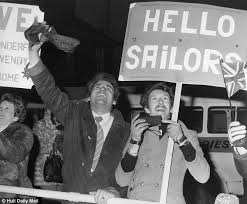
On 1st February 1983, 800 dignitaries, service representatives and families of the Norland crew gathered at the King George Dock Terminal Building, Hull. They were there to greet the return of North Sea Ferries Norland after over 9 months in the Falklands War supporting the troops. Unfortunately, 90 mph winds did not allow the ship to dock, and it rode out the storm in the Humber for several hours , by which time the banquet was over.  Hundreds of people were still there to greet them at the quayside in the evening. The Norland was refurbished and returned to the Rotterdam run on 20thApril.

Norland return

January 30th

Mary Ward

On 30th January 1499, Robert Colstone of Hull and Marmaduke Pateson of  Flambrough claimed sanctuary at the church of St John, Beverley – Colstone for debt and Pateson for the murder at Flambrough of John Mottows.

On 30th January 1645, Mary Ward died aged 60. A cousin of the Wright brothers of Welwick, she spent 5 years living there with her grandmother and spent a further 6 years at Osgodby. She founded the Institute of the Blessed Virgin Mary and championed women’s education. She was declared Venerable in 2009. (b23.1.1585 Mulwith Yorks) see photo

On 30th January 1901, Beverley Mayor Elwell proclaimed the accession of King Edward VII to a large crowd at the Market Cross, despite bitterly cold weather and a snow storm.

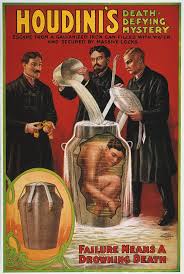
On 30th January 1913, Harry Houdini, escapologist, performed at the Palace Theatre, Hull. He escaped from a canvas sea bag and straps; the challenge was signed by seamen Dan Morris, Tom Carr and Robert Mason.

On 30th January 1983, Captain Derek Wharton of North Sea Ferry Norland spent the day sailing back and forth in Bridlington Bay, having arrived back from service in the Falklands War a little too early for the homecoming celebration planned for 1stFebruary.

Houdini copy