January 22nd

On 22nd January 1430, Katherine Brigham of Ganstead died at Preston aged 6 months. She had been sent by her family to a wet nurse with the Twyer family and was buried at St Sepulchre’s Hospital.

On 22nd January 1621, John Ramsay, a Scottish aristocrat, was created 1stand only Earl of Holderness by James I; he appears to have had no connection with Holderness.

On 22nd January 1643, Nicholas Osgodby, vicar of St Mary’s Beverley, left his post to join the Royalist army.

On 22nd January 1907, John (Jack) Symons died in Hull aged 83. He was the first Jew to hold public office in Hull; 1857 Guardian of the Poor, 1875 alderman, 1890 Sheriff; a local historian with many publications, including ‘Hullinia’ and ‘Kingstoniana’.


St Mary's Beverley

January 16th

On 16th January 1518, John Frost of Twing on the Wold (presumably modern Thwing) claimed sanctuary at the church of St John, Beverley, for debt.

On 16th January 1537, John Hallam and about 20 men entered Hull on market day, planning to seize the town and re-start the Pilgrimage of Grace. Hallam was betrayed by a man called Fowberry of Newbald, and arrested.

On 16th January 1642, William Cavendish, Earl of Newcastle, was appointed by King Charles I as the Governor of Hull, but the Parliament’s choice of Hotham prevailed with the support of the Mayor and aldermen.

Pilgr Grace

January 14th

On 14th January 1180, Hawisa, Lord of Holderness, of the county of Aumale in Normandy, with lands in several English counties, the barony of Copeland and the honour of Skipton, and one of the richest women in the country, was married by Henry II to William de Mandeville, Earl of Essex.

On 14th January 1642, Sir John Hotham arrived in Hull to take up the post of Governor, and was refused entry at Beverley Gate by the Mayor, Thomas Raikes. A messenger was sent to Parliament, who ordered the Mayor to accept Hotham and his forces, and to resign his post, or face a charge of high treason.  Hotham was admitted.

john-hotham-1-sized


January 10th

st mary's sculcoates.JPG

On 10th January 1308, Ivo de Etton of Temple Hirst, near Selby, and William de la Fenne from Faxfleet had been preceptors (heads) of local houses of the outlawed Knights Templar order, when they were arrested and imprisoned by Henry II on instructions of Pope Clement V. Also arrested were Richard de Ryston, chaplain, Thomas Tyeth, claviger (or warden), and Roger de Hugunde or Hogyndon, a brother in residence at Faxfleet, and Adam de Crake, claviger, at Temple Hirst.

On 10th January 1511, Richard Elynor of North Cave claimed sanctuary at the church of St John, Beverley, for a felony, but the register does not give any detail of his crime.

On 10th January 1537, Sir Francis Bigod, of Settrington, and John Hallam, of Cawkeld near Watton, met to discuss rekindling the Pilgrimage of Grace, which had ended in December with promises to restore the monasteries and hold a Parliament at York. They planned to seize Hull and Scarborough before they could be fortified.

On 10th January 1646, Stephen Thompson of Humbleton was fined £400 as the owner of Scarborough Castle and a Royalist (a ‘delinquent’) in order to recover his goods which had been sequestered by Parliament.

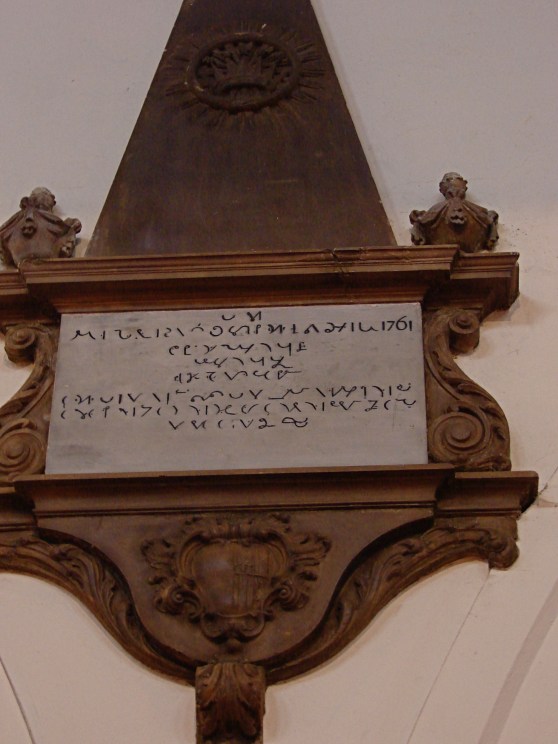
On 10th January 1761, Mrs Jane Delamoth died in Hull. Her memorial in St Mary’s Sculcoates may be the only memorial written in shorthand in the world. It says: ‘In the vault beneath this stone lies the body of Mrs Jane Delamoth, who departed this life 10thJanuary 1761. She was a poor sinner, but not wicked without holiness, departing from good works, and departed in the faith of the Catholic Church, in full assurance of eternal happiness, by the agony and bloody sweat, by the cross and passion, by the precious death and burial, by the glorious resurrection and ascension of Our Lord and Saviour Jesus Christ’. see photo

On 10th January 1783, Rear Admiral John Storr died in Hilston. He is buried in Westminster Abbey. (b 18.8.1709) He commanded the Revenge at the Battle of Quiberon Bay 20.11.1759. His father Joseph built Storr’s Tower at Hilston in 1750. It served as a hospital for troops camped on the coast in 1794–5 and later as a cottage, but was disused in 1990. His memorial is in Hilston church.

On 10th January 1849, Cottingham land agent Thomas Spenceley reported that he had measured the distance from the Spa Inn, Aldbrough to the sea in 1832 and again in 1848 and the loss of land due to coastal erosion was 28 yards in that period. On 6.8.1832 the distance was 160 yards; on 11.8.1848 it was 132 yards, an average loss of 5ft 3” per year.

On 10th January 1952, Madame Clapham (Mrs Emily Clapham) died aged 96, the former Court Dressmaker of Kingston Square, Hull. Her fashions for high society made Hull ‘the rage’ according to Sir Osbert Sitwell.

On 10th January 1968, Hull trawler St Romanus left port and made radio contact with the owners that evening. A Mayday call was heard, but not passed on. The official enquiry concluded ship probably lost on 11thJanuary, reason unknown.

On 10th January 1968, Hull trawler Kingston Peridot of Hull left port and was not contacted until after 26 January. The enquiry concluded she probably capsized on 26th  or 27th January, due to extreme weather.

January 2nd

On 2nd January 1645, Sir John Hotham was executed for treason. He was buried, with his son John, in the Church of All Hallows, Barking. His lands passed to his grandson, aged about 10.

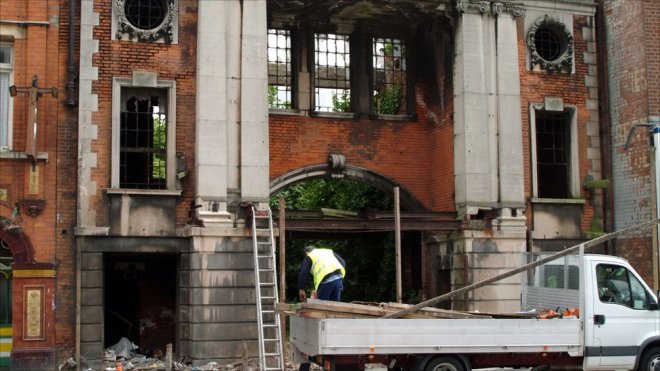
On 2nd January 2007, Historic England listed the former National Picture Theatre on Beverley Road, Hull, Grade II for its special architectural or historic interest. It is believed to be the only civilian WW2 bombed–out building, other than churches, remaining on its site.

nationalpicturetheatre


December 16th

On 16th December 1512, William Crag of Cave claimed sanctuary at the church of St Cuthbert, Durham, for ‘asportation’; along with others, he had stolen 25 horses and mares, near Cave; in addition, in a certain park near Airton by York, he stole 3 other horses.

On 16th December 1586, the Earl of Huntingdon, on behalf of the Council in the North, wrote to the Hull Corporation to ask them to prevent merchants profiteering from the corn shortage by purchasing stocks for poor relief at a reasonable rate.

On 16th December 1645, Hull draper Robert Cartwright was fined £47 as a former Captain in the Royalist army (a ‘delinquent’) in order to recover his goods which had been sequestered by Parliament.

On 16th December 1689, a number of Danish soldiers were in William of Orange’s army, and 2 of them quarrelled and settled their dispute by a sword duel at Beverley. The survivor was beheaded in Saturday Market. (see 23.12)

On 16th December 1929, the R100 airship, the largest airship ever designed, made by a team led by Sir Barnes Neville Wallis, and including novelist Neville Shute Norway, took its maiden voyage from Spaldington Air Station.

On 16th December 2010, Easington tithe barn was offered for sale at an auction with a guide price of £125,000 and failed to sell. The 14thC building is the last remaining tithe barn in the county, and a Grade II listed building.

Easington tithe barn

December 11th

Meaux Abbey Farm


On 11th December 1538, Ellerton Gilbertine Priory was dissolved and the monks pensioned off. Sir John Aske of Aughton was granted the monastic lands, part of which became the parish church and graveyard. I have no record of the fate of the 13 poor elderly men whom the priory hospital was created to house.

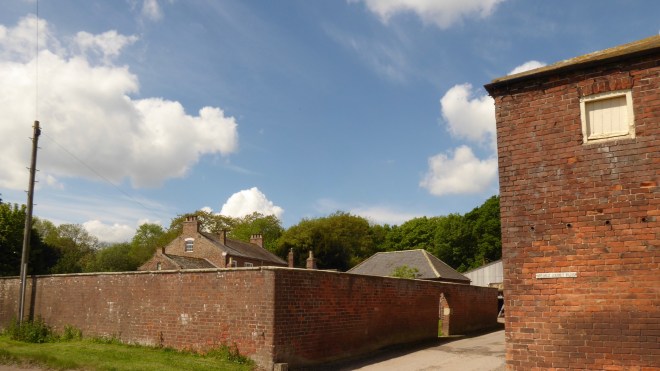
On 11th December 1539, the Abbot and monks of Meaux Abbey were pensioned off when the monastery was dissolved. The abbot retired to Skerne, and some of monks took up posts as curates in Welwick, Keyingham and Beeford. photo shows farm near the site

On 11th December 1647, priest John Saltmarsh, MA, died. Author, theologian, rector, deacon and Chaplain in the Parliamentary Army during the Civil War. Argued for religious toleration and liberty of conscience. Told Cromwell and Fairfax that God was angry with them for their treatment of the Levellers, and resigned his post with the Army. (b Saltmarsh date?)

On 11th December 1915, former Reckitt’s employee Private Edgar Winson was killed in action, serving with 10thBtn West Yorkshire Regiment. Born Spurn. No known grave.


December 9th

On 9th December 1644, Capt John Hotham had a second trial, this time for betraying the trust placed in him as a parliamentary commander. Found guilty and sentenced to beheading on 1stJanuary.

On 9th December 1754, pensioners in Trinity House almshouses were required to attend every Divine Service in the chapel, or lose one week’s pay for every default.

On 9th December 1917, the Spurn lifeboat rescued the crew of the steam ship Florence of Stockton when they ran aground in heavy seas. Coxswain Robert Cross jumped into the sea with a line, and with crewman G. Martin, stood on the sands until all of the crew were safely in the lifeboat. Cross received the RNLI Silver Medal, and Martin received a Monetary Award.

On 9th December 1959, half of the tower of St Martin’s Church, Wharram Percy, collapsed in a storm, 10 years after the last service held in this abandoned village, now probably the subject of more archaeological investigations than any other place in England.

Wharram Percy

December 7th

john-hotham-1-sized


On 7th December 1644, Sir John Hotham’s execution date, set for 16.12, was put back after Lady Hotham appealed for more time for him to settle his affairs.

On 7th December 1791, 22 months after being apprenticed at sea, John Sheriff, pupil of Hull Trinity House School, was allowed a land job in the House, ‘on account of his being twice shipwrecked had been discouraged from a further perseverance’.

On 7th December 1958, the crew of Flamborough lifeboat Friendly Forester saved 2 Bridlington fishing boats and landed their crews of 8 men.


December 1st

john-hotham-1-sized


On 1st December 1644, Sir John Hotham and Captain John Hotham, his son, were tried for treason at the Guildhall, London; both were convicted and condemned to beheading.

On 1st December 1800, Agnes Sharp, aged 24, was interviewed by the Hedon Mayor and one of the Bailiffs to confirm that she was pregnant, that the child (or children) was likely to be born a bastard, in order to claim payment from the parish. The father was a soldier from Sussex whose unit had left Hedon. Eventually, she received 2s6d a week.

On 1st December 1832, Thomas King and William Duesberry stole 3 chickens from John Carter’s farm, Howden. They were arrested and sentenced at Beverley on 14 Oct 1833, Duesberry getting a prison sentence, but King, who had previous form and did not admit the offence, was transported for 7 years. He was given his freedom in 1846 and seems to have died in Hobart in 1859.

On 1st December 1950, The Port of Hull Society’s Sailor’s Orphan Homes changed its name to The Sailors’ Children’s Society and celebrated with a lunch at the Guildhall.  The Society began as a Christian mission to seamen, and began to house ‘orphans’ (children whose father had died) in the 1860s, opening the Newland Homes in the 1890s.