December 1st

john-hotham-1-sized


On 1st December 1644, Sir John Hotham and Captain John Hotham, his son, were tried for treason at the Guildhall, London; both were convicted and condemned to beheading.

On 1st December 1800, Agnes Sharp, aged 24, was interviewed by the Hedon Mayor and one of the Bailiffs to confirm that she was pregnant, that the child (or children) was likely to be born a bastard, in order to claim payment from the parish. The father was a soldier from Sussex whose unit had left Hedon. Eventually, she received 2s6d a week.

On 1st December 1832, Thomas King and William Duesberry stole 3 chickens from John Carter’s farm, Howden. They were arrested and sentenced at Beverley on 14 Oct 1833, Duesberry getting a prison sentence, but King, who had previous form and did not admit the offence, was transported for 7 years. He was given his freedom in 1846 and seems to have died in Hobart in 1859.

On 1st December 1950, The Port of Hull Society’s Sailor’s Orphan Homes changed its name to The Sailors’ Children’s Society and celebrated with a lunch at the Guildhall.  The Society began as a Christian mission to seamen, and began to house ‘orphans’ (children whose father had died) in the 1860s, opening the Newland Homes in the 1890s.


November 30th

On 30th November 1219, William de Forz II, count of Aumale, Lord of Holderness, was declared a rebel and excommunicated for offences against the Crown and the sheriffs of 6 counties were instructed not to give him any help; he had held onto castles after being ordered to restore them to their owners.

On 30th November 1280, the residents of Hedon petitioned government to fix their tax (fee farm) as they were ‘few and poor’ and competition from Ravenserod and Hull were increasing from day to day. The port was firmly in decline. Hedon ship motif can be found in St Augustine’s church.

Hedon ship, St Augustine's

On 30th November 1587, Alexander Crowe, Catholic priest, aged approx 34, was executed in York. Born in Howden, worked as a shoemaker and travelled to Douai; ordained at Rheims 1583. Captured at South Duffield while baptising the baby of Cecily Garnett.

On 30th November 1644, Sir John Hotham began his trial for treason at the Guildhall, London.

On 30th November 1832, Henry John Shepherd, attorney and JP, of Beverley, went bankrupt, having speculated in building projects; his creditors were reported to include mainly individuals who had given him money for investment with no security; the bankruptcy register describes him as ‘dealer and chapman’. Shepherd was again practising as a solicitor in 1833.


November 26th

On 26th November 1319, Geoffrey Fitz Hugh and John de Wetewang conveyed property in Lyle Street (Mytongate), Hull,  to Hugh and Ellen Le Taverner.

On 26th November 1525, Richard Haton, gentleman, from Hayton, claimed sanctuary in St Mary’s Church, Hertford, and confessed to the coroner  that in October he had broken into a parish church in Essex and stolen a silver chalice; and in January he had burgled a house in Bucks and stolen jewellery and money. He abjured, i.e. renounced his country, and left through the port of Southampton.

On 26th November 1597, Sir Francis Barrington, Lord of the Manor of Cottingham (and uncle by marriage of Oliver Cromwell) wrote objecting to Hull Corporation’s drainage plan to move surplus water through his clough at Cottingham, which he said would risk flooding in the area.

On 26th November 1831, Joseph Robinson Pease, JP, spent his third consecutive day swearing in Special Constables to deal with anticipated riots; various sources say between 800 and 2,000 were sworn. James Acland had formed the Hull Political Union, and held meetings critical of the Hull Corporation, and said the aldermen were of out of touch and did not live in the town.

On 26th November 1847, Pocklington Canal Company agreed, at the Feathers Hotel, Pocklington, to sell the canal to the York & North Midland Railway, which also purchased the Market Weighton and Leven Canals. The canal had never been a financial success, and the railway company subsequently raised canal tolls so as to drive freight traffic onto the trains.

Pocklington canal
Melbourne lock

November 24th

On 24th November 1299, King Edward I visited the Collegiate Society of St John, Beverley, and was entertained for 3 days.

On 24th November 1835, Mrs Jane Legard created the Etton Lying-In Charity by her will, providing maternity articles and food for new mothers – so long as they had been married at least 9 months.

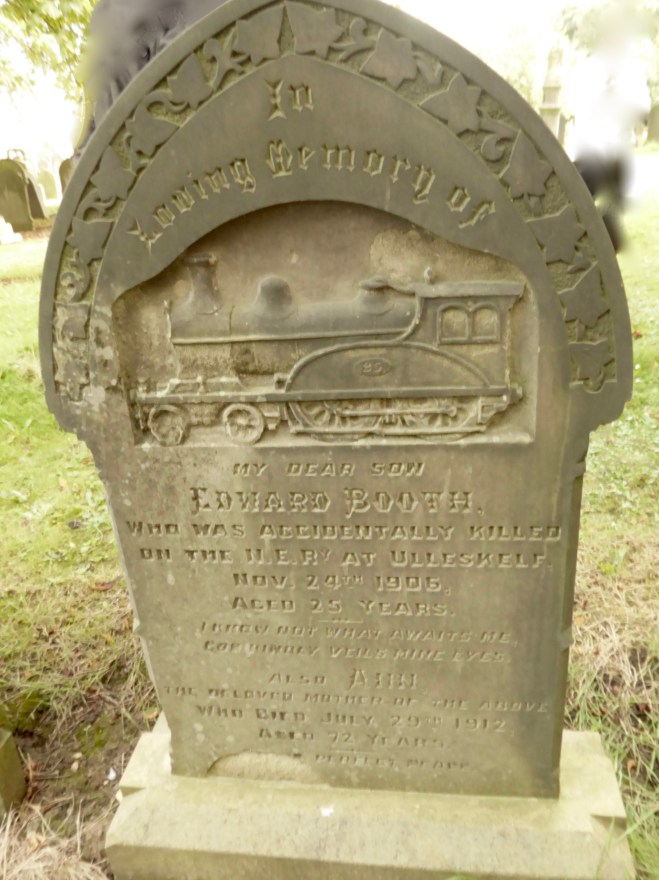
On 24th November 1906, John Dunham, 53, train driver and Edward Booth, 25, fireman, of Hull, died in a rail accident at Ulleskelf , which led to railway safety improvements. photo – Western General Cemetery, Hull

Edwd Booth memorial

November 22nd

On 22nd November 1865, William Stamp, Edward Rodmell, and John Lancaster, of Sutton, appeared at Sproatley Petty Sessions, charged with being drunk and riotous in Sutton. Lancaster was discharged, but Stamp and Rodmell were found guilty and fined 5s with costs of 7s6d.

On 22nd November 1869, Alfred Edward Matthews, known as A.E. Matthews was born in Bridlington. Character actor whose career started in silent films and continued to 1960 (d 25.7. 1960) Clip is from ‘This is Your Life’


On 22nd November 1907, Emmeline Pankhurst, founder of the Women’s Social and Political Union, spoke to a large crowd of dock workers at Hull Fish Dock on the issue of women’s suffrage. Christopher Pickering invited her to talk to the men assembled indoors too. He said that he was Conservative, but his wife was a Radical.

November 21st

On 21st November 1798, Elizabeth Darling, of Scale Lane, Hull, on the death of her father, continued to run his business as apothecary, although as a woman she was unable to train formally.

On 21st November 1823, Joseph R. Pease reported in his diary a fire in their oil windmill; due to thick walls, adjoining warehouses were not affected. 3 fire engines attended. Pease blamed the carelessness of 2 workers.

On 21st November 1940, Sidney Hall, aged 17, mess boy, of Hull, was lost by enemy action with all 45 crew of SS Cree of London; the Merchant Navy  ship, returning to UK from Sierra Leone, was torpedoed by a German submarine.


November 18th

On 18th November 1620, the son of Thomas Peirson of Shipton (now Shiptonthorpe) hoped for a post in the kitchen at Londesborough House, the seat of Francis Clifford, Earl of Cumberland. Either he was not suitable, or there was no post available. He was given 12d costs as compensation. Posts were usually filled by personal recommendation, often from families who had worked in the house in the past.

On 18th November 1910, Benjamin Bolton, aged 48, of 5 Suffolk Terrace, Hornsea, died after falling from a moving train near Brough.  A prominent Hornsea citizen, member of the Conservative Party and member of Hornsea Music Union, he played cricket for Hull, Hornsea & Yorkshire and bowled out W G Grace. The inquest returned a verdict of accidental death. (b23.9.1862 Cottingham)

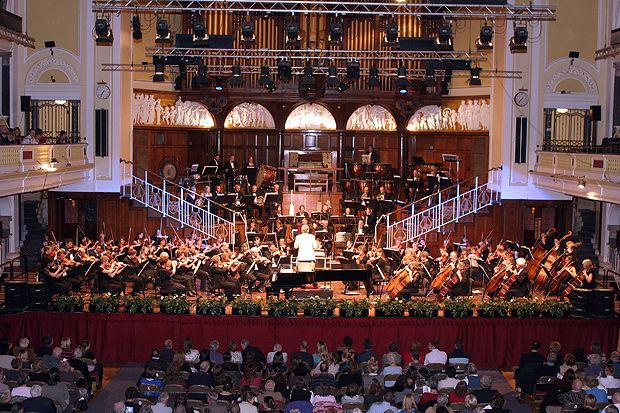
On 18th November 1938, Sir Henry Joseph Wood, founder of the Proms, resigned as conductor of the Hull Philharmonic Society after 15 years. The committee considered Sir Malcolm Sargent as his replacement, but he was not available. Basil Cameron was engaged. photo shows the orchestra in Hull City Hall

hull-philharmonic-orchestra-lst198215

November 17th

On 17th November 1407, Sir John Constable died at Halsham, and indicated in his will a wish to make amends to anyone he had swindled, and to return to their families goods and chattels belonging to his villeins, which he had kept after their death, ‘for the convenience of their sons’.

On 17th November 1868, novelist Anthony Trollope stood as a Liberal candidate and came 4thout of 4 candidates in the election; he referred to Beverley (where ‘political cleanliness was odious to the citizens’) as Percycross in his 1871 novel ‘Ralph the Heir’.

On 17th November 1907, Bokane, Kuarke, Mongonga, Mafutiminga, Matuka and Amuriape, pygmies from the Ituri Forest, Congo River Basin, sailed home from Hull after 30 months in England. 3,000 people paid to see them at Olympia and halls around the country. They also visited the House of Commons. They stayed with Colonel James Harrison at Brandesburton Hall and hunted in the parkland. Human rights activists had campaigned to stop the visit.

Brandesburton pygmies

November 16th

On 16th November 1503, Elizabeth of York, Duchess of Suffolk, died, aged 58. She was married to John de la Pole, 2ndDuke of Suffolk. The lands she held in Hull and Myton reverted to the Crown, and in 1514 Henry VIII gave them to William Sidney, buying them back in 1539 to build his fortifications in the town. She held 1,000 acres of land, including meadow, pasture, 100 dwelling houses, a mansion and gardens and the patronage of the Charterhouse.

On 16th November 1857, ‘A Dissenter’ issued a campaign leaflet encouraging religious dissenters to oppose plans by the Church of England to close down the school run by the Leonard Chamberlain Charity, the trustees of which were all dissenters. The writer estimated that 1/3 of Hessle people were not CofE members. The school remained open for a further 45 years.

On 16th November 1918, PC244 Harry Burgess filed a statement at Hull Central Police Station, reporting on 3 US sailors and 1 American soldier being followed by a large crowd. The Americans used obscene language, threatened to fight, and refused to go to their billets. Police escorted them to the Grosvenor Hotel, guarded the gate and dispersed the crowd, who accused the Americans of attacking British and Canadian soldiers.  The US commander later ordered his men, based at Killingholme US Naval Air Station, not to visit Hull without orders.

On 16th November 2017, Queen Elizabeth II visited Hull and met some of the City of Culture volunteers, had lunch with the Bee Lady among others, visited Siemens, and the new Allam Medical Centre at Hull University.


royal visit 2017

November 14th

On 14th November 1067, William the Conqueror knighted Sir Lionel Saltmarshe of Saltmarsh and gave him the manor of Saltmarsh (needs verification)

On 14th November 1504, Richard Squier, tailor, of Catton, claimed sanctuary at the church of St John, Beverley, for the theft of cloth, and for breaking out of the King’s gaol in York.

On 14th November 1906, Thomas Anderton, 44, of 53 Francis St, Hull, deckhand on steam trawler Canada, drowned along with the ship’s cook, in the River Thames at Gravesend when the ship’s boat capsized.

On 14th November 1913, Dan Billany was born in Essex Street, Hull. An active socialist, he was a teacher, and author. His novel ‘The Trap’ was highly respected. As an officer in the EY Regiment, he was captured in 1942 and a Prisoner of War in Italy until released in 1943. Last seen 20.11.1943, fate unknown.

Dan Billany The Trap