Coming up this week

December 18th

On 18th December 1594, Katherine Johns, chambermaid to the Clifford family, on behalf of Lady Grissell, paid 2s to the Beverley waits, presumably for performing at Londesborough House.

On 18th December 1612, Sir Francis Clifford bought 30 young elm trees to enhance the woodland of the house; it took 3 men with a cart and 5 horses to transport them.

On 18th December 1745, Thomas Owst of Halsham, a ‘popish recusant’, was given licence to travel to Drax to see his wife, who was ill. Catholics were forbidden to travel more than 5 miles from home without permission.

On 18th December 1824, Sir John Hall was born in Hull. Emigrated aged 27 to New Zealand, where he became the 12thPrime Minister, and moved the Parliamentary Bill that gave women the vote in 1893. (d 25.6.1907, Christchurch NZ) see photo

On 18th December 1919, the Clerk to the Hull Local Profiteering Committee, wrote to the Board of Trade, suggesting that an inquiry be held into possible profiteering by Hammonds Ltd. They had sold to Mr E.R. Kidby of Plane Street, 4 knitting needles for 1s 01/2d, on which Hammonds said they made 1 1/2d profit. The complaint was not upheld, as the needles were bought before the Profiteering Act 1919 came into force, but the BoT suggested making another purchase, and they could then investigate.
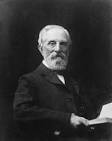
Sir John Hall


December 17th

On 17th December 1216, William de Forz was given as a hostage with his mother Aveline to the new King Henry III when his father, William de Forz II, count of Aumale and Lord of Holderness, supported the barons. Presumably this was to assure the king of his loyalty, as he had been a supporter of King John.

On 17th December 1965, North Sea Ferries began operating a ferry service from Hull to Rotterdam, for freight vehicles and private cars. MV Norwave’s maiden voyage saw a force 10 gale, which caused some trailers to break free of their shackles, but damage was minimal. The sister ship Norwind joined the service in March 1966.

Norwave

December 16th

On 16th December 1512, William Crag of Cave claimed sanctuary at the church of St Cuthbert, Durham, for ‘asportation’; along with others, he had stolen 25 horses and mares, near Cave; in addition, in a certain park near Airton by York, he stole 3 other horses.

On 16th December 1586, the Earl of Huntingdon, on behalf of the Council in the North, wrote to the Hull Corporation to ask them to prevent merchants profiteering from the corn shortage by purchasing stocks for poor relief at a reasonable rate.

On 16th December 1645, Hull draper Robert Cartwright was fined £47 as a former Captain in the Royalist army (a ‘delinquent’) in order to recover his goods which had been sequestered by Parliament.

On 16th December 1689, a number of Danish soldiers were in William of Orange’s army, and 2 of them quarrelled and settled their dispute by a sword duel at Beverley. The survivor was beheaded in Saturday Market. (see 23.12)

On 16th December 1929, the R100 airship, the largest airship ever designed, made by a team led by Sir Barnes Neville Wallis, and including novelist Neville Shute Norway, took its maiden voyage from Spaldington Air Station.

On 16th December 2010, Easington tithe barn was offered for sale at an auction with a guide price of £125,000 and failed to sell. The 14thC building is the last remaining tithe barn in the county, and a Grade II listed building.

Easington tithe barn

December 15th

On 15th December 1604, the Hull Recorder, Sir William Gee, petitioned the Council in the North on behalf of the Hull Corporation for a financial contribution towards the relief of people infected by plague; 788 people had received financial support of some sort, and other costs (wages of watchmen, repairs to pesthouse) totalled over £97. photo shows the Gee memorial in York Minster

sir Wm Gee

December 14th

Ebberston Yorks Aelfrids Memorial


On 14th December 704, the Anglo Saxon Chronicle records, King Aldfrith of Northumbria died in battle at Ebberston and was buried at Little Driffield. A man of great learning, educated for a career in the church, but he succeeded to the throne when his brother died. A memorial to him, called King Alfred’s Stone, is at Ebberston, North Yorks. Driffield may have been a royal seat of the Saxon kings. (sources vary as to his exact dates)

On 14th December 1610, an anonymous tinker was invited in to Londesborough House, home of the Earl of Cumberland, to mend broken pans and was paid 3s4d by the clerk of the kitchen.

On 14th December 1660, surgeon Joseph Thornnton was granted a licence to practice in Hull, after being invited to move from Great Horton, West Riding, to deal with a typhus outbreak. 18 people signed a testimonial to his effectiveness.

On 14th December 1775, Hull Corporation delegated its responsibility to provide a town dump to the official Town Scavenger; the condition of the Spring Ditch soon gave cause for concern, and in 1777 a bank was built to stop dung and rubbish entering the water.

December 13th

thwing meteorite

On 13th December 1760, John Courtney, gentleman, reported in his diary being awoken at midnight by the sound of bells ringing to announce that Hugh Bethell had declared himself a candidate for Parliament. The bells rang all day. A week later, Bethell changed his mind and withdrew his name.  He served as Beverley MP 1768-72.

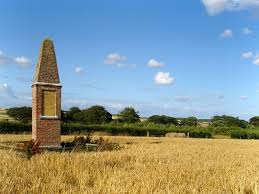
On 13th December 1795, at 3p.m., a meteorite weighing 56 pounds landed in a field near Wold Cottage, Thwing, home of Capt Edward Topham. It embedded itself 9 inches into the soil, weighing 56lbs, and 3 ft long. Capt Topham displayed the meteorite in London at a charge of 1shilling. He raised a brick obelisk on the landing site (see photo). The meteorite is now in the Natural History Museum, and is the origin of the name of Wold Top Brewery’s ‘Falling Stone bitter’.

On 13th December 1816, Frederick Brown, 60, was buried in Holy Trinity, Hull, after dying in the workhouse. Born in Guinea, he worked as a labourer in a number of jobs in Whitby and Hull. In 1794 he was acquitted of burglary by a Hull jury, apparently a case of being mistaken for another black man.

On 13th December 1830, Joseph Robinson Pease, JP, recorded in his diary an attempt to swear in special constables to deal with the ‘Swing Riots’ by agricultural labourers protesting about high rents, low wages, and the introduction of new machinery. However, they found it difficult to recruit in Cottingham.

On 13th December 1842, Moses Roper, student and escaped slave, gave a lecture at Beverley Guildhall on his personal experience of slavery in the USA, in which he exhibited instruments of torture used on slaves. He lectured extensively and published an autobiography.

On 13th December 1889, John Nicholson reported seeing the “Plough Lads’ (groups of men not hired on farms) going round Beverley, dancing and asking for money or drink. They dressed in ‘motley garb’, with one dressed as a woman with a broom, one (Blether Dick) with a bladder on a stick, one with a coat covered in strips of rag. “Often … at lonely houses they are rude and bold, demanding money or drink in such a way as to terrify the women who have been left at home”.  

December 12th

On 12th December 1303, Hull burgess John Schayl left 20shillings in his will towards the rebuilding of Holy Trinity Church.

On 12th December 1659, James Primrose MD, aged 63, of Whitefriargate, Hull, signed his will, and died sometime in the same month. Raised and educated in France, related to James I’s principal surgeon and Scottish nobility. Prominent writer on medical matters, and highly respected Hull physician. Andrew Marvell referred to him in a poem. A religious nonconformist who was fined for non-attendance at church at least twice.

On 12th December 1895, Robin Pockley, coxswain of th eFlamborough lifeboat, saved the 3 crew of the fishing boat Elizabeth, who had been washed into the sea several miles off Flamborough Head; as there was not enough time to call out the lifeboat, he put out to sea with 2 colleagues in an ordinary fishing boat. He was awarded the RNLI silver medal.

On 12th December 1946, Barrie Rutter was born in Hull. Actor, director and founder of the Northern Broadsides theatre company; awarded OBE for services to drama. photo shows him (middle) in 2017 production of ‘Richard III’.

-Barrie-Rutter-Mat-Fraser

December 11th

Meaux Abbey Farm


On 11th December 1538, Ellerton Gilbertine Priory was dissolved and the monks pensioned off. Sir John Aske of Aughton was granted the monastic lands, part of which became the parish church and graveyard. I have no record of the fate of the 13 poor elderly men whom the priory hospital was created to house.

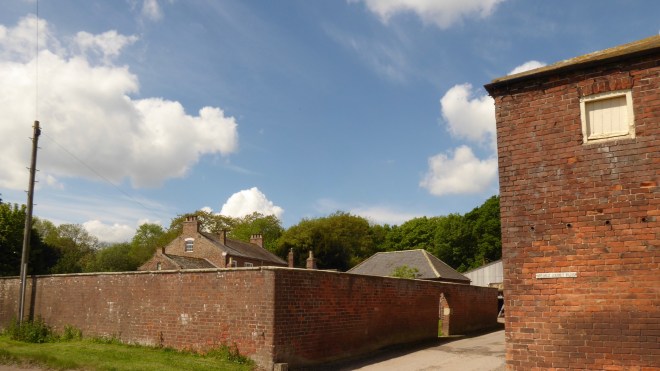
On 11th December 1539, the Abbot and monks of Meaux Abbey were pensioned off when the monastery was dissolved. The abbot retired to Skerne, and some of monks took up posts as curates in Welwick, Keyingham and Beeford. photo shows farm near the site

On 11th December 1647, priest John Saltmarsh, MA, died. Author, theologian, rector, deacon and Chaplain in the Parliamentary Army during the Civil War. Argued for religious toleration and liberty of conscience. Told Cromwell and Fairfax that God was angry with them for their treatment of the Levellers, and resigned his post with the Army. (b Saltmarsh date?)

On 11th December 1915, former Reckitt’s employee Private Edgar Winson was killed in action, serving with 10thBtn West Yorkshire Regiment. Born Spurn. No known grave.


December 10th

On 10th December 1621, Thurley Cammiskish, servant at Londesborough House, was given £10 p.a. for life when he left the employ of the Earl of Cumberland; this may have been more than he earned, but he would no longer receive board, lodgings, clothing and perks of the job.

On 10th December 1889, James Reckitt public library (which bears the name of its founder and donor), opened – Hull’s first free library.  Reckitt donated over 8,000 books, and gave the library to Hull Corporation in 1892. The building was designed by Sir Alfred Gelder.

On 10th December 1920, Gerald Thomas was born in Hull. Film director, mainly known for directing 31 Carry On films. (d 9.11.1993)

Carry On


December 9th

On 9th December 1644, Capt John Hotham had a second trial, this time for betraying the trust placed in him as a parliamentary commander. Found guilty and sentenced to beheading on 1stJanuary.

On 9th December 1754, pensioners in Trinity House almshouses were required to attend every Divine Service in the chapel, or lose one week’s pay for every default.

On 9th December 1917, the Spurn lifeboat rescued the crew of the steam ship Florence of Stockton when they ran aground in heavy seas. Coxswain Robert Cross jumped into the sea with a line, and with crewman G. Martin, stood on the sands until all of the crew were safely in the lifeboat. Cross received the RNLI Silver Medal, and Martin received a Monetary Award.

On 9th December 1959, half of the tower of St Martin’s Church, Wharram Percy, collapsed in a storm, 10 years after the last service held in this abandoned village, now probably the subject of more archaeological investigations than any other place in England.

Wharram Percy