January 16th

On 16th January 1518, John Frost of Twing on the Wold (presumably modern Thwing) claimed sanctuary at the church of St John, Beverley, for debt.

On 16th January 1537, John Hallam and about 20 men entered Hull on market day, planning to seize the town and re-start the Pilgrimage of Grace. Hallam was betrayed by a man called Fowberry of Newbald, and arrested.

On 16th January 1642, William Cavendish, Earl of Newcastle, was appointed by King Charles I as the Governor of Hull, but the Parliament’s choice of Hotham prevailed with the support of the Mayor and aldermen.

Pilgr Grace

January 14th

On 14th January 1180, Hawisa, Lord of Holderness, of the county of Aumale in Normandy, with lands in several English counties, the barony of Copeland and the honour of Skipton, and one of the richest women in the country, was married by Henry II to William de Mandeville, Earl of Essex.

On 14th January 1642, Sir John Hotham arrived in Hull to take up the post of Governor, and was refused entry at Beverley Gate by the Mayor, Thomas Raikes. A messenger was sent to Parliament, who ordered the Mayor to accept Hotham and his forces, and to resign his post, or face a charge of high treason.  Hotham was admitted.

john-hotham-1-sized


January 10th

st mary's sculcoates.JPG

On 10th January 1308, Ivo de Etton of Temple Hirst, near Selby, and William de la Fenne from Faxfleet had been preceptors (heads) of local houses of the outlawed Knights Templar order, when they were arrested and imprisoned by Henry II on instructions of Pope Clement V. Also arrested were Richard de Ryston, chaplain, Thomas Tyeth, claviger (or warden), and Roger de Hugunde or Hogyndon, a brother in residence at Faxfleet, and Adam de Crake, claviger, at Temple Hirst.

On 10th January 1511, Richard Elynor of North Cave claimed sanctuary at the church of St John, Beverley, for a felony, but the register does not give any detail of his crime.

On 10th January 1537, Sir Francis Bigod, of Settrington, and John Hallam, of Cawkeld near Watton, met to discuss rekindling the Pilgrimage of Grace, which had ended in December with promises to restore the monasteries and hold a Parliament at York. They planned to seize Hull and Scarborough before they could be fortified.

On 10th January 1646, Stephen Thompson of Humbleton was fined £400 as the owner of Scarborough Castle and a Royalist (a ‘delinquent’) in order to recover his goods which had been sequestered by Parliament.

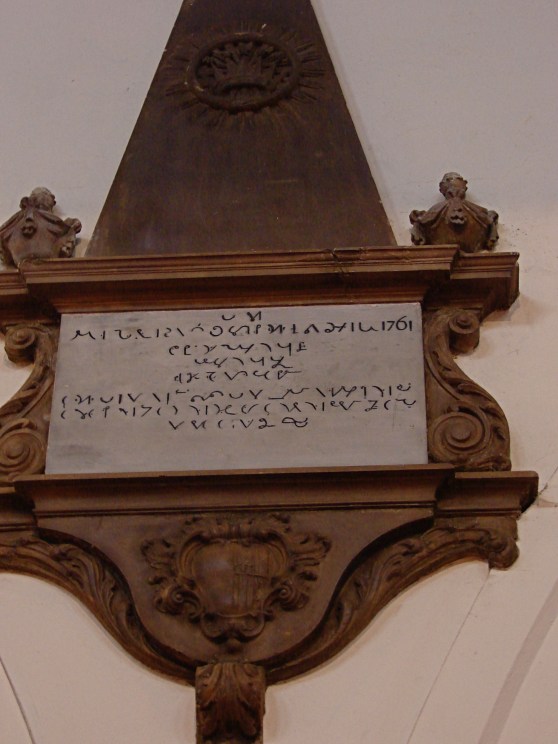
On 10th January 1761, Mrs Jane Delamoth died in Hull. Her memorial in St Mary’s Sculcoates may be the only memorial written in shorthand in the world. It says: ‘In the vault beneath this stone lies the body of Mrs Jane Delamoth, who departed this life 10thJanuary 1761. She was a poor sinner, but not wicked without holiness, departing from good works, and departed in the faith of the Catholic Church, in full assurance of eternal happiness, by the agony and bloody sweat, by the cross and passion, by the precious death and burial, by the glorious resurrection and ascension of Our Lord and Saviour Jesus Christ’. see photo

On 10th January 1783, Rear Admiral John Storr died in Hilston. He is buried in Westminster Abbey. (b 18.8.1709) He commanded the Revenge at the Battle of Quiberon Bay 20.11.1759. His father Joseph built Storr’s Tower at Hilston in 1750. It served as a hospital for troops camped on the coast in 1794–5 and later as a cottage, but was disused in 1990. His memorial is in Hilston church.

On 10th January 1849, Cottingham land agent Thomas Spenceley reported that he had measured the distance from the Spa Inn, Aldbrough to the sea in 1832 and again in 1848 and the loss of land due to coastal erosion was 28 yards in that period. On 6.8.1832 the distance was 160 yards; on 11.8.1848 it was 132 yards, an average loss of 5ft 3” per year.

On 10th January 1952, Madame Clapham (Mrs Emily Clapham) died aged 96, the former Court Dressmaker of Kingston Square, Hull. Her fashions for high society made Hull ‘the rage’ according to Sir Osbert Sitwell.

On 10th January 1968, Hull trawler St Romanus left port and made radio contact with the owners that evening. A Mayday call was heard, but not passed on. The official enquiry concluded ship probably lost on 11thJanuary, reason unknown.

On 10th January 1968, Hull trawler Kingston Peridot of Hull left port and was not contacted until after 26 January. The enquiry concluded she probably capsized on 26th  or 27th January, due to extreme weather.

January 1st

On 1st January 1151, Meaux Abbey was founded on land given by William le Gros, count of Aumale, Lord of Holderness.

On 1st January 1645, Captain John Hotham was executed for treason on Tower Hill, London.

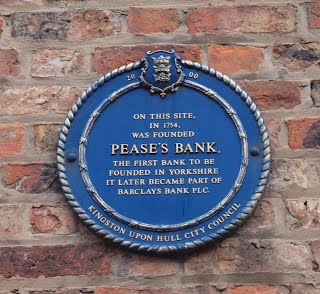
On 1st January 1754, Joseph Pease opened Hull’s (and Yorkshire’s) first commercial bank at 18 High Street, Hull.

pease

On 1st January 1841, Daniel Boyes started a new tradition at The Angel, Beverley, to bake an enormous game pie for customers; it weighed more than 7 stone. In 1844 the pie weighed 10 stone, and was 18” wide, 12” high, and 2’ 2” long.

On 1st January 1904, Dr Francis William Fullerton, GP of Prospect Street, obtained the first driving licence issued in Hull.

On 1st January 1908, the newly created Humber Conservancy Board took over responsibility for Humber lifeboats from Hull Trinity House, which had managed Spurn lifeboat for 97 years; the RNLI took over in 1911.


January 2nd

On 2nd January 1645, Sir John Hotham was executed for treason. He was buried, with his son John, in the Church of All Hallows, Barking. His lands passed to his grandson, aged about 10.

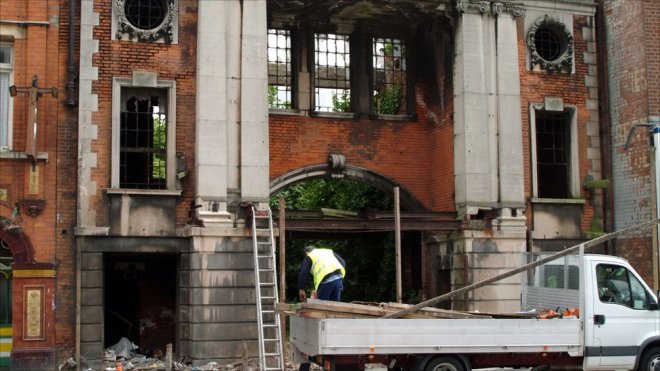
On 2nd January 2007, Historic England listed the former National Picture Theatre on Beverley Road, Hull, Grade II for its special architectural or historic interest. It is believed to be the only civilian WW2 bombed–out building, other than churches, remaining on its site.

nationalpicturetheatre


December 30th

wars-of-the-roses

On 30th December 1460, Richard Hanson, mayor of Hull, died at the battle of Wakefield, in the Wars of the Roses, fighting on the Lancastrian side. image copyright threetwoone.org

On 30th December 1872, David Tong, apprentice blacksmith, was charged at Roos Petty Sessions with absconding from his employer’s service. He had worked for James Blenkin of Roos, blacksmith and machine maker, for 5 years, and his labour was worth £1 per week. Tong made no complaint of any kind against his master, and was ordered by JPs Sir Talbot C. Constable and Rev C.J. Wall to return and pay costs.

December 28th

Beverley Minster


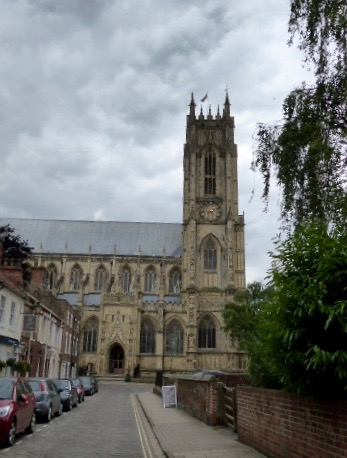
On 28th December 1703, an earthquake was felt in Beverley, and may have worsened the already poor condition of the fabric of the Minster.

On 28th December 1795, the Duke of Portland, Home Secretary,  wrote to the Hull Mayor and other town councils concerning methods to be adopted for reducing the consumption of wheat. There had been several years’ poor harvest, and supply was reduced by war with France. There were  food riots in Hull in August that year.


December 26th

On 26th December 1220, William de Forz II, Count of Aumale and Lord of Holderness was with King Henry III at the Royal court at Oxford; the King made an appointment William hoped to get; disappointed, he left Oxford for Lincolnshire, and began a rebellion, known as the war of Bytham.

On 26th December 1489, George Gusterd, weaver of Bishop Burton, claimed sanctuary at Beverley for the murder of a servant of Edward Barnaby, a gentleman. He did not know the servant’s name.

On 26th December 1495, William Middleton was threatened with a pole-axe by John of Cottingham, John of Wawne, Thomas Warde, Robert Bate, and (- ) Mykill, and was so afraid for his life that he took sanctuary in Wawne church and stayed there for 10 hours, afterwards leaving the area. He applied to the Chancery Court for leave to prosecute his attackers, but the outcome is not recorded.

On 26th December 1645, Rev Nicholas Osgodby was reported to be using the forbidden Prayer Book in secret.

On 26th December 1750, the chapter house roof of Howden church collapsed, to join the rubble of the chancel which had collapsed in 1696.

On 26th December 1890, residents of Hornsea had a fair on the frozen surface of the Mere, and a sheep was roasted on the ice.

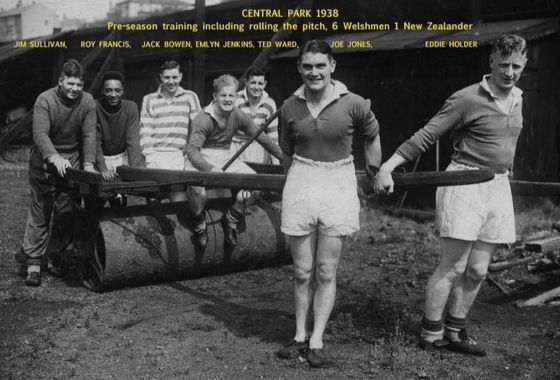
On 26th December 1955, Roy Francis played his last game after 6 years with Hull FC, and became UK’s first black professional sporting coach, and team manager 1971 to 1973.

roy-francis

December 25th

On 25th December 1703, Mrs Frances Maister of Penzance, born in Patrington, she left £10, the interest of which was to be given to the poor of Patrington every Christmas Day.

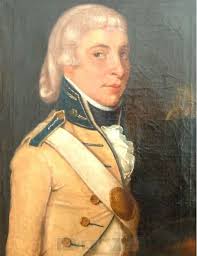
On 25th December 1794, fearing an invasion from France, the Beverley volunteers militia was uniformed and drilled for the first time in Saturday Market. The uniform was probably similar to the image below.

On 25th December 1876, during the rescue of the Grace Darling of Goole, sunk on Middle Bank, River Humber, Spurn lifeboatman Edward Weldrake had to jump into the sea and climb the rigging of the ship, and to prise the captain’s frozen fingers from the rigging. Awarded the RNLI silver medal for bravery.

EY Militia

December 19th

Dame Ann Percy (Percehay)

On 19th December 1511, Ann Percy died in Hessle, the wife of Sir Henry Percy (or Percehay) and mother of 17 children. Although she is not of the Northumberland Percies, the Duke of Northumberland in 1862 arranged for a transcription of the original brass in Hessle Church, presumably under the assumption that she was of his line.

On 19th December 1656, the second of 2 boy twins of Philip Ellerker died at Ellerker, 2 days after the death of the first, at the age of 3 days.

On 19th December 1939, it was reported that of the 1,774 children evacuated from Hull  in September and October, 900 had returned home, during the ‘phoney war’.