February 24th

On 24th February 1814, John Taylor, aged 62, of Soffham Farm, Sutton-on-Hull, was in Chamberlain Road, on his way home from Hull, when he was shot by a man who leapt out from the hedge, robbed him of £30 and ran off. Taylor died a week later, but had identified his assailant as James Forbes, an Irishman. Forbes was tried at York but acquitted despite being identified, for lack of corroborating evidence.

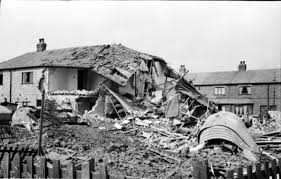
On 24th February 1942, Charles James Kent of Bristol Road, Hull, a foreman in the Rescue Party Service, was awarded the George Medal for gallantry in the rescue of Mrs Crawford (deceased) and Miss Crawford. They were trapped when their house in Eva’s Terrace, De la Pole Avenue, was demolished, and Kent managed to crawl to them and create space for jacks to be used.

On 24th February 1943, Thomas Cooper Kinchin, aged 27, 2ndofficer, of North Ferriby, was lost by enemy action aboard SS Stockport of Grimsby, an Atlantic convoy rescue ship.
Blitz

February 23rd

On 23rd February 1643, Queen Henrietta Maria was woken at 4a.m. in Bridlington Quay by a bombardment of the house by Parliamentary ships; she sheltered in a ditch until the ebb tide moved the ships out of range.

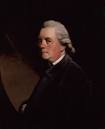
On 23rd February 1724, William Mason was born at Holy Trinity vicarage, Hull. A poet, biographer, composer and garden designer, in 1785 he was  William Pitt the Younger’s  choice as Poet Laureate,  but he refused the post. He is commemorated in Poets’ Corner, Westminster Abbey, and in Hull with a cream plaque. (d 7.4.1797) see picture below

On 23rd February 1830, a report in the Hull Packet said that Revd John Earle’s boarding school at Driffield had been relocated to Watton Abbey, the stately home of the Legard family. It remained there for 10 years, and Earle took on the living at Watton church.

On 23rd February 1919, Company Sgt Major Kelly died of flu in Hull Royal Infirmary. He had been discharged from the East Yorkshires a week before, after serving in WW1 from September 1914. He is buried in Hedon Road cemetery.

Wm Mason

February 20th

On 20th February 1889, ‘Riding the stang’ took place in Hedon, for the 3rdconsecutive night, for a man who beat his wife; a procession sang, shouted, hit pans, banged drums and whistled and finally burned the man’s effigy on Market Hill. Also known as charivari, skimmington, or rough music in other areas.

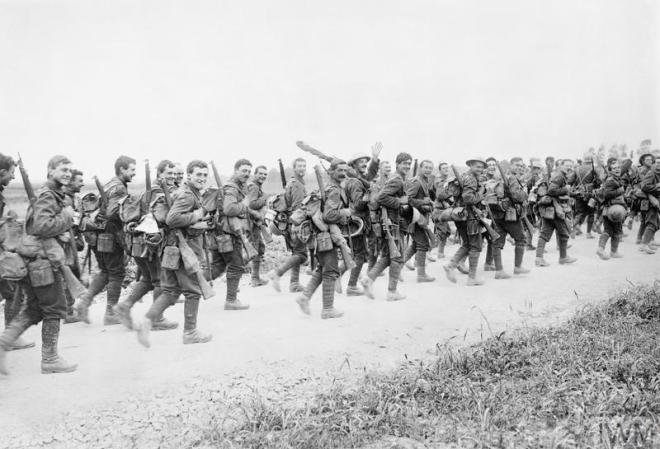
On 20th February 1918, former Reckitt’s employee Private George Charlton, 32, was killed in action on service with 11thEast Yorks (2ndHull Pals). Buried Roclincourt, France. photo (Imperial War Museum) shows some of the Hull PALS.

Hull PALS

February 19th

Pilgr Grace

On 19th February 1408, Henry Percy, 1stEarl of Northumberland, was killed in battle against King Henry IV, after supporting Edmund Mortimer’s claim to the throne. The Percies held lands across Yorkshire, the Lakes and Northumberland, but their main seat appeared to be Leconfield until the 16thC.

On 19th February 1499, William Fechet of Harpham claimed sanctuary at St Cuthbert’s church, Durham, for assaulting William Fox on 22ndOctober, striking him in several places with a sword; he assumed that Fox had died from his wounds, and fled.

On 19th February 1537, Sir Ralph Ellerker, the elder, chased Sir Francis Bigod and his men out of Beverley, and took 62 prisoners, who were taken to Hull. Bigod escaped. This appeared to be the end of the Pilgrimage of Grace in East Yorkshire.

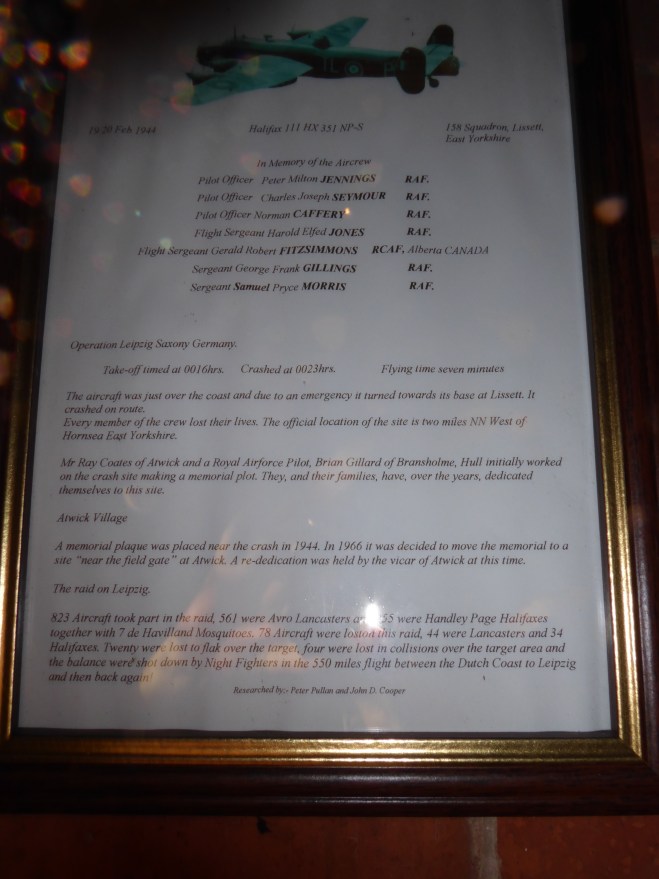
On 19th February 1944, a Halifax bomber crashed 2m NNW of Hornsea shortly after take-off, killing all 7 crew. Photo -notice in Atwick church. Sadly, I was unable to find the memorial.

Atwick Halifax crash

February 15th

On February 15th 1518, Richard Jakson of Hogett on the Wolds (presumably modern Huggate) claimed the sanctuary of St John’s church, Beverley, for debt.

On February 15th 1530, John Gillco, labourer of Painsthorpe, fled to his parish church in Kirby Underdale from York, where he had assaulted and killed John Notyngham at 4p.m. the previous day. A coroner’s inquest the same day reported that the killing took place within the liberty of the monastery of the Blessed Mary.

On February 15th 1793, a contemporary report said a horseman galloped into Hull with urgent news that men had landed near Patrington from a privateer. Nervous of the risk of French invasion, part of the Corps of Invalids stationed at the Citadel and several volunteer seamen were immediately dispatched to meet the enemy. A 2ndmessenger met them on the road near Hedon, and informed them that instead of French enemies, those who had landed were the crews of several colliers, who had left their ships to avoid the press gang. HM Sloop of War, The Queen, was lying at anchor in the Humber.

On February 15th 1898, James Ashton, 39, skipper, of Witty St, Hull, was lost with his crew when trawler European foundered in the North Sea.

press-gang

February 11th

On 11th February 1346, William de la Pole agreed to resume lending money to King Edward III, in return for the return of all his goods that were in the hands of the sheriff. Relations between the king and his banker were precarious, but he remained in favour for the time being…

On 11th February 1657, Thomas Cowlam, labourer, and Jane Millington were married in a private alehouse at Spaldington by Robert Browne, vicar of Eastrington.

On 11th February 1941 at 5.30p.m., an anti-aircraft shell fell in Jalland Street, Hull, with no casualties. The blitz on Hull reached its peak in May that year.

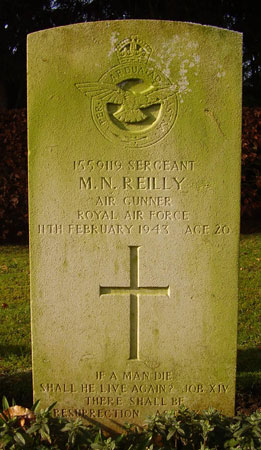
On 11th February 1943, Flt Sgt 785073 Harold E.R. Saunders died with 6 other crew (1 survived) when mechanical problems caused his Halifax bomber to crash near North Dalton, shortly after taking off from Pocklington. 6 of them are buried in Barmby Moor churchyard.

Halifax crash Feb 43


February 4th

On 4th February 1516, John Holme, labourer, of Ottringham, claimed sanctuary at the church of St John ‘for divers felonies’.

On 4th February 1634, William Kitching, 39, of Little Driffield, and 9 other men, were hanged at York for rioting at Hull about corn, for demolishing the dwellinghouse of Edward Cooper, and for stealing clothes. None of those convicted were from Hull.

On 4th February 1783, Hull Trinity House accepted the proposal of Mr Blaydes of Hull to build a yacht for £500; they used the yacht Humber for 23 years.

On 4th February 1809, Ebenezer Bettison and 2 others, of Hull, drowned during a storm when going in a boat to secure a lighter which appeared to be in danger.

On 4th February 1821, Thomas Wilkinson Wallis was born in Hull. The son of a cabinet maker, he became a wood carver. He was a pprenticed to Thos Ward in Waterworks St, Hull, and trained at the Mechanics Institute. His work can be found in the Victoria & Albert Museum, London. photo shows one of his carvings

On 4th February 1900, Sir Leo Schultz (Joseph Leopold Schultz) was born in Hull. He was  the Leader of Hull City Council from 1945-79. Was awarded the OBE in 1946 for war work, including as an air raid warden, and for his campaign to provide all households with a bomb shelter. He was knighted in 1966 for services to local government. Honorary Doctor of Law Hull University 1979. d 1991. photo above

On 4th February 1968, Hull trawler Ross Cleveland capsized and sank with all but 1 of the 20 crew. An enquiry concluded the ship was unable to cope with ice build-up. The wreckage was located in 2002.

St Andrews Dock memorial

February 2nd

On 2nd February 1141, during the Anarchy, William of Aumale, Lord of Holderness and Earl of York led part of the cavalry protecting King Stephen, but were overrun by the Welsh and fled. The King was captured, and Matilda took the throne for a time. William remained loyal to Stephen.

On 2nd February 1786, Revd T.O. Rogers Hull opened the new Trinity House School with 36 pupils.

On 2nd February 1799, Capt Henry Gunter RN was in charge of HMS Nautilus when she was wrecked in a storm Off Flamborough Head; all the crew survived. She was leading a convoy of 22 merchantmen returning from the Baltic; one of the other ships was also wrecked.

On 2nd February 1801, Hull Trinity House paid relief of £1 1s to 4 seamen who had escaped from captivity in Russia.

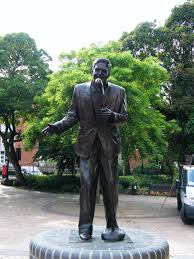
On 2nd February 1925, David Whitfield was born in Hull. A popular singer, he was the first UK male vocalist to earn a gold disc, and the first British artiste to reach No 1 simultaneously in the US and the UK. Commemorated by a statue outside the New Theatre. d 16.1.1980

David Whitfield


February 1st

On 1st February 1639, King Charles I issued an order to enclose Hull and improve its fortifications.

On 1st February 1714, a great wind caused damage in several places, and blew down Richard Stevenson’s house in Kilpin, then the fire in the hearth destroyed the remains.

On 1st February 1884, at the Hull Sanitary Congress, Hull City Hall, Rev Joseph Malet Lambert called for bold action to save hundreds of lives, and improve thousands more, by dealing with dreadful housing conditions, some of them a stone’s throw from the City Hall. The slums were cleared 20 years later.

On 1st February 1893, Hedon Gymnastic Society put on an ‘Assault-at-Arms’, with an appearance by a clown, and followed by a dance in the Board School room, Roos.

On 1st February 1922, Robert Anderson, 26 of 7 Emily Terrace, Gillett St was lost with 9 shipmates when Hull trawler Magneta was wrecked off Murmansk, under Russian arrest.

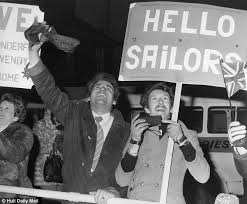
On 1st February 1983, 800 dignitaries, service representatives and families of the Norland crew gathered at the King George Dock Terminal Building, Hull. They were there to greet the return of North Sea Ferries Norland after over 9 months in the Falklands War supporting the troops. Unfortunately, 90 mph winds did not allow the ship to dock, and it rode out the storm in the Humber for several hours , by which time the banquet was over.  Hundreds of people were still there to greet them at the quayside in the evening. The Norland was refurbished and returned to the Rotterdam run on 20thApril.

Norland return