July 19th

On 19th July 1692, Elizabeth Howe, nee Jackson, aged 57,  was hanged for witchcraft at Salem, Massachusetts with 4 other women; at the age of 3, she was among the Puritans who emigrated from Rowley to found Rowley, Massachusetts.

On 19th July 1750, Hull soldier John Hasselbe made a sworn statement to John Wood, Deputy Mayor, that when he was on duty at Beverley Gate between 1.00 and 3.00, his musket went missing, and he suspected it had been stolen and concealed.

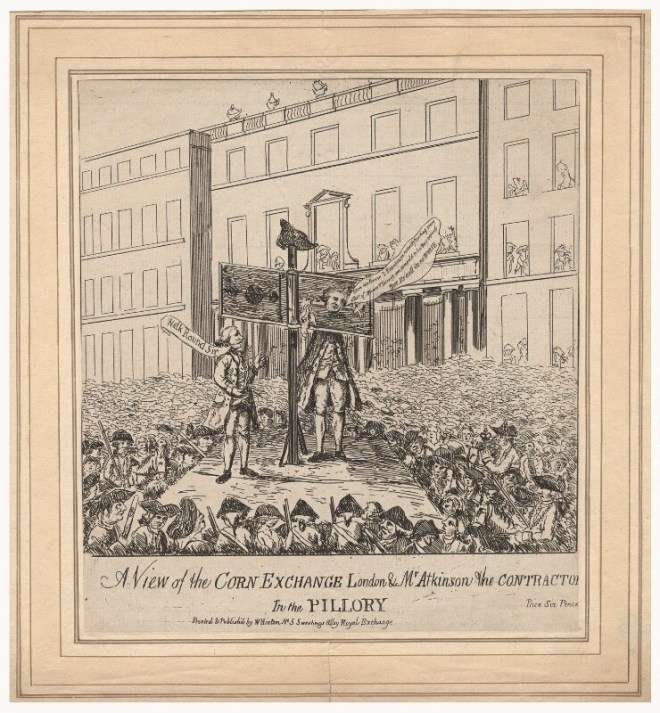
On 19th July 1783, Christopher Atkinson, MP for Hedon & corn factor, was tried in London for perjury, found guilty and committed to prison for 12 months, , first being pilloried at the Corn Exchange, London, and expelled from the House of Commons.  He resigned from his commercial post, but stood again as MP for Hedon in 1796 and 1802 and was elected. He later changed his name to Saville. picture shows Atkinson at the pillory

On 19th July 1786, Hull’s Rev George Lambert visited several sick parishioners, and commented on the contemporary habit of family and friends crowding into the room with the minister, so that the sick person was unable to speak openly.

On 19th July 1794, Edward Bogg, carpenter’s mate,  was shot and killed on board Hull fishing vessel Sarah and Elizabeth Off St Abb’s Head by the crew of a naval press gang on the frigate Aurora; 3 other crew were injured; the coroner’s court returned a verdict of wilful murder by Captain Essington; the captain was sent to the East Indies for several years and never stood trial.

On 19th July 1849, an All England Eleven cricket team played a 30-day match against a Hull amateur side at the Hull Athenaeum Club ground, Anlaby Road. Despite funding from the Hull Sheriff and both MPs, the entrance fee was 1s a day. The professionals won by an innings and 82 runs.

On 19th July 1919, 368 children living at Newland Homes, Cottingham Road, Hull, took part in official peace celebrations included games and setting fire to an effigy of the ex-Kaiser.chrisatkinson MP
July 18th

On 18th July 1509, Lockington labourer Christopher Wylton claimed sanctuary at the church of St John, Beverley, for theft.

On 18th July 1511, Tailor Thomas Mateson, of Stamford Bridge, claimed sanctuary at Beverley for the homicide of John Pott, also of Stamford Bridge, labourer.

On 18th July 1642, the first Hull siege ended after 17 days; as the Royalists withdrew to Beverley, they destroyed the sluice at Hull Bank, causing flooding in Newland, and probably set fire to St Andrew’s Church at Paull.

On 18th July 1833, the work of the Humber Pilots involved more than directing ships into harbour; the day’s work included: relaying 14 buoys; taking carpenters to Bull Float and relaying Transport buoy (at the entrance of the River Hull).

On 18th July 1878, Anthony Bannister JP died at Hessle aged 61; twice Sheriff and twice Mayor of Hull, Vice commodore of the Royal Yorkshire Yacht Club. Promoted the Hull to Withernsea rail line; he is commemorated by a street in Withernsea, by a statue in Hull, and an effigy in Hessle.

On 18th July 1929, Boothferry Bridge opened to traffic across the River Ouse, replacing the ferry which had operated there since the 14thcentury.

On 18th July 1941, Ernest Dean Hodgson of Deepdale Grove, Hull, member of the Rescue Service, was commended for the rescue of Mrs Pounder and her 3 children from a damaged air raid shelter in rustenburg St. For their actions on the same night, John Joseph McHugh of Lilly Grove, and Arthur George Dixon were both awarded the British Empire Medal.  The same raid caused major damage to Reckitt’s Dansom Lane HQ, about 75% of the buildings being destroyed.

On 18th July 1969, Barry Francis, 22, decky learner, was lost overboard from Hull trawler Arctic Vandal off the North Cape.

July 15th

On 15th July 1855, Hull-born John Sheppard, a Boatswain’s mate, attempted single-handedly to blow up a Russian warship at Sebastopol, Crimea, and was awarded the Victoria Cross ‘for valour’.

On 1th July 1868, John Ellerthorpe, the ‘Hero of the Humber’ died aged 62. He had rescued 39 people from drowning and was awarded the Royal Humane Society Silver Medal. Buried in Hull General Cemetery. (b 1806)

On the night of 14/15 July 1943, Bill Shepherd, engineer at Wm Jackson & Son Ltd, Derringham St, Hull, died when the factory was bombed; his colleague Sid Charlton escaped injury, as they dived for cover in opposite directions.


July 14th

On 14th July 1746, William Pulteney, MP for Hedon, Baron Hedon and the Earl of Bath, stepped down when after “48 hours, three quarters, seven minutes, and eleven seconds” he failed to form a government, and is now reckoned to be England’s shortest-serving Prime Minister. photo shows his portrait in Hedon Town Hall.

On 14th July 1873, Hull hosted the Royal Agricultural Show at Newington, on the site of the former race course; the event has been held at Stoneleigh since 1963.

On 14th July 1943, Ernest Wilson of Hutt Street, Air Raid Warden, and Charles Henry Burgess rescued Mr Cherry from his home in Leonard Street, Hull, during an air raid. Wilson was later awarded the British Empire Medal.

On 14th July 2007, (Florence) Eva Crackles, MA, MBE,  died aged 89. Botanist and teacher; Honorary Doctor of Science, Univ of Hull 1991; Fellow of the Linnean Socy; and Honorary Life member Botanical Societyy of Britain & Ireland. Some of her work can be seen on the external wall of the Wilberforce Health Centre, and she is commemorated by a cream plaque. (born 23.1.1918)

Wm Pulteney, Hedon MP

July 11th

On 11th July 1843, Archdeacon Wilberforce preached the last ever sermon in St Faith’s church, Leven, before it was demolished, leaving only the chancel, which was itself demolished in 1882.

On 11th July 1941, Special Constable George Brignall Marshall, aged 54, was killed in Hull by enemy action whilst on duty with East Riding of Yorkshire Constabulary during an air raid. Damage north of Paragon station and a major fire at Blundell Spence factory. 20 other people died, and 46 were seriously injured.

St Faith Leven

July 10th

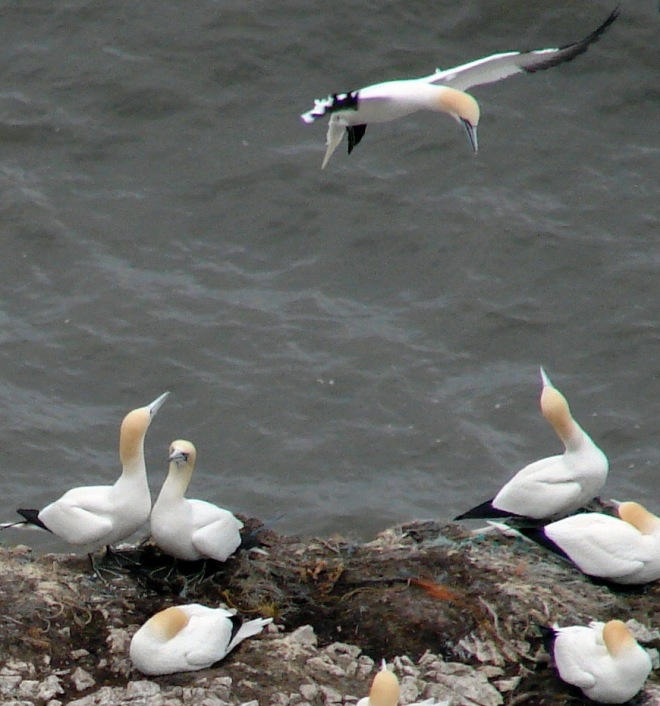
On 10th July 1157, Eustace FitzJohn, Lord of Alnwick, died this day.  He acquired substantial lands in the north, and married into the ER family of de Vescy. Fought on the Scottish side in the Battle of the Standard in 1138. Founded priories in Bridlington, Watton and North Ferriby.

On 10th July 1508, John Tod of Swine claimed sanctuary at the church of St Cuthbert, Durham, for the theft of a horse and 5 marks from chaplain N. Dale, the steward of the Lord of Hastings, and also for debt. As he claimed the theft happened 10 years earlier, presumably the debt concerned him more.

On 10th July 1642, Sir John Meldrum arrived in Hull by boat with 500 Parliamentary troops, and money, to support the town being besieged in the 1st siege of Hull. A further 1,500 troops were sent later.

On 10th July 1869, Mr Tasker of Sheffield was found guilty at Bridlington of shooting 28 protected seabirds, and fined 2s6d for each bird killed, plus 9s costs.

On 10th July 1931, Paul Robeson, singer, actor and political activist,  performed at Bridlington Spa Royal Hall on his first trip to Yorkshire,  receiving several encores; when the Royal Hall re-opened after refurbishment in 1933, he returned to Bridlington.

gannets

July 9th

On 9th July 1905, Robert Skilling, Hull chauffeur,  caused possibly Hornsea’s first motoring offence, when under the influence of drink, he drove at 20mph from Market Place into Newbegin without sounding his horn. About 200 people who had just come out of the parish church, had to scatter.  At Leven Petty Sessions Skilling was fined £3.

On 9th July 1915, Albert Baxter, private, and former Reckitt’s employee, died in action with the East Yorkshire Regiment and is buried in RE Farm Cemetery, Heuvelland.

On 9th July 1952, Henry Saunderson, aged 13, the son of the skipper of the Cape Duner,  was a cadet at the Boulevard Nautical School who joined his father for a pleasure trip during the summer break, and was lost overboard. His father presented a cup in his memory at the school’s prizegiving day.


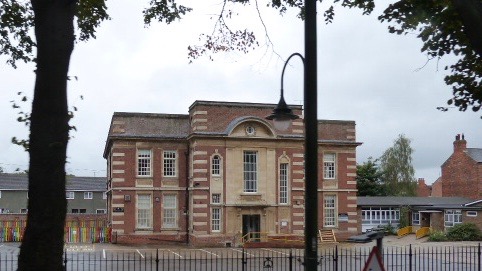
Nautical School Boulevard

July 8th

On 8th July 1497, Thomas Thompson, labourer of Stamford Bridge, claimed sanctuary at the church of St John ‘for the security of his body’. The register does not state why he was in fear for his life.

On 8th July 1642, King Charles I sent a troop of infantry and cavalry to set fire to windmills outside Hull, aiming to starve the besieged town; they were repulsed. John Shawe, Holy Trinity lecturer said this incident incensed many previously uncommitted Hull people and turned them against the Royalists. Charles also issued a proclamation from ‘our court at Beverley’, part of the continuing ‘paper war’.

On 8th July 1840, the 3rd day of a horse racing meet at the George Inn, Aldbrough, offered prizes up to £4, and included a men’s foot race for a hat valued at 10s, and a wrestling match to win a pair of gloves. In later years, the prizes for the horse race included a purse of gold, saddles and bridles.  However, the field where the sports were held may have been lost to the sea.

On 8th July 1940, Mrs Evelyn Cardwell of East Carlton Farm, Aldbrough, arrested and disarmed a German airman who had parachuted from a crashed bomber. She was presented on 1.8 with the British Empire Medal by King George VI at Marine Hotel, Hornsea.


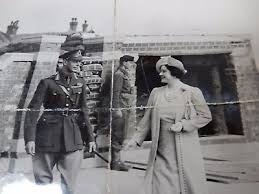
royal visit Hornsea

July 2nd

On 2nd July 1642, the Royalist ship Providence, commissioned by Queen Henrietta Maria, evaded Parliamentary ships by entering Keyingham Creek, which was too narrow for the larger ships, and landed a consignment of arms from Holland for the Royalist army. With help from local people, they unloaded ammunition which was taken to the king at York.

On the same day, the Royalist army secured Hull Bridge, Tickton, on the Beverley side, to prevent attacks from Hull and stop provisions reaching Hull, and evicted constable William Cuthbert and his family at midnight.

On 2nd July 1644, Sir Thomas Metham of Metham near Howden,  died at the Battle of Marston Moor fighting on the Royalist side, captain of the Yorkshire gentlemen volunteers.

On 2nd July 1830, Hull whaler Progress was wrecked in a storm when iced in near the Davis Strait; 19 whalers were wrecked or lost that season, 4 of them from Hull.

On 2nd July 1837, Hull whaler Swan was sighted off Spurn Point as a memorial service was being held in Hull for the crew. They had been away for over a year and had been trapped in ice. 25 of the 48 crew had died.

On 2nd July 1954, Harold Macmillan, Minister of Housing and Local Government, approved the amended Hull Development Plan, regenerating the city after the bomb damage of the war. Hull Georgian Society lamented the loss of buildings such as many on High Street, the whole of Nile Street and houses in Lowgate. Not all of the proposals came about – there was to have been a ‘town park’ open area from Holy Trinity to Princes Dock.


July 1st

On 1st July 1643, cannoneer John Stevenson was buried in St Mary’s Beverley, having died in the town in a ‘great scrimmage’ in the Civil War (possibly the day before).

On 1st July 1801, Hull Subscription Mill Ltd opened to provide cheap flour to the poor of Hull, 3 years or so after the opening of Hull Anti-Mill, one of the first co-operatives in the country.

On 1st July 1830, the Hull whaler Eagle had been stuck in the ice of Baffin Bay for 5 days.   With the help of 200 men from nearby ships, Captain Matthew Wright and crew, were finally able to repair the keel and heave the ship upright again.

On 1st July 1903, Amy Johnson was born in St George’s Road, Hull. She went on to become the first woman to fly solo to Australia, and to break many aviation records. (d5.1.1941)

On 1st July 1918, Hull coroner Colonel Alfred Thorney held inquests on 2 early cases in the flu epidemic: Kate Denman, aged 11, daughter of a labourer of Hodgson Street, and Elsie Barton, aged 9, daughter of a soldier, of Arthur’s Terrace Courtney Street. Both died within 24 hours of being taken ill, of influenza followed by pneumonia.

On 1st July 1940, the first-ever daylight air-raid on the British mainland attacked Saltend oil terminal.  Between 16.40 and 17.00, bombs caused a 2,500-ton tank of oil to explode, and threatened to spread to other tanks. For preventing even greater damage, the following were all awarded the George Medal: Clifford Turner, leading fireman; William Sigsworth, Manager, Anglo-American Oil Co Ltd; George Samuel Sewell, engineer, Shell-Mex & BP Ltd; Jack Owen, fireman; George Archibald Howe, Manager, Shell-Mex & BP Ltd. No loss of life.

On 1st July 1976, Withernsea Lighthouse ceased operating, after 82 years, having been superseded by modern navigational aids. It is now open to the public as a museum to Kay Kendall, to local history and the lifeboat service.Withernsea