March 12th

On 12th March 1511, Elizabeth Nelson, spinster of Pollington, claimed sanctuary at the church of St John, Beverley, for felony and murder of an infant (possibly her own child) at Hull.

On 12th March 1553, on the surrender to King Edward VI of the castle and fortifications at Hull, the King granted to Ralph Constable former monastery lands in Swine, Newton Grange, and all the extensive lands formerly belonging to the dissolved Hospital of St Sepulchre, Hedon. He was also the tenant of the site of Hull Charterhouse.

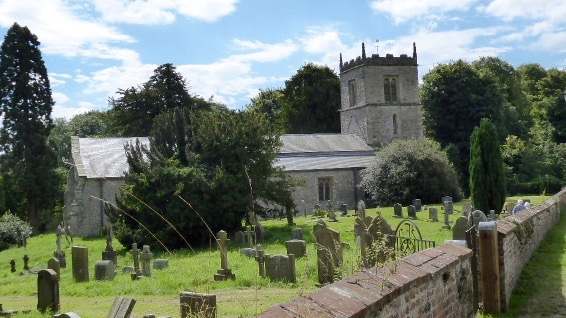
On 12th March 1622, Josias Lambert, schoolmaster, left the employment of Francis Clifford, Earl of Cumberland, after 9 months teaching ‘scholars’, which may have included some of the Londesborough House household staff and/or their children. The Earl also supported the village school at (Market) Weighton. photo shows Londesborough church

On 12th March 1647, Sir Matthew Boynton died at Bainton aged 56. Sheriff of Yorkshire twice, MP twice (once for Hedon and once for Scarborough), 1stBaronet, of Barmston. He helped capture Sir John Hotham when he intended to surrender Hull to the Royalists. His son Colonel Matthew Boynton was killed fighting for the Royalists in the Battle of Wigan Lane in 1651. (bapt 26.1.1591)

On 12th March 1697, the Brethren of Hull Trinity House charged almost £21 for the launch of the 60-gun Royal Navy ship HMS Kingston from Hessle. Work included laying buoys from the launching site to Hull.
Londesborough

March 8th

On 8th March 1517, Thomas Tode, cutler, of Beverley, claimed sanctuary at the church of St John, Beverley, for theft.

On 8th March 1517, Thomas Stokell, 19, boatsteerer on the Hull whaler Three Brothers, received a certificate of protection from impressment, certifying that he was a seaman having completed 3 voyages in the Greenland Trade and could not by law be pressed into the Navy.

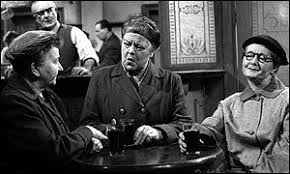
On 8th March 1897, Kathleen Mary Margaret Bryant was born in Hull. As actor Margot Bryant, she played many parts on stage and screen, but won fame at the age of 63 in the role of Minnie Caldwell on Coronation Street (on left in photo). died 1.1.88

On 8th March 1939, George H. Newton, 2ndengineer, and 8 other crewmen, were lost when the returning Hull trawler Lady Jeanette grounded on a sandbank on her way into dock.

Margot Bryant

March 5th

On 5th March 1514, John Taillour of Beverley claimed sanctuary at the church of St John, Beverley, for ‘the security of his body’, but the register does not state who was threatening him, or why.

On 5th March 1642, Queen Henrietta Maria stopped one night at the Manor House, Burton Fleming. She was still on her way to York to join her husband, Charles I, with arms from Holland. She is then said to have stayed 2 weeks at Boynton with the Stricklands. Luckily, Sir William, Parliamentary MP for Hedon, was away in London.

On 5th March 1646, Hull merchant Leonard Scott was fined £74 10s as a member of the Royalist army (a ‘delinquent’) in order to recover his goods which had been sequestered by Parliament.

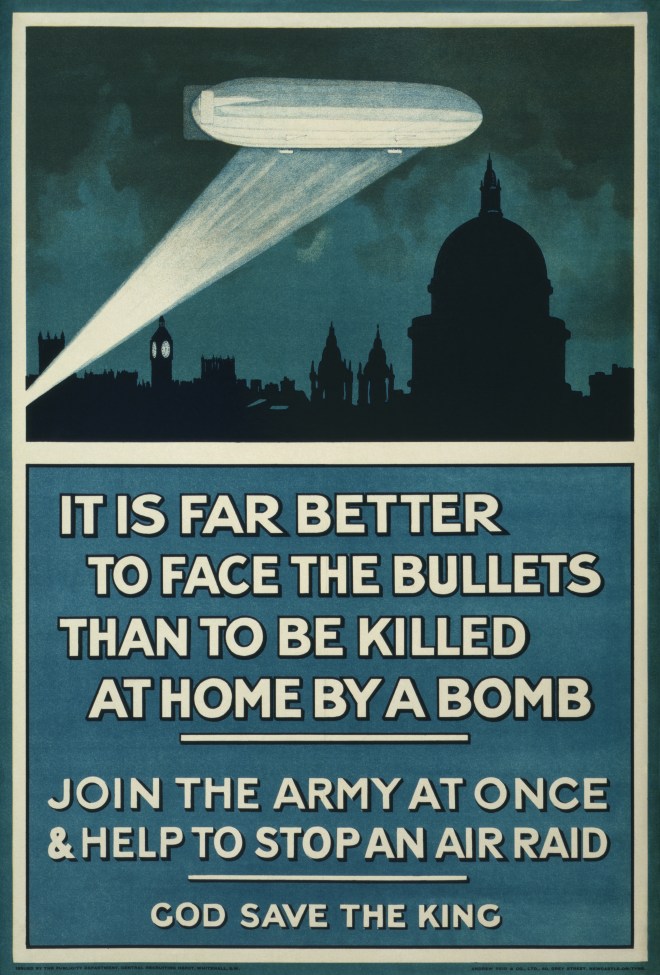
On 5th March 1916, Martha, Ethel and Mira Ingamells of Linnaeus St, Hull, were among the 18 people who died in the 2ndZeppelin raid on Hull; 60 people were injured. Queen Street was hit, as were Linnaeus St., Porter St., Church St and Selby St, and Earle’s shipyard. A mob afterwards smashed up a vehicle belonging to the Royal Flying Corps, presumably in anger at their failure to defend the town, resulting in hasty installation of 7 guns, and the general strengthening of defences around the Humber. Bombs were also dropped on Gembling and Woodmansey.

WWI Zeppelin

February 19th

Pilgr Grace

On 19th February 1408, Henry Percy, 1stEarl of Northumberland, was killed in battle against King Henry IV, after supporting Edmund Mortimer’s claim to the throne. The Percies held lands across Yorkshire, the Lakes and Northumberland, but their main seat appeared to be Leconfield until the 16thC.

On 19th February 1499, William Fechet of Harpham claimed sanctuary at St Cuthbert’s church, Durham, for assaulting William Fox on 22ndOctober, striking him in several places with a sword; he assumed that Fox had died from his wounds, and fled.

On 19th February 1537, Sir Ralph Ellerker, the elder, chased Sir Francis Bigod and his men out of Beverley, and took 62 prisoners, who were taken to Hull. Bigod escaped. This appeared to be the end of the Pilgrimage of Grace in East Yorkshire.

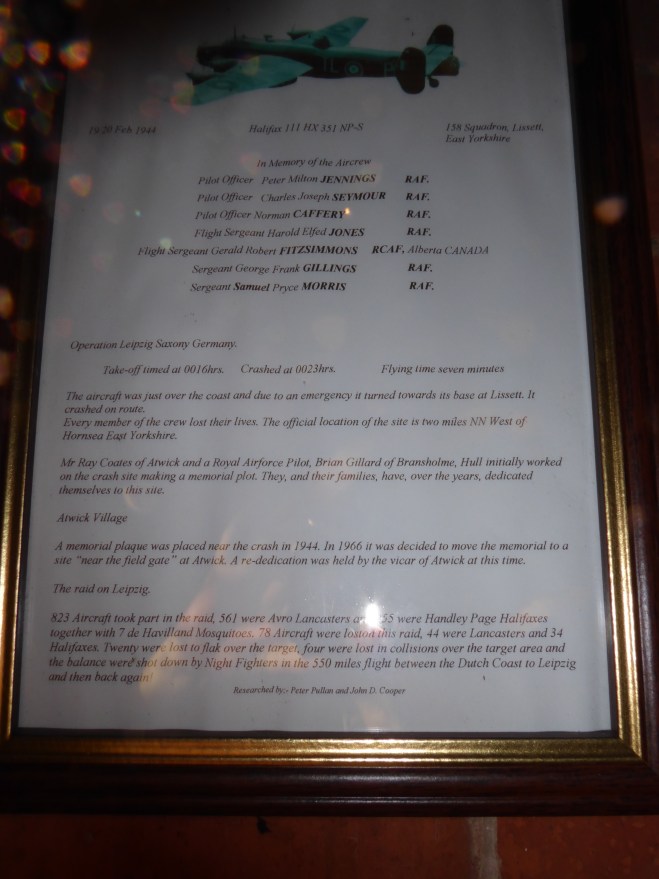
On 19th February 1944, a Halifax bomber crashed 2m NNW of Hornsea shortly after take-off, killing all 7 crew. Photo -notice in Atwick church. Sadly, I was unable to find the memorial.

Atwick Halifax crash

February 15th

On February 15th 1518, Richard Jakson of Hogett on the Wolds (presumably modern Huggate) claimed the sanctuary of St John’s church, Beverley, for debt.

On February 15th 1530, John Gillco, labourer of Painsthorpe, fled to his parish church in Kirby Underdale from York, where he had assaulted and killed John Notyngham at 4p.m. the previous day. A coroner’s inquest the same day reported that the killing took place within the liberty of the monastery of the Blessed Mary.

On February 15th 1793, a contemporary report said a horseman galloped into Hull with urgent news that men had landed near Patrington from a privateer. Nervous of the risk of French invasion, part of the Corps of Invalids stationed at the Citadel and several volunteer seamen were immediately dispatched to meet the enemy. A 2ndmessenger met them on the road near Hedon, and informed them that instead of French enemies, those who had landed were the crews of several colliers, who had left their ships to avoid the press gang. HM Sloop of War, The Queen, was lying at anchor in the Humber.

On February 15th 1898, James Ashton, 39, skipper, of Witty St, Hull, was lost with his crew when trawler European foundered in the North Sea.

press-gang

February 12th

On 12th February 1519, tailor William Bowman of Sewerby claimed anctuary in Flambrough parish church after assaulting William Johnson. At a coroner’s inquest at Bridlington 2 days later, the jurors reported that Bowman assaulted and killed Johnson with a staff on the king’s road between Sewerby and Bridlington, then fled to ‘Flaynburgh’. The King’s Bench declared Bowman an outlaw on 27.12.1519.

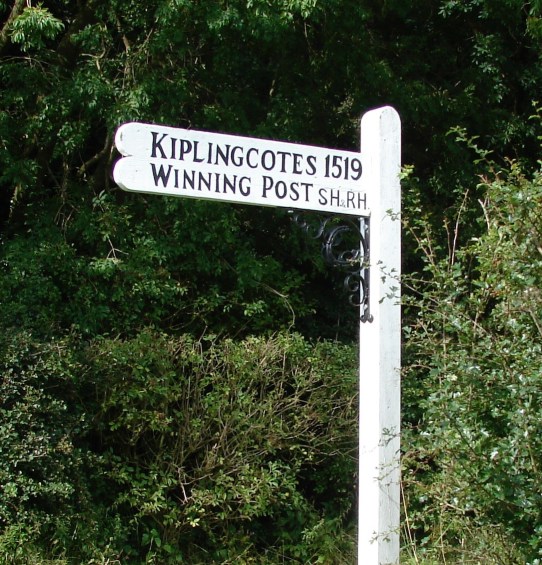
On 12th February 1556, in evidence given in court at York, Thomas Carter of Helperthorpe, 40, herdsman, made the first recorded reference to England’s oldest horse race, Kiplingcotes Derby.

On 12th February 1644, Sir William Constable of Flamborough led Parliamentary troops to capture the Royalist garrison at Bridlington, and took 159 prisoners. On their way back to Hull, they won a skirmish against the Royalists at Driffield.

On 12th February 1687, John Johnson, Rector of Cherry Burton recorded in his diary an earthquake at 3.45 on a Sunday afternoon.

Kiplingcotes

February 7th

On 7th February 1518, Hull weaver John Watson claimed the sanctuary of St John’s church, Beverley, for debt.

On 7th February 1519, John Gilson, a gentleman of Garton claimed the sanctuary of St John’s church, Beverley, for debt. It is not known whether this was Garton on the Wolds or Garton in Holderness.

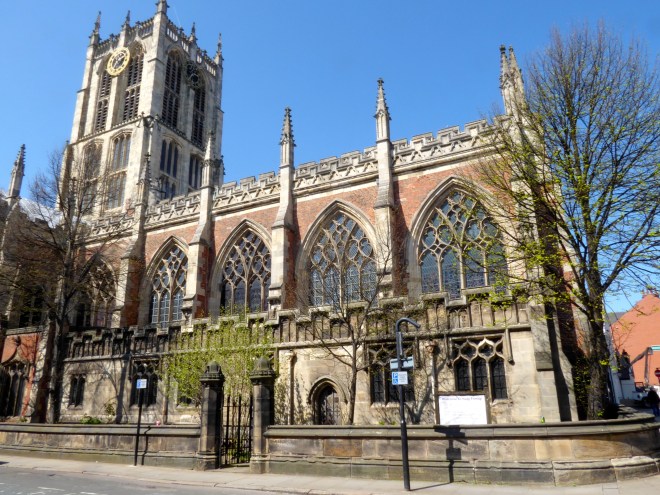
On 7th February 1651, the Mayor of Hull wrote to the Sheriff Thomas Raikes concerning the partitioning of Holy Trinity church to allow soldiers to be billeted there, whilst services could continue in part of the church.

On 7th February 1799, Lutheran Pastor Triebner came to Hull to preach to the Germans employed in the two Sugar Houses in Drypool.

Holy Trinity

February 4th

On 4th February 1516, John Holme, labourer, of Ottringham, claimed sanctuary at the church of St John ‘for divers felonies’.

On 4th February 1634, William Kitching, 39, of Little Driffield, and 9 other men, were hanged at York for rioting at Hull about corn, for demolishing the dwellinghouse of Edward Cooper, and for stealing clothes. None of those convicted were from Hull.

On 4th February 1783, Hull Trinity House accepted the proposal of Mr Blaydes of Hull to build a yacht for £500; they used the yacht Humber for 23 years.

On 4th February 1809, Ebenezer Bettison and 2 others, of Hull, drowned during a storm when going in a boat to secure a lighter which appeared to be in danger.

On 4th February 1821, Thomas Wilkinson Wallis was born in Hull. The son of a cabinet maker, he became a wood carver. He was a pprenticed to Thos Ward in Waterworks St, Hull, and trained at the Mechanics Institute. His work can be found in the Victoria & Albert Museum, London. photo shows one of his carvings

On 4th February 1900, Sir Leo Schultz (Joseph Leopold Schultz) was born in Hull. He was  the Leader of Hull City Council from 1945-79. Was awarded the OBE in 1946 for war work, including as an air raid warden, and for his campaign to provide all households with a bomb shelter. He was knighted in 1966 for services to local government. Honorary Doctor of Law Hull University 1979. d 1991. photo above

On 4th February 1968, Hull trawler Ross Cleveland capsized and sank with all but 1 of the 20 crew. An enquiry concluded the ship was unable to cope with ice build-up. The wreckage was located in 2002.

St Andrews Dock memorial

January 30th

Mary Ward

On 30th January 1499, Robert Colstone of Hull and Marmaduke Pateson of  Flambrough claimed sanctuary at the church of St John, Beverley – Colstone for debt and Pateson for the murder at Flambrough of John Mottows.

On 30th January 1645, Mary Ward died aged 60. A cousin of the Wright brothers of Welwick, she spent 5 years living there with her grandmother and spent a further 6 years at Osgodby. She founded the Institute of the Blessed Virgin Mary and championed women’s education. She was declared Venerable in 2009. (b23.1.1585 Mulwith Yorks) see photo

On 30th January 1901, Beverley Mayor Elwell proclaimed the accession of King Edward VII to a large crowd at the Market Cross, despite bitterly cold weather and a snow storm.

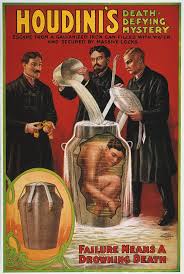
On 30th January 1913, Harry Houdini, escapologist, performed at the Palace Theatre, Hull. He escaped from a canvas sea bag and straps; the challenge was signed by seamen Dan Morris, Tom Carr and Robert Mason.

On 30th January 1983, Captain Derek Wharton of North Sea Ferry Norland spent the day sailing back and forth in Bridlington Bay, having arrived back from service in the Falklands War a little too early for the homecoming celebration planned for 1stFebruary.

Houdini copy


January 29th

On 29th January 1505, Richard Naperton, labourer, of Goodmanham, claimed sanctuary at the church of St John, Beverley, for debt.

On 29th January 1885, William Barlow, 15, cook, was lost overboard from Hull trawler Only Son in the North Sea.

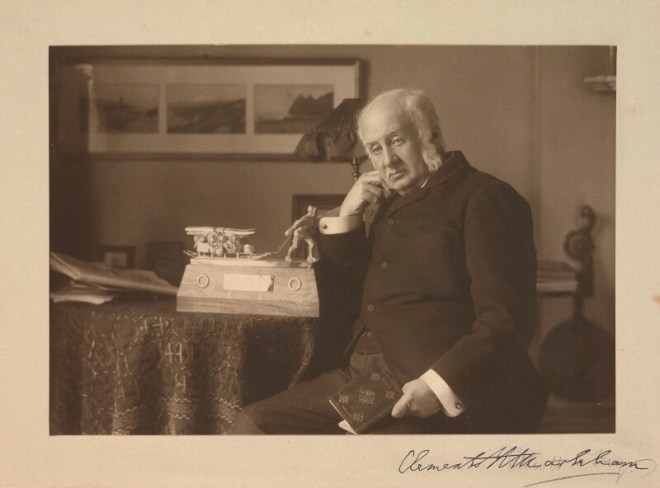
On 29th January 1916, Sir Clements Robert Markham KCB, FRS of Stillingfleet died aged 85. Born in Stillingfleet, he became a Navy officer, explorer and geographer, Secretary of the Royal Geographical Society, organiser of Scott’s 1901-4 National Antarctic Expedition, author, and organiser of the 1860 expedition to collect cinchona for quinine.

sir clemts markham