August 22nd

On 22nd August, 1138, William le Gros, Earl of Albemarle and Lord of Holderness, was made Earl of York, in recognition of his prowess in the Battle of the Standard at Cowton Moor, Northallerton. The 4 standards of St John of Beverley, St Peter of York, St Cuthbert of Durham, and St Wilfred of Ripon, were used as a rallying point for the English against the Scots. The East Riding contingent included a Percy and a de Stuteville. (and see 20.8)

On 22nd August 1572, Thomas Percy, 7thEarl of Northumberland, was executed at York for treason, as leader of the Rising of the North. He was offered mercy if he renounced Catholicism, and refused.  Beatified by the Catholic church. (b 1528, probably in  Leconfield)

On 22nd August 1711, James Rand left £160 in his will for ‘the poor and needful of Preston’. Rands Estate in the village is named for him.

On 22nd August 1917, a bomb from a German Zeppelin destroyed the Primitive Methodist chapel, Baxtergate, Hedon.

On 22nd August 1918, Alfred Buchanan Cheetham of Bean Street, Hull, was killed when the SS Prunelle was torpedoed in the North Sea by a German U-boat. He took part in 3 Polar expeditions, and spent a total of 6 years in the Antarctic, with both Scott and Shackleton. Awarded the Silver Polar Medal clasp, he claimed to have crossed the Antarctic Circle 14 times. Cape Cheetham is named for him. (b 6.5.1867 Liverpool)

On 22nd August 1925, Robin Skelton died aged 72 in victoria, Canada. Poet, literary editor, professor and author of books on wicca. Born in Easington 12.10.1925

 

robin skelton

August 3rd

On 3rd August 1349, John de Preston was elected Prior of North Ferriby on the death of John de Beverley, himself elected Prior just 10 days earlier on 24thJuly, when he succeeded the previous Prior Walter de Hessell on his death. This outbreak of the Black Death killed 35 out of 95 parish priests in East Yorkshire, and presumably a similar proportion of the general population.

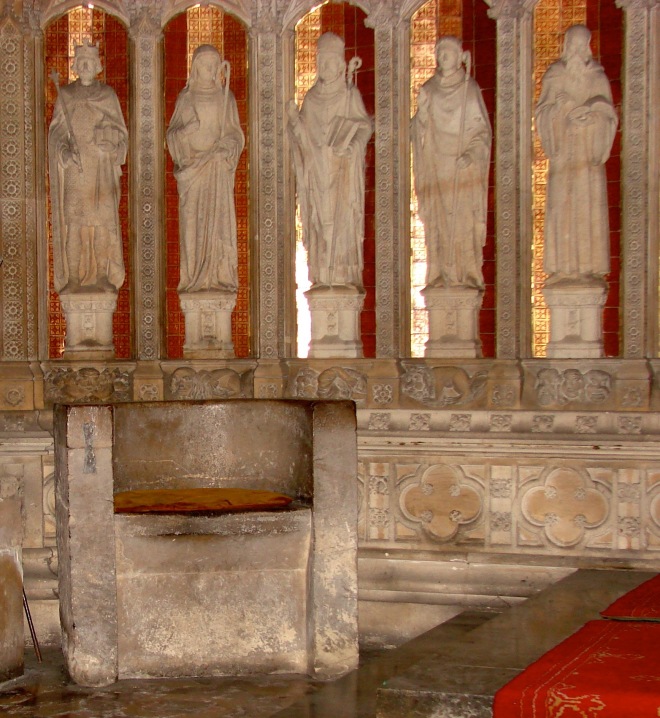
On 3rd August 1523, Thomas Senexer, yeoman, of Holme on Spalding Moor, claimed sanctuary at the church of St John, Beverley, for debt. photo shows the Frith Stool (sanctuary chair)

On 3rd August 1732, Robert Cook was killed when he fell from a wagon at one of the chalk pits in Hutton.

On 3rd August 1798, Press Gang seamen John Sykes and John Burnock or Burnick were killed when attempting to press the crew of the returning whaler Blenheim (& see 2.8). The fight was watched by crowds on the dockside. Capt Mitchinson was charged with murder (& see 31.3) The navy men were buried in Drypool Cemetery.

On 3rd August 1878, for 1d working people could attend a lecture on ‘The Yorkshire Wolds in Prehistory’ as part of Hull Literary and Philosophical Society’s new series of lectures to the working classes in the Exchange Building, aimed at keeping working people occupied during the new Saturday half holiday.

On 3rd August 1942, Mrs Frances Snowden, Lieut Stanley Lawrence and Charles Cross were killed when 4 bombs were dropped on Flemingate, Beverley, damaging Hodgson’s Tannery and destroying a house, a medical centre and a warden’s post. 15 people were injured, some of them machine-gunned by the German bomber.

minster - frith stool.JPG

July 30th

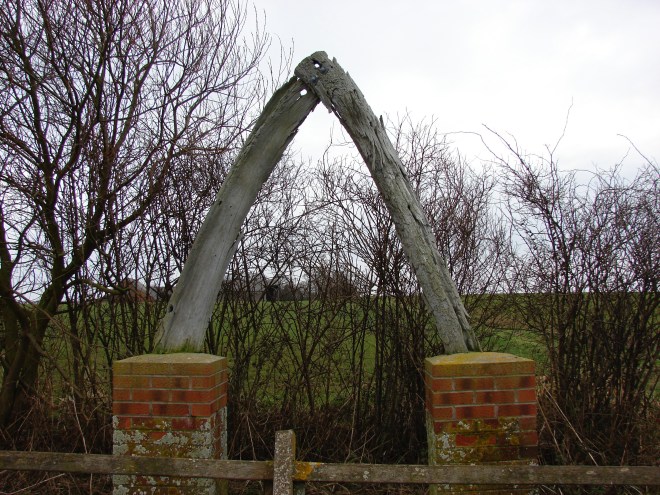
whalebone arch Pat.JPG

On 30th July  1526, Preston butcher John Erdy claimed sanctuary at the church of St John, Beverley, for felony and debt.

On 30th July 1643, the parish clerk of St Mary’s, Beverley, reported in the parish register that they buried 13 men killed on the King’s side in the Civil War.

On 30th July 1782, the crew of Hull whaler Benjamin landed 135 butts of blubber and over 2 tons of whalebone, the product of 3 whales caught in the Davis Strait. (Rev George Lambert had shares in the ship). photo shows whalebone arch outside Patrington

On 30th July 1861, John Ellerthorpe, aged 55, rescued John Eaby, who had fallen into the Humber Dock Basin, Hull. This was Ellerthorpe’s 39thand last rescue. Named ‘The Hero of the Humber’, he was awarded with the Royal Humane Society’s Silver Medal.

On 30th July 1891, Mary Jane Langley, 18 years, of Westfield Farm, Long Lane (now Neat Marsh Road) Preston, was last seen alive when she walked to Marfleet and took the train to Hull to have her photo taken. Her body was found in a ditch near her home. Her throat had been cut. John Rennard was arrested and tried, but not convicted.


July 7th

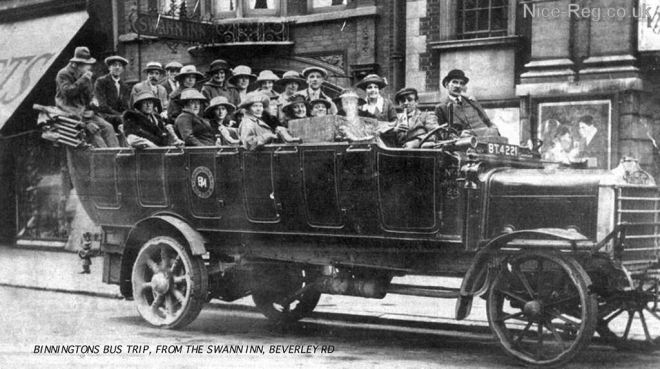
charabanc

On 7th July 1626, the Council in the North ordered Hull Corporation to fortify the town against threat from the Spanish.

On 7th July 1643, the Mayor and Aldermen of Hull  wrote to William Lenthall, Speaker of the House of Commons, to say that after suffering the tyrannical government of the town by Sir John Hotham,  (arrested the week before) they wished to have Lord Ferdinando Fairfax remain in the town as governor.

On 7th July 1788, George Wether(h)ill, butcher, of Hull, aged 80, died aged 80, killed by a bull’s leg. He is buried in Preston.

On 7th July 1928, the staff of Woolworths Ltd (Hull branch) went on their staff outing to Aldbrough by Binnington’s saloon buses. I hope someone had cut steps to the beach. (see yesterday’s item).


July 5th

On 5th July 1532, Henry VIII’s charter was read out in Hull Market Place, and prohibited anyone but Hull burgesses from conducting business in the port; the corporation paid £31 19s4d to obtain the charter, part of which was paid in the form of a sturgeon for Thomas Cromwell.

On 5th July 1657, a major fire in Hedon starting at 1 a.m. resulted in the loss of 42 houses, and others damaged. In August, the Mayor petitioned Parliament for permission to hold a collection to raise money; £4,000 was raised.

On 5th July 1776, John Wesley paid a visit to Howden and preached to a large congregation during a thunderstorm near Station Road, Howden. Wesley’s picture below

On 5th July 1811, Bridlington Collector of Customs Benjamin Milne discovered a tidal spring near the quay, now commemorated by a stone inscription.

On 5th July 1899, Hull Alderman Larard took the controls of the city’s first municipal electric tram (Siemens Bros & Co provided the electrical equipment). A spectator hoping for a good view, climbed on the roof of the public lavatories and fell through.

On 5th July 1930, the annual King’s Cup Air Race took place on this date, and planes had to follow a route of around 800 miles. Hull Aerodrome was a main control station on the route. Tickets were sold for 1s and 2s6d. The winner was Miss Winifred Brown in an Avro Avian III. (N.B. Hull Aerodrome is actually in Preston South.)


john wesley