November 2nd

On 2nd November 1304, Lord Walter de Fauconberg, first Baron Fauconberg, of Rise, died aged about 80 at Rise (or Withernwick) and was buried at Nunkeeling. He had a long military career, and supported Simon de Montfort in his rebellion against King Henry III, for which he lost his lands for several years to Robert Bruce, but redeemed them in 1268.  Married Agnes de Brus.

On 2nd November 1595, John Thorgey left 5s per year for ever, to be distributed by Patrington church wardens to the poor. photo shows Patrington church

On 2nd November 1988, one of the worst industrial fires in Hull killed employee Jennifer Powley, 17, and left Janine Gilfillan with serious burns when a fire led to explosions and evacuation of nearby houses.

Pat church

November 1st

On 1st November 1151, Adam, a monk from Fountains Abbey, is reported to have led a colony from the older abbey to found the new house of Meaux Abbey.

On 1st November 1831, the Scholfield and Clough Bank was the first bank in Howden declared bankrupt after 14 years. Partner Barnard Clarkson had to sell estates in Kirkham Abbey, Holme on Spalding Moor and Foggathorpe.

On 1st November 1834, Beverley youths lit a bonfire early, rolled lit tar barrels and threw fireballs into shops in Beverley marketplace.

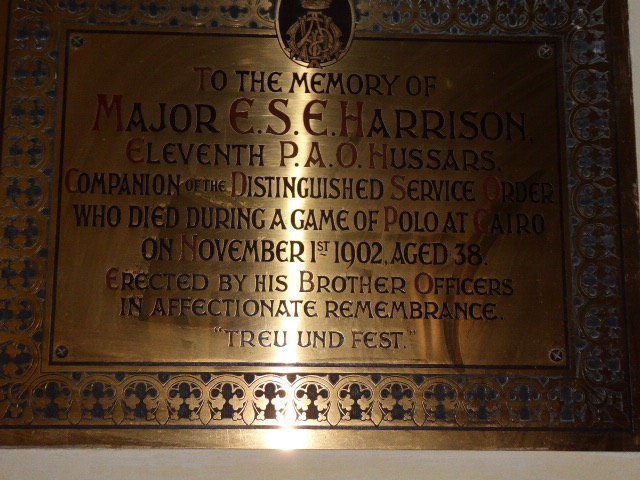
On 1st November 1902, Major E.S.E. Harrison, aged 38, Adjutant, 11thHussars (of the Broadley Harrison family of Welton House) died from a fall during a polo match at Ghezireh, Egypt. He served with distinction in the Boer War (DSO) and bequeathed to the Regiment the Bhurtpoor Sword, now in the Royal Hussars Museum, Winchester.

Major ESE Harrison

October 31st

On 31st October 1640, the gentry of Cottingham, Swanland and other villages petitioned Sir John Conyers to remove his regiment to other quarters, as they were eating up all their cattle fodder and supplies, and many other ‘insupportable damages and dangers’. Many troops had already been removed from Hull into the surrounding villages for similar reasons. The petition was not successful, although the troops did look for other quarters.

On 31st October 1646, Sir Robert Hildyard of Patrington was fined £610 as a Royalist (delinquent) in order to recover his goods which had been sequestered by Parliament. He was a member of the King’s Privy Council.

On the same day, Michael Wharton of Beverley was fined £1,600 for the same reason. He had been a captain in the Royalist army.

On 31st October 1793, John Woodhead, mason, was killed at work on the building site of the Neptune Inn, Whitefriargate. Hull Trinity House gave his widow a gratuity of £5 5s.

On 31st October 1833, the Humber pilots’ work for that day included taking men from Trinity House to relay the Bull buoy.

On 31st October 1929, George Jackson Bentham died suddenly, while boarding a train home, in the company of a young lady not his wife. Hull city councillor, JP, and MP for Gainsborough, he was the son of the founder of Wm Jackson & Son, and the company’s managing director. He changed his name by deed poll to that of his Liberal hero, Jeremy Bentham.


Pilot Office

October 25th

On 25th October 1037, Aelfric, Archbishop of York, placed the relics of the recently canonised St John of Beverley in a new shrine of gold and silver, ornamented with precious stones in the Collegiate Church of St John the Evangelist, Beverley.

On 25th October 1415, Michael de la Pole, 3rdEarl of Suffolk, died in battle, with 2 of his brothers. His brother William succeeded as Earl.

On 25th October 1841, Private Stephen Bennington, of Lockington, 20, batman to vet surgeon John Gloag, rode into the Russian guns at the Charge of the Light Brigade, Balaclava, and survived.  He was awarded the Crimea Medal with clasps. Also served at Inkerman and Sebastopol and was discharged from the service in 1859 with long service and good conduct medals. Gloag did not take part in the charge.

Light Brigade


October 18th

On 18th October it was the tradition, on St Luke’s Day, to appoint an official dog-whipper to keep dogs out of church, and to whip any dogs found in the streets; the tradition is said to have begun when a dog ate a consecrated wafer in York Minster.

On 18th October 1654, The Petition of the Three Colonels or The Humble Petition of Several Colonels of the Army was published, authored by Alured, John Okey and Thos Saunders. Colonel Matthew Alured, brother of Hedon MP John Alured, lost his commission, and was imprisoned for a year for stirring up dissatisfaction with Parliament among English troops in Ireland.

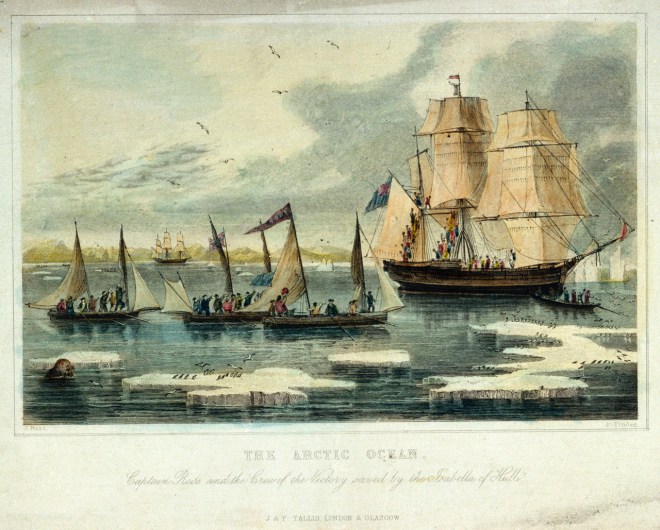
On 18th October 1833, Capt John Ross was granted the Freedom of the Town of Hull. Having returned to Hull on expedition to find the lost Isabella, was then himself thought lost.  (He was also granted the freedoms of London, Liverpool, Bristol and Wicklow)

On 18th October 1850, the Hull Advertiser reported that the ring leaders of a riot which resulted in the deaths of 4 Irish labourers on Sunk Island in July were found guilty of riot and sentenced to 4 months each with hard labour.They were: Robert Smith, John Londsbro, George Bellamy, John Dent, George Bielby and Fewson Towse.


John_Ross_rescued_by_Isabella,_1833

October 17th

On 17th October 1285, Richard son of Walter le Pessoner, clerk, while sick and delirious in the hospital in Beverley, killed Brother Walter, his ‘dear master’; the jury declared death by misadventure, and imprisoned Richard indefinitely.

On 17th October 1917, former Reckitt’s employee Private Frederick Bartholomew Coupland, 29, was killed in service with the Royal Army Medical Corps, whilst bandaging a comrade’s wounds. Buried at Langemark, Belgium. photo shows Services Memorial, East Park.

Services memorial, E Pk

October 15th

On 15th October 1536, Hull besieged by troops of local men, from of Holderness, Cottingham, Beverley and Hullshire supporting the Pilgrimage of Grace.  William Stapleton reported he had trouble restraining the Beverley men under his command from setting fire to shipping in Hull haven. He sentenced 2 ‘unmanageable’ followers to death, but reprieved both after inflicting one with the punishment of being towed behind a boat by a rope attached to his waist.

Pilgr Grace

October 12th

On 12th October 1536, 9,000 armed men from across East Yorkshire mustered on Market Weighton Hill as part of the Pilgrimage of Grace. Robert Aske led one group to York via Pocklington, and William Stapleton led a march on Hull, besieged it and captured it for the rebels. Holderness gentry Sir John Constable, Sir Wm Constable and Sir Ralph Ellerker had taken refuge in the town from the revolt.

On 12th October 1643, the Earl of Newcastle abandoned the 2ndsiege of Hull after 5 weeks and withdrew Royalist forces to York. To prevent pursuit, the Royalists destroyed bridges and roads and cut the banks of waterways as they retreated. The date was observed as a day of public thanksgiving in Hull until the Restoration.

On 12th October 1697, Robert Pattinson, Humber pilot, was fined 30shillings for damaging the ‘dolphin’ at the entrance to the River Hull while handling a vessel entering the Haven.

On 12th October 1767, Beverley gentleman John Courtney reported in his diary seeing a firework display for the first time, in the Market Place, paid for by subscription.

On 12th October 1896, at Hull Fair, one of the attrractions was the first showing in Hull of moving pictures, only 8 months after Louis Lumiere’s first performance, included scenes of Whitefriargate, the W’force Monument, the Corporation Pier, the Humber Ferry.

On 12th October 1933, Louis Armstrong performed at Beverley Road Baths, Hull, during his European Tour.


louis armstrong

October 10th

On 10th October 1536, a large crowd of armed men from Holderness supporting the Pilgrimage of Grace met on Beverley Westwood and Sutton Ings and chose captains.

On 10th October 1596, the Howden churchwardens gave 8d to Oswald Metcalfe, a poor man, licensed by My Lord Grace and the Council (i.e. given licence to beg while on his way to his home parish).

On 10th October 1918, former Reckitt’s employee gunner George Henry Saul, 26, died of wounds while serving with the Royal Garrison Artillery. Buried Etaples, France.

Pilgr Grace

September 29th

On 29th September 1541, King Henry VIII stayed overnight with the Earl of Northumberland at Leconfield.

On 29th September 1638, the Council in the North wrote to the East Riding Commissioner for Sewers at Hedon complaining of the ruinous condition of the banks of the Humber in Drypool.

On 29th September 1829, some postboys were watering the Archbishop of York’s horses at Bar Dyke, Beverley (next to North Bar) after a trip to Rise; one fell in and was saved from drowning by 2 young men. One of the horses dropped dead, whether from exertion or from drinking the dirty water, the Hull Advertiser did not say.

On 29th September 1947, interpreter Sergeant Wadey, and Sgt Cramer were both killed, together with 7 German prisoners of war, when the Army truck they were driving crashed through the railway crossing gates, and stopped on the track in the path of a train heading for Bridlington. 19 other POWs were injured. They were being transported from POW camp 250 at Thorpe Hall, Rudston.

b.agnes level crossing