December 23rd

On 23rd December 1226, Robert ‘Furfan’ de Ros, of Roos, died, aged about 54. 1stLord of Helmsley, son-in-law of the Scottish king William the Lion, a Knight Templar and one of the barons enforcing the Magna Carta. His tomb is in the Temple church, London.

On 23rd December 1510, Peter Swake and Roland Dale of Catton claimed sanctuary at the church of St Cuthbert, Durham, as accessories to homicide. About 25.11.1510, they were present when Richard Horsley of Catton was taken from his mother’s house in Catton to a field, where he received several wounds, from which he died about a month later. They feared being  indicted as accessories. On 5.7.1511, another Catton man, William Ratcliff, entered the sanctuary with the same story, although he had taken sanctuary in Beverley for the homicide the previous year.

On 23rd December 1535, Austin Tennant of Hull claimed sanctuary at the church of St John, Beverley, for homicide and felony (details not recorded).  On the same day, the sanctuary received another 4 fugitives, from Leeds, Wakefield, and Thornton and Tealby in Lincs, 3 for felony and 1 for debt.

On 23rd December 1640, Sir John Lister died in Hull, aged 53. He left land at Thorngumbald to provide income for the poor, and money to set up the almshouses known as Lister’s Hospital. Twice Mayor of Hull, and MP, he built the house now known as Wilberforce House. He is commemorated in Holy Trinity church, where he also left money for repairs.

On 23rd December 1689, Johannes Frederick Bellow, a Danish trooper, was executed in Beverley Market Place for killing fellow soldier Daniel Straker, in a duel. Both are buried in St Mary’s churchyard.

On 23rd December 1732, a hurricane removed the roof and steeple of Hornsea church, destroyed 24 houses and overturned a windmill, and interrupted the parish clerk in the act of concealing smuggled goods in the crypt of the church.
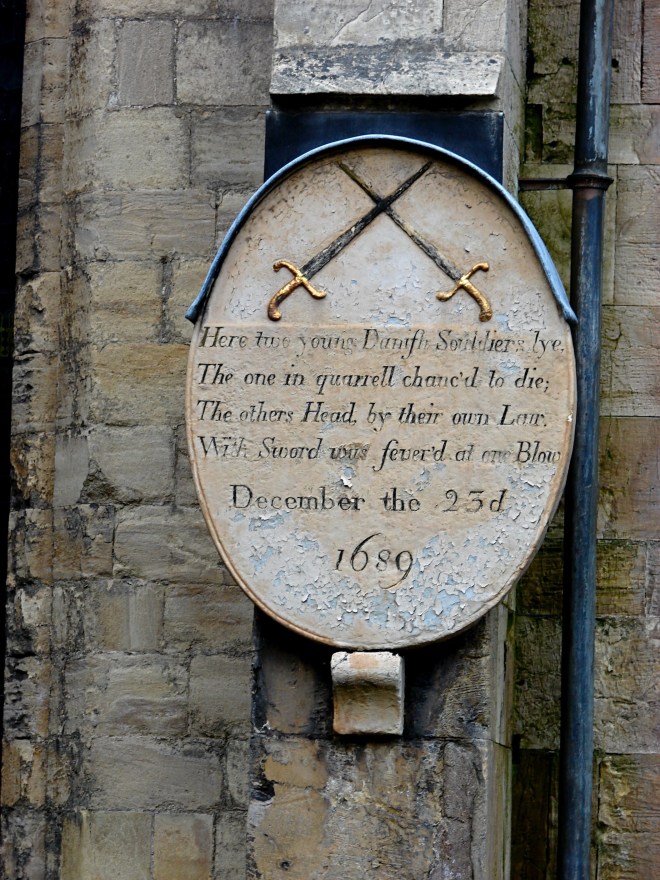
danish soldiers st mary's.JPG

December 22nd

On 22nd December 1530, Beverley draper William Leryfax wrote his will, and appointed as guardians for his son Robert the priors of Watton Abbey and Meaux Abbey. In 1539, both abbeys were dissolved, and the subprior of Watton had been hanged in chains in 1537 for his part in the Pilgrimage of Grace.

On 22nd December 1580, the Hull Mayor and aldermen set the price of ale at a penny for a quart and a pint outsales, and a penny a quart and a gill in the alehouse.

On 22nd December 1802, George Knowsley of Cottingham Grange held a meeting at the Duke of Cumberland, Cottingham, to propose the building of a canal from Cottingham to Hull; the aim was to reduce transport costs and establish a local grain market. The Napoleonic Wars caused the project to be shelved, and it was never revived.

December 16th

On 16th December 1512, William Crag of Cave claimed sanctuary at the church of St Cuthbert, Durham, for ‘asportation’; along with others, he had stolen 25 horses and mares, near Cave; in addition, in a certain park near Airton by York, he stole 3 other horses.

On 16th December 1586, the Earl of Huntingdon, on behalf of the Council in the North, wrote to the Hull Corporation to ask them to prevent merchants profiteering from the corn shortage by purchasing stocks for poor relief at a reasonable rate.

On 16th December 1645, Hull draper Robert Cartwright was fined £47 as a former Captain in the Royalist army (a ‘delinquent’) in order to recover his goods which had been sequestered by Parliament.

On 16th December 1689, a number of Danish soldiers were in William of Orange’s army, and 2 of them quarrelled and settled their dispute by a sword duel at Beverley. The survivor was beheaded in Saturday Market. (see 23.12)

On 16th December 1929, the R100 airship, the largest airship ever designed, made by a team led by Sir Barnes Neville Wallis, and including novelist Neville Shute Norway, took its maiden voyage from Spaldington Air Station.

On 16th December 2010, Easington tithe barn was offered for sale at an auction with a guide price of £125,000 and failed to sell. The 14thC building is the last remaining tithe barn in the county, and a Grade II listed building.

Easington tithe barn

December 13th

thwing meteorite

On 13th December 1760, John Courtney, gentleman, reported in his diary being awoken at midnight by the sound of bells ringing to announce that Hugh Bethell had declared himself a candidate for Parliament. The bells rang all day. A week later, Bethell changed his mind and withdrew his name.  He served as Beverley MP 1768-72.

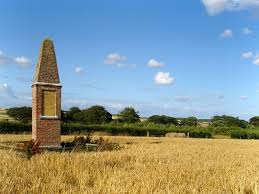
On 13th December 1795, at 3p.m., a meteorite weighing 56 pounds landed in a field near Wold Cottage, Thwing, home of Capt Edward Topham. It embedded itself 9 inches into the soil, weighing 56lbs, and 3 ft long. Capt Topham displayed the meteorite in London at a charge of 1shilling. He raised a brick obelisk on the landing site (see photo). The meteorite is now in the Natural History Museum, and is the origin of the name of Wold Top Brewery’s ‘Falling Stone bitter’.

On 13th December 1816, Frederick Brown, 60, was buried in Holy Trinity, Hull, after dying in the workhouse. Born in Guinea, he worked as a labourer in a number of jobs in Whitby and Hull. In 1794 he was acquitted of burglary by a Hull jury, apparently a case of being mistaken for another black man.

On 13th December 1830, Joseph Robinson Pease, JP, recorded in his diary an attempt to swear in special constables to deal with the ‘Swing Riots’ by agricultural labourers protesting about high rents, low wages, and the introduction of new machinery. However, they found it difficult to recruit in Cottingham.

On 13th December 1842, Moses Roper, student and escaped slave, gave a lecture at Beverley Guildhall on his personal experience of slavery in the USA, in which he exhibited instruments of torture used on slaves. He lectured extensively and published an autobiography.

On 13th December 1889, John Nicholson reported seeing the “Plough Lads’ (groups of men not hired on farms) going round Beverley, dancing and asking for money or drink. They dressed in ‘motley garb’, with one dressed as a woman with a broom, one (Blether Dick) with a bladder on a stick, one with a coat covered in strips of rag. “Often … at lonely houses they are rude and bold, demanding money or drink in such a way as to terrify the women who have been left at home”.  

December 1st

john-hotham-1-sized


On 1st December 1644, Sir John Hotham and Captain John Hotham, his son, were tried for treason at the Guildhall, London; both were convicted and condemned to beheading.

On 1st December 1800, Agnes Sharp, aged 24, was interviewed by the Hedon Mayor and one of the Bailiffs to confirm that she was pregnant, that the child (or children) was likely to be born a bastard, in order to claim payment from the parish. The father was a soldier from Sussex whose unit had left Hedon. Eventually, she received 2s6d a week.

On 1st December 1832, Thomas King and William Duesberry stole 3 chickens from John Carter’s farm, Howden. They were arrested and sentenced at Beverley on 14 Oct 1833, Duesberry getting a prison sentence, but King, who had previous form and did not admit the offence, was transported for 7 years. He was given his freedom in 1846 and seems to have died in Hobart in 1859.

On 1st December 1950, The Port of Hull Society’s Sailor’s Orphan Homes changed its name to The Sailors’ Children’s Society and celebrated with a lunch at the Guildhall.  The Society began as a Christian mission to seamen, and began to house ‘orphans’ (children whose father had died) in the 1860s, opening the Newland Homes in the 1890s.


November 30th

On 30th November 1219, William de Forz II, count of Aumale, Lord of Holderness, was declared a rebel and excommunicated for offences against the Crown and the sheriffs of 6 counties were instructed not to give him any help; he had held onto castles after being ordered to restore them to their owners.

On 30th November 1280, the residents of Hedon petitioned government to fix their tax (fee farm) as they were ‘few and poor’ and competition from Ravenserod and Hull were increasing from day to day. The port was firmly in decline. Hedon ship motif can be found in St Augustine’s church.

Hedon ship, St Augustine's

On 30th November 1587, Alexander Crowe, Catholic priest, aged approx 34, was executed in York. Born in Howden, worked as a shoemaker and travelled to Douai; ordained at Rheims 1583. Captured at South Duffield while baptising the baby of Cecily Garnett.

On 30th November 1644, Sir John Hotham began his trial for treason at the Guildhall, London.

On 30th November 1832, Henry John Shepherd, attorney and JP, of Beverley, went bankrupt, having speculated in building projects; his creditors were reported to include mainly individuals who had given him money for investment with no security; the bankruptcy register describes him as ‘dealer and chapman’. Shepherd was again practising as a solicitor in 1833.


November 25th

On 25th November 1641, Nicholas Pearson, parish clerk at St Mary’s Beverley, wrote this rhyme in the parish register, as a reminder of the dates when the Catholic church traditions forbade the celebration of marriage: ‘When Advent comes do thou refrain till Hillary set ye free again. Next Septuagissima saith ye nay But when Low Sunday comes thou may. Yet at Rogation thou must tarry Till Trinity shall bid ye marry.’ However, Pearson was a Puritan, showing perhaps that many traditions continued in the Church of England.

On 25th November 1818, Hull Trinity House started a fund to build cottages for the Spurn lifeboat crew, to help the lifeboat get under way more quickly after a call. £800 was raised.

On 25th November 1857 (or 1851) died when the steam packet Empress collided with the Ouse ferry in the dark at Whitgift. 3 passengers from Sheffield also died.  Verdict of accidental drowning by the carelessness of the ferrymen. photo –  Whitgift

Whitgift

November 24th

On 24th November 1299, King Edward I visited the Collegiate Society of St John, Beverley, and was entertained for 3 days.

On 24th November 1835, Mrs Jane Legard created the Etton Lying-In Charity by her will, providing maternity articles and food for new mothers – so long as they had been married at least 9 months.

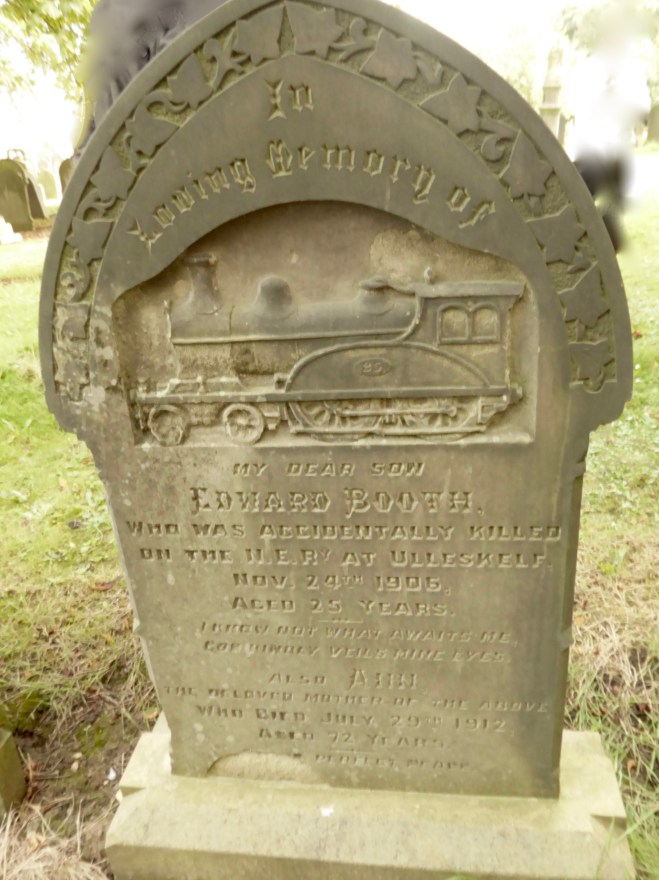
On 24th November 1906, John Dunham, 53, train driver and Edward Booth, 25, fireman, of Hull, died in a rail accident at Ulleskelf , which led to railway safety improvements. photo – Western General Cemetery, Hull

Edwd Booth memorial

November 23rd

On 23rd November 1599, the Council in the North made an order that John Gregory should serve as Hull Sheriff, although he had held the office 32 years before in 1567, and had asked to be released. He appears to have been successful in spite of the order.

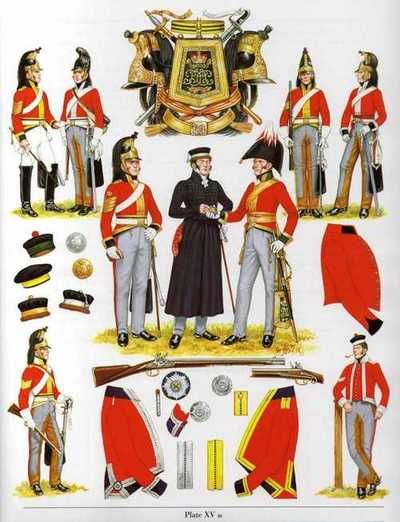
On 23rd November 1796, John Taylor jnr, member of the Hull Troop of Gentlemen and Yeomanry Cavalry, was unanimously expelled and voted to Coventry for improper conduct. The record does not state what he did. photo shows cavalry of the time.

On 23rd November 1863, at the Howden Martinmas hiring fair, 700 men and 800 women attended, the largest number of any ER town; fairs were also held in Beverley, Bridlington, Driffield, Hedon, Patrington, where farmers and people seeking employment gathered. The church was concerned about the moral issues involved when single women had to parade themselves in public. Traditionally, farmworkers had a week’s holiday, annual wages paid, and there were pleasure fairs.

cavalry1796

November 19th

On 19th November 1484, Thomas Squirry, husbandman of Leven, claimed sanctuary at the church of St John, Beverley, for killing John Hewlyn.

On 19th November 1855, Henry Holmes and John Combes, crew members of the Spurn lifeboat, drowned in stormy weather attempting to rescue the schooner Zabina on the Binks, River Humber.

spurn boats.JPG