Coming up this week

January 27th

Pilgr Grace

On 27th January 1332, Sir John de Sutton was summoned to Parliament by writ and thereafter become Lord Sutton of Holderness.

On 27th January 1537, John Hallam and others captured during the attempt by the Pilgrimage of Grace to seize Hull were examined by local justices; Hallam and 2 others were condemned to death and the rest awaited the arrival of the Duke of Norfolk for a decision on their fate.

On 27th January 1599, the Earl of Pembroke’s Players arrived at Londesborough House for a week performing plays for the Shrovetide period, for payment of £15shillings.

On 27th January 1645,  14 Hull burgesses gave evidence that Thomas Swann was  not a Royalist, and should not have his property sequestered, but in fact was owed money by Parliament because his new house was demolished to build a defences for the town. His appeal failed.

On 27th January 1882, the Prince of Wales, the future King Edward VII, joined the Holderness Hunt at Brantinghamthorpe, which recorded 1,400 horsemen, 4,000 on foot and 1,000 in carriages.

On 27th January 1901, Joseph Smith of Hull, on board SS Friary, was the 7thand last Hull passenger to have died of pneumonic plague contracted in the Mediterranean. He is commemorated in the columbarium at Hedon Road Cemetery.

On 27th January 1924, Brian Norman Roger Rix, Lord Rix of Whitehall in the City of Westminster and Hornsea in Yorkshire,  was born in Cottingham. He was a comic actor, specialising in Whitehall farce; awarded CBE for his charity work; campaigner for people with learning disability. He was also awarded 8 honorary degrees, 5 fellowships and many other awards, and was the first Chancellor of the University of East London, and vice Lord Lieutenant of Greater London. d20.8.2016


January 26th

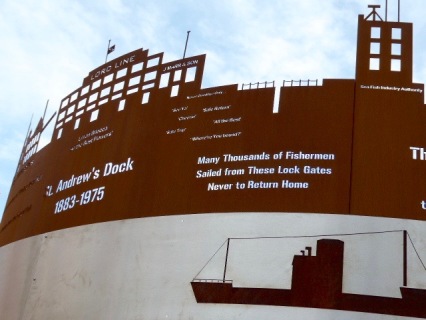
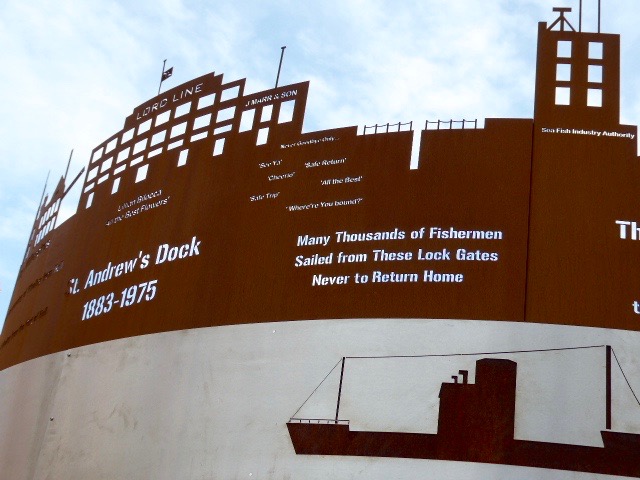
St Andrews Dock memorial
Zebedee’s Yard

On 26th January 1509, William Ivenson, Hull tailor, claimed sanctuary at the church of St John, Beverley for debt.

On 26th January 1516, John Catton, husbandman, of Allerthorpe, claimed sanctuary at the church of St John, Beverley, for felony.

On 26th January 1884, former pupil of Hull Trinity House School John Blakeston drowned after falling into the sea while reefing sails on the Barque Cape City off Rosario, Cape Horn.

On 26th January 1926, Ronnie Hilton was born Adrian Hill  in Hull. A singer, had 9 top 20 hits in the 1950s, and was also a radio presenter and pantomime artiste.  d 21.2.2001

On 26th January 1968, Hull trawler Kingston Peridot made her last contact by radio. See 10.1

On 26th January 1972, students at Hull University held a sit-in, called The January 26 Movement, in the Students Union building. It was part of an anti-apartheid campaign to persuade Hull University to divest itself of shares in Reckitt & Colman, which had extensive interests in South Africa and Rhodesia. The sit-in ended on 7th February.

ronnie-hilton-a-windmill-in-old-amsterdam-1965

January 25th

On 25th January 1201, King John and Queen Isabella visited Cottingham and Beverley on their way to Driffield, where they stayed on 27th.

On 25th January 1582, Christofer Danbroke, Hull merchant, and John Whelpdaile, draper, were fined 10shillings and 6s8d respectively for buying herrings from a Scottish ship, against the port regulations.

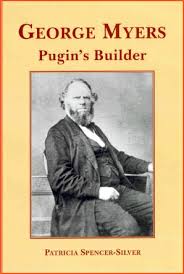
On 25th January 1875, George Myers died aged 72 in London. A Hull-born builder with a national reputation, particularly for his work with Pugin; he was involved in restoring Holy Trinity, in erecting the Wilberforce column, and in building the Royal Pavilion at Aldershot for Prince Albert.  His blue plaque is at 131 St George’s Road, London SE1. (b1803)

On 25th January 1886, Hull Philharmonic Society adopted a rule that evening dress be compulsory at concerts in the body of the hall.

On 25th January 1898, Mr Good and 19 other Hornsea gentlemen met at Fairfield’ Cliff Road, Hornsea, to form Hornsea Golf Club, and invited Capt F.C.S. Constable of Wassand Hall to become its President. The first ground was at Old Hall Fields.

George Myers

January 24th

On 24th January 1882, Peter Hughes, 16, ship’s cook, died on board the fishing smack Gleaner on the Dogger Bank. He died at the hand of Edward Wheatfill, after two weeks of beating, starvation, and torture, including being tied naked on deck. Wheatfill was found guilty of wilful murder and executed at York on 28.11.1882.

On 24th January 1906, the name of Leona Sherman was found on the Hornsea electoral list for the General Election; there is no record whether she tried to cast her vote.

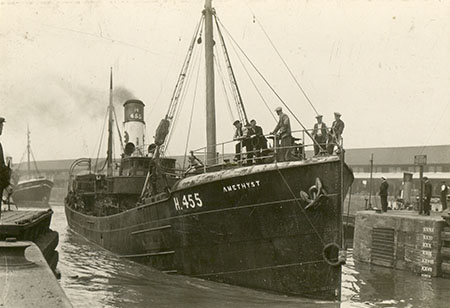
On 24th January 1937, Richard Baker, 28, skipper, of Bernadette Ave, Anlaby and all his crew were lost when the trawler Amethyst foundered off Kinnaird Head.

AMETHYST-H455-leaving-SAFD-450px

January 23rd

On 23rd January 1221, William de Forz II, Count of Aumale and Lord of Holderness, was excommunicated for the second time, for rebelling against the King, fortifying castles which were not his, and failing to fulfil a vow to go on crusade.

On 23rd January 1803, Burnett’s Shipping List reported 5 ships arriving in Hull from London that day; the Hope had lost an anchor and cable, and the Manchester had lost an anchor. 2 ships sailed for Yarmouth, 1 for Shields, and 1 for London.

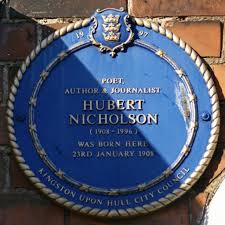
On 23rd January 1908, Hubert Nicholson was born in Washinton Street, Hull. He was a journalist, poet and novelist, best known for “Sunk Island’ 1956. He took holidays in the Holderness marshes, the strong attachment to the area being reflected in his writing.       d Epsom 11.1.1996 Commemorated by a blue plaque.

Hubert Nicholson

January 22nd

On 22nd January 1430, Katherine Brigham of Ganstead died at Preston aged 6 months. She had been sent by her family to a wet nurse with the Twyer family and was buried at St Sepulchre’s Hospital.

On 22nd January 1621, John Ramsay, a Scottish aristocrat, was created 1stand only Earl of Holderness by James I; he appears to have had no connection with Holderness.

On 22nd January 1643, Nicholas Osgodby, vicar of St Mary’s Beverley, left his post to join the Royalist army.

On 22nd January 1907, John (Jack) Symons died in Hull aged 83. He was the first Jew to hold public office in Hull; 1857 Guardian of the Poor, 1875 alderman, 1890 Sheriff; a local historian with many publications, including ‘Hullinia’ and ‘Kingstoniana’.


St Mary's Beverley

January 21st

On 21st January 1516, William Wilbert, husbandman of Brantingham, claimed sanctuary at the church of St John, Beverley, for asportation, which usually referred to theft, in this case described as ‘a felony committed over a sheep’.

On 21st January 1585, William Roper, Hull market keeper, was ordered to inspect all fish landed by Flemings and ensure it was fit for human consumption before being sold in the market.

On 21st January 1795, Henry Wolsey Bayfield was born in Hull. He joined the Navy at age 10, advancing to the rank of admiral. He took part in surveying the Canadian lakes, and was a notable artist. He lived to the age of 90, and is considered a Canadian hero, with many places named for him. Watch: https://www.youtube.com/watch?v=hGVmyGOjc04

January 20th

On 20th January 1577, John de Tradescant of Cottingham broke into the York house of John Paschal with 2 associates; they were convicted, hanged and their bodies given to the surgeons of the city to be dissected and anatomized.

On 20th January 1595, Robert Cripling and William Lucas, servants to Sir Francis Clifford, bet another Londesborough servant, George Ingmire, that they could beat him in a race on foot from Londesborough to Market Weighton; they won.

On 20th January 1652, John Rogers, Mayor, and Hull aldermen Edward Wingate, Durand Hotham, and Lance Roper, asked the Court of Chancery for help in compelling Mr Stiles and other former Masters and Brethren of Hull Charterhouse, to appear before them and produce documents to account for corruption in the management of the Charterhouse Hospital. (Things appear to have changed after this: a report in 1668 showed an increase in the number of poor cared for from 12 to 40.)

On 20th January 1782, Dr Robert Levett, or Levet, of Westella,  was buried in Bridewell church yard, London. He had died, aged 79, apparently of a heart attack. He had lived in Dr Samuel Johnson’s household for 20 years. Earned a living as a servant, waiter and physician to the poor. Johnson wrote a poem ‘On the Death of Dr Robert Levet’. Tablet in Kirkella church. B 1703 Westella.

On 20th January 1968, Ross Cleveland of Hull set out from Hull for the last time for the North-West coast of Iceland.

St Andrews Dock memorial
Zebedee’s Yard

January 19th


Pilgr Grace

On 19th January 1537, Sir Francis Bigod was attacked by Ellerker’s men in Beverley, and most of his men were captured. After failing to capture Scarborough, he had gathered more followers at Bainton, but heard that John Hallam had failed to capture Hull. Bigod escaped to the north, and was eventually captured in March. Both Bigod and Hallam were executed.

On 19th January 1684, Sir Robert Hilyard, knight & Baron of Patrington, gave his son Capt Robert Hilyard ‘2 whole pues or closets, which were positioned in the South Transept’.

On 19th January 1970, Alan Plater oversaw the first production at the new theatre in Spring Street of his own play ‘Don’t Build a Bridge, Drain the River’, with music by Mike Chapman and Mike Waterson. The Humberside Arts Centre later became Humberside Theatre, and then Hull Truck Theatre. see photo

On 19th January 1979, William Rodgers, Secretary of State for Transport, reported in the House of Commons that as the result of an industrial dispute in the road haulage industry, there was no movement of grain or animal feed out of Hull docks. The importance of Hull was stressed, as other parts of the country depended on it to deliver goods.

On 19th January 2014, the Environment Agency closed Sutton Lock on the River Derwent to navigation due to safety concerns. The lock had been reconstructed in 1972 to enable pleasure craft to travel up to Stamford Bridge and give access to the Pocklington Canal. There seemed to be uncertainty as to who owned the gates and equipment.

Spring St theatre

January 18th

On 18th January 1482, William Rougthwayt, baker, of Beverley, claimed sanctuary in Durham cathedral for killing John Thomson at Beverley on 8 Dec; he claimed it was in self-defence. He wounded Thomson in the thigh with a dagger, and he died of the wound later that day, presumably from loss of blood.

On 18th January 1511, tailor Thomas Bonfay of Everingham claimed sanctuary at the church of St John, Beverley, for the theft of goods and chattels from Nicholas Suttell, a gentleman.

On 18th January 1582, Hull draper William Robertson was fined 5s8d for buying herrings landed from a Scottish ship, against the port regulations. Because he was ignorant of the statute, and promised not to reoffend, he was allowed to keep the herrings.

On 18th January 1801, James Evans was born in Hull. A teacher, Methodist minister and linguist, he developed a script for the previously unwritten Ojibwe and Cree languages, leading to almost universal literacy among speakers of these languages. d23.11.1846 in Canada.

james evans