February 11th

On 11th February 1346, William de la Pole agreed to resume lending money to King Edward III, in return for the return of all his goods that were in the hands of the sheriff. Relations between the king and his banker were precarious, but he remained in favour for the time being…

On 11th February 1657, Thomas Cowlam, labourer, and Jane Millington were married in a private alehouse at Spaldington by Robert Browne, vicar of Eastrington.

On 11th February 1941 at 5.30p.m., an anti-aircraft shell fell in Jalland Street, Hull, with no casualties. The blitz on Hull reached its peak in May that year.

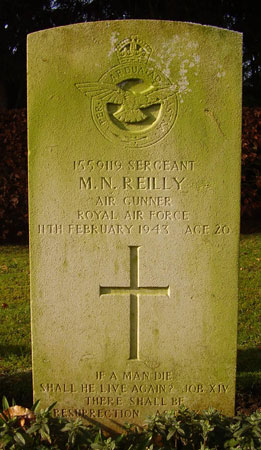
On 11th February 1943, Flt Sgt 785073 Harold E.R. Saunders died with 6 other crew (1 survived) when mechanical problems caused his Halifax bomber to crash near North Dalton, shortly after taking off from Pocklington. 6 of them are buried in Barmby Moor churchyard.

Halifax crash Feb 43


February 7th

On 7th February 1518, Hull weaver John Watson claimed the sanctuary of St John’s church, Beverley, for debt.

On 7th February 1519, John Gilson, a gentleman of Garton claimed the sanctuary of St John’s church, Beverley, for debt. It is not known whether this was Garton on the Wolds or Garton in Holderness.

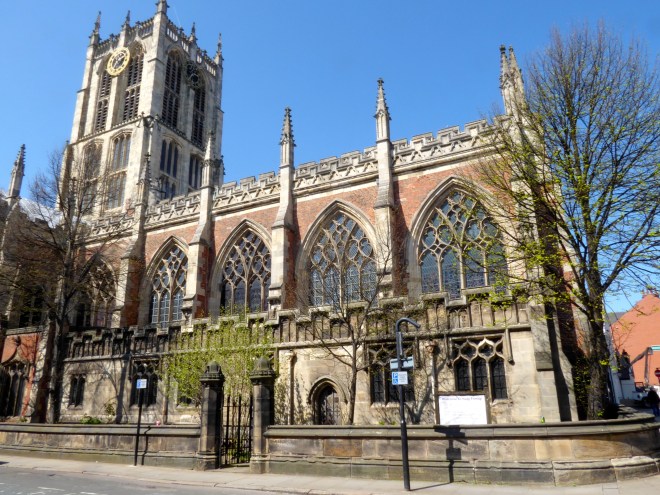
On 7th February 1651, the Mayor of Hull wrote to the Sheriff Thomas Raikes concerning the partitioning of Holy Trinity church to allow soldiers to be billeted there, whilst services could continue in part of the church.

On 7th February 1799, Lutheran Pastor Triebner came to Hull to preach to the Germans employed in the two Sugar Houses in Drypool.

Holy Trinity

February 6th

On 6th February 1611, Stephen Taylor, steward of the household and receiver-general at Londesborough House, home of the Earl of Cumberland, bought a barrel of white herrings from Hull merchant Mr Foddle. He also bought sea fish landed at Scarborough and Carlisle, but had bought eels from Thomas Williamson of Hull the previous December.

On 6th February 1889, John William Dishman, aged 10,  Died in the care of Port of Hull Society’s Sailor’s Orphan Home – photo: memorial in Hull Western General Cemetery

On 6th February 1901, William Bernard Traynor, a sergeant in the 2ndBattalion, West Yorkshire Regiment, went to the aid of a wounded man under heavy fire at Bothwell Camp, South Africa, and was severely injured; he was awarded the Victoria Cross ‘for valour’. Traynor was born in Moxon Street, Hull. (31.12.1870)

Orphan deaths, Sailor's Orphan Home
Western General Cemetery


February 2nd

On 2nd February 1141, during the Anarchy, William of Aumale, Lord of Holderness and Earl of York led part of the cavalry protecting King Stephen, but were overrun by the Welsh and fled. The King was captured, and Matilda took the throne for a time. William remained loyal to Stephen.

On 2nd February 1786, Revd T.O. Rogers Hull opened the new Trinity House School with 36 pupils.

On 2nd February 1799, Capt Henry Gunter RN was in charge of HMS Nautilus when she was wrecked in a storm Off Flamborough Head; all the crew survived. She was leading a convoy of 22 merchantmen returning from the Baltic; one of the other ships was also wrecked.

On 2nd February 1801, Hull Trinity House paid relief of £1 1s to 4 seamen who had escaped from captivity in Russia.

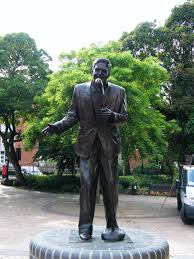
On 2nd February 1925, David Whitfield was born in Hull. A popular singer, he was the first UK male vocalist to earn a gold disc, and the first British artiste to reach No 1 simultaneously in the US and the UK. Commemorated by a statue outside the New Theatre. d 16.1.1980

David Whitfield


January 29th

On 29th January 1505, Richard Naperton, labourer, of Goodmanham, claimed sanctuary at the church of St John, Beverley, for debt.

On 29th January 1885, William Barlow, 15, cook, was lost overboard from Hull trawler Only Son in the North Sea.

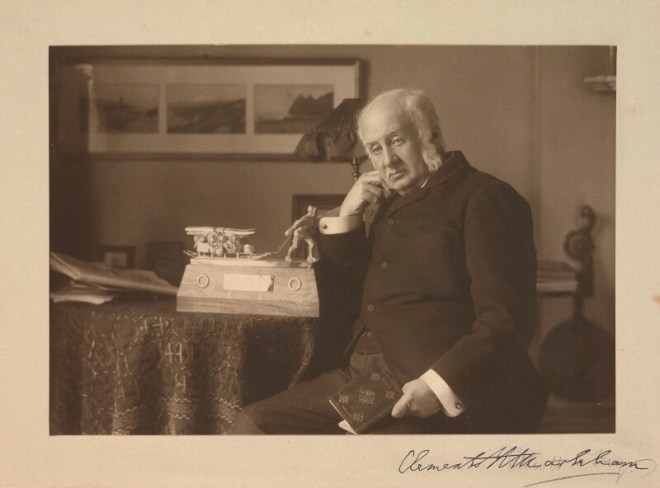
On 29th January 1916, Sir Clements Robert Markham KCB, FRS of Stillingfleet died aged 85. Born in Stillingfleet, he became a Navy officer, explorer and geographer, Secretary of the Royal Geographical Society, organiser of Scott’s 1901-4 National Antarctic Expedition, author, and organiser of the 1860 expedition to collect cinchona for quinine.

sir clemts markham

January 21st

On 21st January 1516, William Wilbert, husbandman of Brantingham, claimed sanctuary at the church of St John, Beverley, for asportation, which usually referred to theft, in this case described as ‘a felony committed over a sheep’.

On 21st January 1585, William Roper, Hull market keeper, was ordered to inspect all fish landed by Flemings and ensure it was fit for human consumption before being sold in the market.

On 21st January 1795, Henry Wolsey Bayfield was born in Hull. He joined the Navy at age 10, advancing to the rank of admiral. He took part in surveying the Canadian lakes, and was a notable artist. He lived to the age of 90, and is considered a Canadian hero, with many places named for him. Watch: https://www.youtube.com/watch?v=hGVmyGOjc04

January 17th

On 17th January 1527, George Ableson, a wheelwright from Hutton Cranswick, claimed sanctuary at the church of St John, Beverley, for debt.

On 17th January 1583, William Lyon, fisherman of Yarmouth, obtained permission to move with his family to Hull, to become a freeman, to set up business as a fisherman and train others in the trade, giving a surety of £40, but also receiving £10 in expenses towards his costs.

On 17th January 1786, Capt Edward Thompson died of fever in post, aged about 48.   Born in Hull, the son of a merchant. Naval commodore; he wrote an account of the Battle of Quiberon Bay in 1759; he was responsible for organising the government of West Indian colonies of Berbice, Demerara and Essequibo. He was acquitted at court martial of leaving his station in 1781. He published a number of satirical poems, sea songs, plays and a report of naval life. b c1738

Capt EdwdThompson


January 10th

st mary's sculcoates.JPG

On 10th January 1308, Ivo de Etton of Temple Hirst, near Selby, and William de la Fenne from Faxfleet had been preceptors (heads) of local houses of the outlawed Knights Templar order, when they were arrested and imprisoned by Henry II on instructions of Pope Clement V. Also arrested were Richard de Ryston, chaplain, Thomas Tyeth, claviger (or warden), and Roger de Hugunde or Hogyndon, a brother in residence at Faxfleet, and Adam de Crake, claviger, at Temple Hirst.

On 10th January 1511, Richard Elynor of North Cave claimed sanctuary at the church of St John, Beverley, for a felony, but the register does not give any detail of his crime.

On 10th January 1537, Sir Francis Bigod, of Settrington, and John Hallam, of Cawkeld near Watton, met to discuss rekindling the Pilgrimage of Grace, which had ended in December with promises to restore the monasteries and hold a Parliament at York. They planned to seize Hull and Scarborough before they could be fortified.

On 10th January 1646, Stephen Thompson of Humbleton was fined £400 as the owner of Scarborough Castle and a Royalist (a ‘delinquent’) in order to recover his goods which had been sequestered by Parliament.

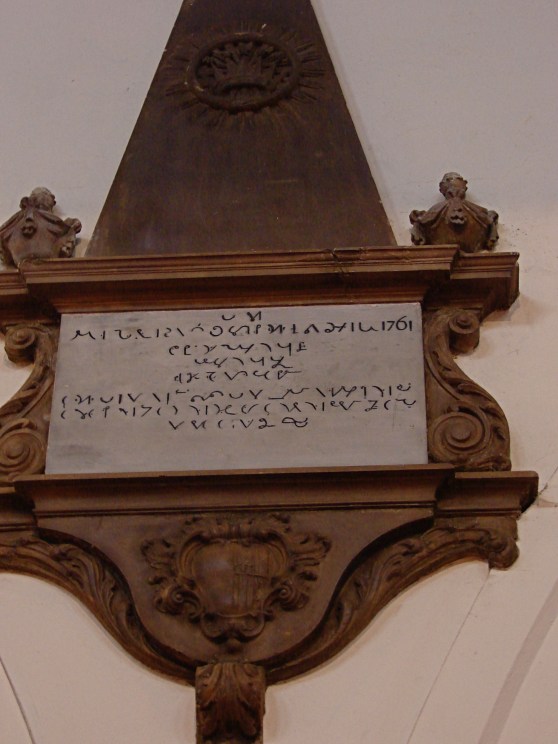
On 10th January 1761, Mrs Jane Delamoth died in Hull. Her memorial in St Mary’s Sculcoates may be the only memorial written in shorthand in the world. It says: ‘In the vault beneath this stone lies the body of Mrs Jane Delamoth, who departed this life 10thJanuary 1761. She was a poor sinner, but not wicked without holiness, departing from good works, and departed in the faith of the Catholic Church, in full assurance of eternal happiness, by the agony and bloody sweat, by the cross and passion, by the precious death and burial, by the glorious resurrection and ascension of Our Lord and Saviour Jesus Christ’. see photo

On 10th January 1783, Rear Admiral John Storr died in Hilston. He is buried in Westminster Abbey. (b 18.8.1709) He commanded the Revenge at the Battle of Quiberon Bay 20.11.1759. His father Joseph built Storr’s Tower at Hilston in 1750. It served as a hospital for troops camped on the coast in 1794–5 and later as a cottage, but was disused in 1990. His memorial is in Hilston church.

On 10th January 1849, Cottingham land agent Thomas Spenceley reported that he had measured the distance from the Spa Inn, Aldbrough to the sea in 1832 and again in 1848 and the loss of land due to coastal erosion was 28 yards in that period. On 6.8.1832 the distance was 160 yards; on 11.8.1848 it was 132 yards, an average loss of 5ft 3” per year.

On 10th January 1952, Madame Clapham (Mrs Emily Clapham) died aged 96, the former Court Dressmaker of Kingston Square, Hull. Her fashions for high society made Hull ‘the rage’ according to Sir Osbert Sitwell.

On 10th January 1968, Hull trawler St Romanus left port and made radio contact with the owners that evening. A Mayday call was heard, but not passed on. The official enquiry concluded ship probably lost on 11thJanuary, reason unknown.

On 10th January 1968, Hull trawler Kingston Peridot of Hull left port and was not contacted until after 26 January. The enquiry concluded she probably capsized on 26th  or 27th January, due to extreme weather.
January 5th

On 5th January 1304, Sir John de Sutton was pardoned, because of his military service to King Edward II in Scotland, for taking hares in the King’s warren of Holderness.

On 5th January 1773, Mrs Bridget Briggs of Sproatley died and left money in her will to educate 10 poor boys and 10 poor girls in the village.

On 5th January 1824, the Port of Hull Society for the Religious Instruction of Seamen set up a nautical school for seamen and apprentices to receive practical and academic instruction, open several evenings a week. Many of the early students were illiterate.

On 5th January 1836, Captain James Clark Ross left Hull on an expedition to resupply 11 whaling vessels trapped in Arctic ice. About 600 men were in the overwintering ships.

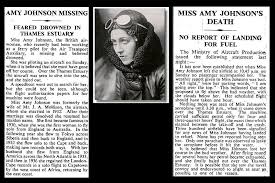
On 5th January 1941, Amy Johnson, while flying for the Air Transport Auxiliary from Blackpool to RAF Kidlington, went off course in bad weather and bailed out as her aircraft crashed.  An attempt was made to rescue her, but she died and her body was never recovered. There is still, however, controversy surrounding the circumstances of her death in the Thames.

AmyJohnson death

December 29th

On 29th December 1594, Sir Francis and Lady Clifford began a tradition in their new house  (Londesborough Hall) of Christmas and New Year feasts, entertaining 93 staff and local people, tenants from different villages on the estate on different days, to meals until 6thJanuary.

On 29th January 1611, they paid for entertainment from visiting puppeteers, 2 men and a woman, who called at the great house.

On 29th December 1817, Mary Woodall married John Lewis Friday, private in the 33rd (WR) Regiment of Foot, a  Waterloo veteran, who was probably born in Mozambique.

On 29th December 1829, Hedon MP Col John Baillie informed the Mayor of Hedon that the Post Office would have a daily post from Hedon instead of 4 days a week.

On 29th December 1881,  William Papper, 15, was murdered aboard fishing smack Rising Sun, in the North Sea, by Osmond Otto Brand, skipper of the boat, after prolonged mistreatment amounting to torture. Brand was found guilty of murder at Leeds Assizes and sentenced to death. Richard Rycroft was sentenced to 3 months’ hard labour for assault.

On 29th December 1898, Elsa (formerly Elfie) Gidlow was born in Hull. Lesbian poet known for On A Grey Thread 1923. Her family emigrated to Canada when she was 6 (d 8.6.1986)