July 19th

On 19th July 1692, Elizabeth Howe, nee Jackson, aged 57,  was hanged for witchcraft at Salem, Massachusetts with 4 other women; at the age of 3, she was among the Puritans who emigrated from Rowley to found Rowley, Massachusetts.

On 19th July 1750, Hull soldier John Hasselbe made a sworn statement to John Wood, Deputy Mayor, that when he was on duty at Beverley Gate between 1.00 and 3.00, his musket went missing, and he suspected it had been stolen and concealed.

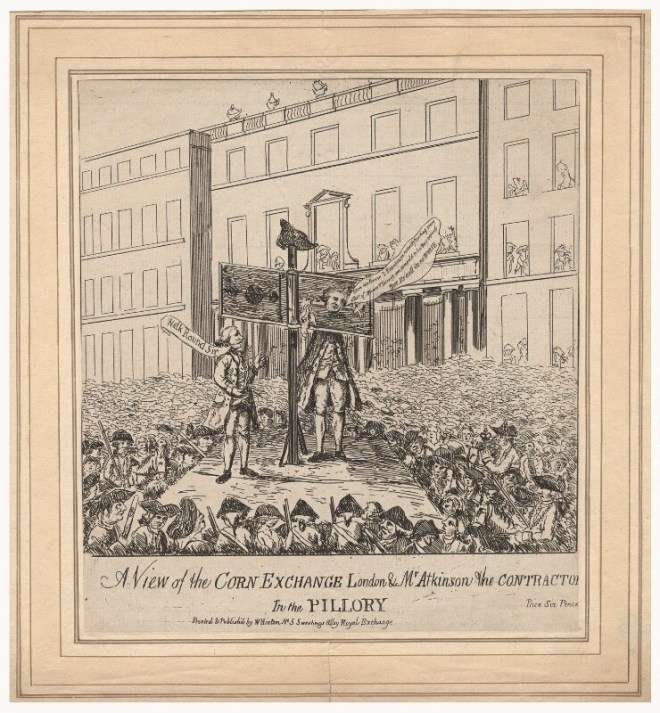
On 19th July 1783, Christopher Atkinson, MP for Hedon & corn factor, was tried in London for perjury, found guilty and committed to prison for 12 months, , first being pilloried at the Corn Exchange, London, and expelled from the House of Commons.  He resigned from his commercial post, but stood again as MP for Hedon in 1796 and 1802 and was elected. He later changed his name to Saville. picture shows Atkinson at the pillory

On 19th July 1786, Hull’s Rev George Lambert visited several sick parishioners, and commented on the contemporary habit of family and friends crowding into the room with the minister, so that the sick person was unable to speak openly.

On 19th July 1794, Edward Bogg, carpenter’s mate,  was shot and killed on board Hull fishing vessel Sarah and Elizabeth Off St Abb’s Head by the crew of a naval press gang on the frigate Aurora; 3 other crew were injured; the coroner’s court returned a verdict of wilful murder by Captain Essington; the captain was sent to the East Indies for several years and never stood trial.

On 19th July 1849, an All England Eleven cricket team played a 30-day match against a Hull amateur side at the Hull Athenaeum Club ground, Anlaby Road. Despite funding from the Hull Sheriff and both MPs, the entrance fee was 1s a day. The professionals won by an innings and 82 runs.

On 19th July 1919, 368 children living at Newland Homes, Cottingham Road, Hull, took part in official peace celebrations included games and setting fire to an effigy of the ex-Kaiser.chrisatkinson MP
July 5th

On 5th July 1532, Henry VIII’s charter was read out in Hull Market Place, and prohibited anyone but Hull burgesses from conducting business in the port; the corporation paid £31 19s4d to obtain the charter, part of which was paid in the form of a sturgeon for Thomas Cromwell.

On 5th July 1657, a major fire in Hedon starting at 1 a.m. resulted in the loss of 42 houses, and others damaged. In August, the Mayor petitioned Parliament for permission to hold a collection to raise money; £4,000 was raised.

On 5th July 1776, John Wesley paid a visit to Howden and preached to a large congregation during a thunderstorm near Station Road, Howden. Wesley’s picture below

On 5th July 1811, Bridlington Collector of Customs Benjamin Milne discovered a tidal spring near the quay, now commemorated by a stone inscription.

On 5th July 1899, Hull Alderman Larard took the controls of the city’s first municipal electric tram (Siemens Bros & Co provided the electrical equipment). A spectator hoping for a good view, climbed on the roof of the public lavatories and fell through.

On 5th July 1930, the annual King’s Cup Air Race took place on this date, and planes had to follow a route of around 800 miles. Hull Aerodrome was a main control station on the route. Tickets were sold for 1s and 2s6d. The winner was Miss Winifred Brown in an Avro Avian III. (N.B. Hull Aerodrome is actually in Preston South.)


john wesley

June 9th

On 9th June 1786, a servant of Rev George Lambert of Hull gave notice that she was leaving after living with the family for 15 years, to live with a sailor who had recently sold his wife to another man. Most people considered this equivalent to divorce, although it had no status in law.

On 9th June 1888, a water spout in Langtoft sucked up mud and stones, and removed the soil from gardens, leaving bare chalk, as it moved across the local valleys. When it was halted by a steep hill, it deposited debris to the depth of 7 feet.

On 9th June 1965, Leslie Anthony Wegg was born in Hedon Road Maternity Hospital, Hull, with a full caul. A fisherman’s son, it was kept as a precious possession, despite a £100 offer to buy it. (from Eric Gill’s book “Superstitions’)


June 8th

On 8th June 1300, a year after Hull’s establishment, King Edward I gave a charter to allow the mayor and aldermen to pave the major streets, with a central gutter for ease of drainage. The work began in 1301.

On 8th June 1661, King Charles II wrote a letter to the Hull Mayor, prohibiting John Shaw from preaching in Holy Trinity, as he was too radical a Puritan. He retained his post as Master of the Charterhouse, and his sermons there continued to draw large crowds, but he resigned the following year.

On 8th June 1806, in a kitchen accident, in Hull, Mrs Lambert reported being struck on the back by a large hanging lump of sugar she had dislodged; she expected that if it had hit her on the head, she would have died.

On 8th June 1815, the Commissioner of Customs acquired the former Neptune Inn, Whitefriargate, as a Custom House. The Inn had opened in 1797, but had never made the expected profit of a first-class coaching inn. The building now houses Boots Chemists.

On 8th June 1821, the troopship Thomas of London was driven on to the Binks sands, in the Humber; the 26 troops, crew, 2 women and a child were rescued, and 1 woman drowned, despite brave attempts by the captain, Lieutenant Pritchard, to save her. The operation by Robert Richardson, master of the Spurn lifeboat, and crew, took 11 hours.

On 8th June 1829, Ira Aldridge, celebrated American actor of African heritage, performed in Hull for the first time, at the Theatre Royal, Humber Street; over a long and distinguished career he visited Hull several times, and performed at the Nag’s Head, Driffield in 1841.


Ira-Aldridge-Covent-Garden-1833-public-domain1

May 30th

On 30th May 1778, Frank Slaiter returned to work at Escrick Hall 4 ½ months after breaking his thigh at work. His employer, Beilby Thompson, paid his medical fees, and gave him an allowance of 2/3 his normal wage while he was off sick.

On 30th May 1782, Rev George Lambert and Mr Towers began a journey to London with a ferry crossing of the Humber, which took 3 hours; it took from 11a.m. to the evening to reach Lincoln by coach. They arrived in London about 50 hours after leaving Hull. This was probably typical for the time.

On 30th May 1820, William Bradley died aged 33 of tuberculosis in  Market Weighton. Known as the Yorkshire Giant, he grew to 7’9”. Travelled with shows and fairs, and later charged visitors to his home. Was presented to King George III. (b 10.2.1787)

On 30th May 1859, a Hull Coroner’s Court jury returned a verdict of wilful murder against Isabella Hewson.  On 27.5 she had hanged her son, aged 2, and then gave herself up to police. No evidence of insanity was found on medical examination.

On 30th May 1912, Brigadier Mark Sykes inspected the Yorkshire Catholic Reformatory, Market Weighton, and found lack of discipline, bullying, filth, poor food, lack of fire precautions and drill, and poor medical treatment. Recommended all staff but one be dismissed. The management of the school was changed later that year.


Yorks reformatory