January 26th

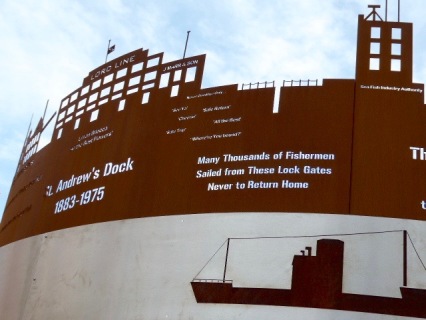
St Andrews Dock memorial
Zebedee’s Yard

On 26th January 1509, William Ivenson, Hull tailor, claimed sanctuary at the church of St John, Beverley for debt.

On 26th January 1516, John Catton, husbandman, of Allerthorpe, claimed sanctuary at the church of St John, Beverley, for felony.

On 26th January 1884, former pupil of Hull Trinity House School John Blakeston drowned after falling into the sea while reefing sails on the Barque Cape City off Rosario, Cape Horn.

On 26th January 1926, Ronnie Hilton was born Adrian Hill  in Hull. A singer, had 9 top 20 hits in the 1950s, and was also a radio presenter and pantomime artiste.  d 21.2.2001

On 26th January 1968, Hull trawler Kingston Peridot made her last contact by radio. See 10.1

On 26th January 1972, students at Hull University held a sit-in, called The January 26 Movement, in the Students Union building. It was part of an anti-apartheid campaign to persuade Hull University to divest itself of shares in Reckitt & Colman, which had extensive interests in South Africa and Rhodesia. The sit-in ended on 7th February.

ronnie-hilton-a-windmill-in-old-amsterdam-1965

January 23rd

On 23rd January 1221, William de Forz II, Count of Aumale and Lord of Holderness, was excommunicated for the second time, for rebelling against the King, fortifying castles which were not his, and failing to fulfil a vow to go on crusade.

On 23rd January 1803, Burnett’s Shipping List reported 5 ships arriving in Hull from London that day; the Hope had lost an anchor and cable, and the Manchester had lost an anchor. 2 ships sailed for Yarmouth, 1 for Shields, and 1 for London.

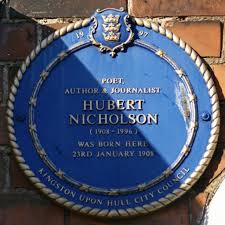
On 23rd January 1908, Hubert Nicholson was born in Washinton Street, Hull. He was a journalist, poet and novelist, best known for “Sunk Island’ 1956. He took holidays in the Holderness marshes, the strong attachment to the area being reflected in his writing.       d Epsom 11.1.1996 Commemorated by a blue plaque.

Hubert Nicholson

January 12th

On 12th January 1808, Robert Escritt and John Paul, agricultural labourers, were probably the last people to be sentenced to the pillory in Driffield. They were found guilty of blackmailing gentleman farmer Francis Brown of Kelleythorpe, after accusing him of raping John Paul. They were sentenced to stand in the pillory at Driffield on 3 consecutive market days, and to a year in the House of Correction, Beverley. N.B. Sodomy was punishable by hanging at the time.

On 12th January 1819, William Clowes, one of the founders of Primitive Methodism,  began an evangelical mission in Hull, preaching in an old factory in North Street.               (b12.3.1780 Burslem, d3.3.1851, buried in Western General Cemetery).

On 12th January 1963, Hull Pilot cutter J.H. Fisher sank west of Spurn Point after colliding with the oil tanker Esso Glasgow, heading for Saltend in a blinding snowstorm. All crew were safely taken off. During the coldest weather in Britain since 1740, pilots also had to cope with ice-floes off Spurn, and the River Humber itself freezing near Brough. photo credit: Ian Burrett

Big Freeze 1963


January 6th

On 6th January every Plough Monday, in the15th and 16th centuries, Hull Trinity House  Guild presented the Miracle play of Noah in the streets of Hull.

On 6th January 1600, George Wolstenholme, Esq (59), Thomas Wilson, Esq (48), Richard Thomas (60), James Norrison (39), Robert Noke (43), Francis Mitchell (46), and Henry Hutchinson (29), all of Hull, murdered Captain Thomas Fletcher, of the ship Nancy, of Hull, mate Guy Foster, and William Forest and George Fowler, seamen of same ship. All 7 were convicted at York on Monday 2ndApril 1600 of murder and smuggling, and their bodies given to surgeons of York and Hull to be dissected and anatomized.

On 6th January 1764, flooding was so bad that the Holderness turnpike was unusable  between Hull and Bilton until 1stApril. One man and a horse were drowned attempting the route. The building of Holderness Drain was begun that year.

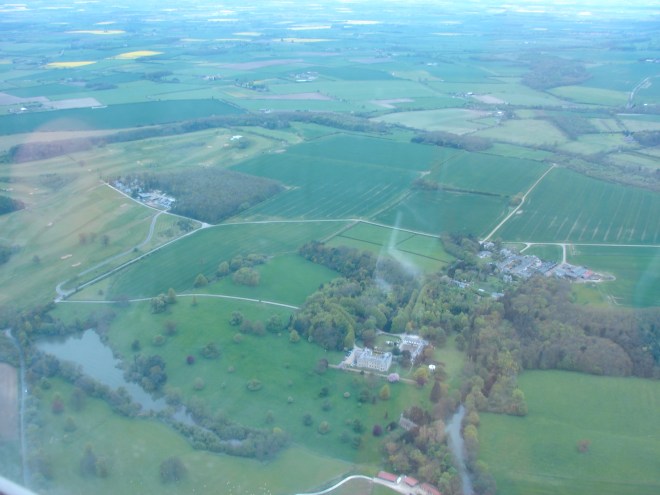
On 6th January 1839, the Nafferton house of Mr Thompson, a miller, was destroyed in ‘the Great Storm’ and his 2 sons, his daughter and a servant girl were all killed. Joseph Robinson Pease reported salt spray from the South-West on windows at Kilnwick Percy (i.e. it had come from the nearest coast in that direction, South Wales). photo shows Kilnwick Percy from the air

On 6th January 1840, William Dunn pleaded guilty at Beverley Sessions Court to a burglary. He was convicted and sentenced to transportation for life.

kilnwick percy.JPG


January 5th

On 5th January 1304, Sir John de Sutton was pardoned, because of his military service to King Edward II in Scotland, for taking hares in the King’s warren of Holderness.

On 5th January 1773, Mrs Bridget Briggs of Sproatley died and left money in her will to educate 10 poor boys and 10 poor girls in the village.

On 5th January 1824, the Port of Hull Society for the Religious Instruction of Seamen set up a nautical school for seamen and apprentices to receive practical and academic instruction, open several evenings a week. Many of the early students were illiterate.

On 5th January 1836, Captain James Clark Ross left Hull on an expedition to resupply 11 whaling vessels trapped in Arctic ice. About 600 men were in the overwintering ships.

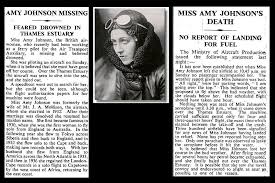
On 5th January 1941, Amy Johnson, while flying for the Air Transport Auxiliary from Blackpool to RAF Kidlington, went off course in bad weather and bailed out as her aircraft crashed.  An attempt was made to rescue her, but she died and her body was never recovered. There is still, however, controversy surrounding the circumstances of her death in the Thames.

AmyJohnson death

December 31st

On 31st Dec 1458, Robert Foster enrolled into post as Collector of Customs, joining existing staff Thomas Everyngham (Collector) and Thomas Maygne (Controller).

On 31st December 1501, William Croswet of Hull claimed sanctuary at the church of St John, Beverley, for debt.

On 31st December 1511, Audrey, or Etheldreda, spinster from Lincolnshire, claimed sanctuary at the church of St John, Beverley, for a felony; the register gives no detail of her offence.

On 31st December 1626, the Council of the North summoned a representative of the Hull Corporation to appear and explain Hull’s failure to provide ships ordered. (Under Charles I’s unpopular Ship Money tax, Hull was required to provide the cost of 3 ships in 1626, and appealed against the decision, saying it was too much).

On 31st December 2007, new research revealed that the Hell’s Gate, Hunsley archaeological dig site site was an Anglo-Saxon execution cemetery (mid 7thC to early 11thC). The heads would have been displayed on posts  at the site between Welton and Cave. 12 male Anglo-Saxon skeletons, 10 of them headless, were found in a Bronze Age barrow in the 1960s, and known as the Walkington Wold burials.

Hell's Gate

December 24th

Coat_of_arms_of_the_baron_de_Ros_-_Premier_baron_of_England

On 24th December 1264, Robert de Ros of Roos and Helmsley was created Baron de Ros, probably the first English Barony created, and the title holder is styled the Premier Baron of England.

On 24th December 1510, Welwick labourer James Martynson claimed sanctuary at the church of St John for the murder of John Lewes of Welwickthorpe, labourer.

On 24th December 1592, the Council in the North ordered that no merchants carry goods or merchandise up the river or trade with other parts of the north except through the port of Hull.

On 24th December 1911, James Adamson, 34, deckhand, was lost overboard from Hull trawler Eldorado, 250 miles ENE of Spurn.


December 7th

john-hotham-1-sized


On 7th December 1644, Sir John Hotham’s execution date, set for 16.12, was put back after Lady Hotham appealed for more time for him to settle his affairs.

On 7th December 1791, 22 months after being apprenticed at sea, John Sheriff, pupil of Hull Trinity House School, was allowed a land job in the House, ‘on account of his being twice shipwrecked had been discouraged from a further perseverance’.

On 7th December 1958, the crew of Flamborough lifeboat Friendly Forester saved 2 Bridlington fishing boats and landed their crews of 8 men.


December 1st

john-hotham-1-sized


On 1st December 1644, Sir John Hotham and Captain John Hotham, his son, were tried for treason at the Guildhall, London; both were convicted and condemned to beheading.

On 1st December 1800, Agnes Sharp, aged 24, was interviewed by the Hedon Mayor and one of the Bailiffs to confirm that she was pregnant, that the child (or children) was likely to be born a bastard, in order to claim payment from the parish. The father was a soldier from Sussex whose unit had left Hedon. Eventually, she received 2s6d a week.

On 1st December 1832, Thomas King and William Duesberry stole 3 chickens from John Carter’s farm, Howden. They were arrested and sentenced at Beverley on 14 Oct 1833, Duesberry getting a prison sentence, but King, who had previous form and did not admit the offence, was transported for 7 years. He was given his freedom in 1846 and seems to have died in Hobart in 1859.

On 1st December 1950, The Port of Hull Society’s Sailor’s Orphan Homes changed its name to The Sailors’ Children’s Society and celebrated with a lunch at the Guildhall.  The Society began as a Christian mission to seamen, and began to house ‘orphans’ (children whose father had died) in the 1860s, opening the Newland Homes in the 1890s.


November 30th

On 30th November 1219, William de Forz II, count of Aumale, Lord of Holderness, was declared a rebel and excommunicated for offences against the Crown and the sheriffs of 6 counties were instructed not to give him any help; he had held onto castles after being ordered to restore them to their owners.

On 30th November 1280, the residents of Hedon petitioned government to fix their tax (fee farm) as they were ‘few and poor’ and competition from Ravenserod and Hull were increasing from day to day. The port was firmly in decline. Hedon ship motif can be found in St Augustine’s church.

Hedon ship, St Augustine's

On 30th November 1587, Alexander Crowe, Catholic priest, aged approx 34, was executed in York. Born in Howden, worked as a shoemaker and travelled to Douai; ordained at Rheims 1583. Captured at South Duffield while baptising the baby of Cecily Garnett.

On 30th November 1644, Sir John Hotham began his trial for treason at the Guildhall, London.

On 30th November 1832, Henry John Shepherd, attorney and JP, of Beverley, went bankrupt, having speculated in building projects; his creditors were reported to include mainly individuals who had given him money for investment with no security; the bankruptcy register describes him as ‘dealer and chapman’. Shepherd was again practising as a solicitor in 1833.