December 13th

thwing meteorite

On 13th December 1760, John Courtney, gentleman, reported in his diary being awoken at midnight by the sound of bells ringing to announce that Hugh Bethell had declared himself a candidate for Parliament. The bells rang all day. A week later, Bethell changed his mind and withdrew his name.  He served as Beverley MP 1768-72.

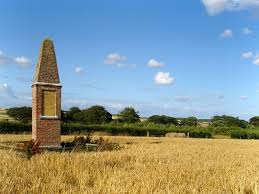
On 13th December 1795, at 3p.m., a meteorite weighing 56 pounds landed in a field near Wold Cottage, Thwing, home of Capt Edward Topham. It embedded itself 9 inches into the soil, weighing 56lbs, and 3 ft long. Capt Topham displayed the meteorite in London at a charge of 1shilling. He raised a brick obelisk on the landing site (see photo). The meteorite is now in the Natural History Museum, and is the origin of the name of Wold Top Brewery’s ‘Falling Stone bitter’.

On 13th December 1816, Frederick Brown, 60, was buried in Holy Trinity, Hull, after dying in the workhouse. Born in Guinea, he worked as a labourer in a number of jobs in Whitby and Hull. In 1794 he was acquitted of burglary by a Hull jury, apparently a case of being mistaken for another black man.

On 13th December 1830, Joseph Robinson Pease, JP, recorded in his diary an attempt to swear in special constables to deal with the ‘Swing Riots’ by agricultural labourers protesting about high rents, low wages, and the introduction of new machinery. However, they found it difficult to recruit in Cottingham.

On 13th December 1842, Moses Roper, student and escaped slave, gave a lecture at Beverley Guildhall on his personal experience of slavery in the USA, in which he exhibited instruments of torture used on slaves. He lectured extensively and published an autobiography.

On 13th December 1889, John Nicholson reported seeing the “Plough Lads’ (groups of men not hired on farms) going round Beverley, dancing and asking for money or drink. They dressed in ‘motley garb’, with one dressed as a woman with a broom, one (Blether Dick) with a bladder on a stick, one with a coat covered in strips of rag. “Often … at lonely houses they are rude and bold, demanding money or drink in such a way as to terrify the women who have been left at home”.  

December 9th

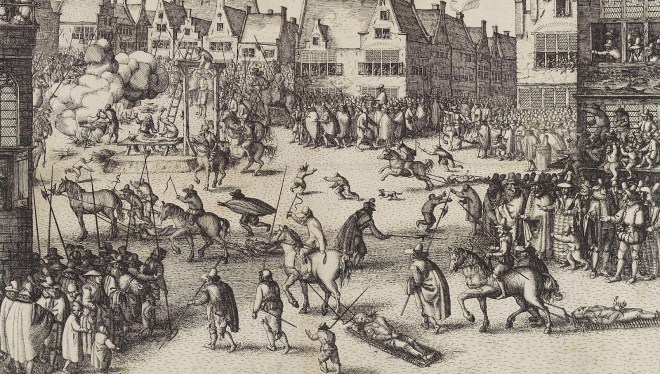
On 9th December 1644, Capt John Hotham had a second trial, this time for betraying the trust placed in him as a parliamentary commander. Found guilty and sentenced to beheading on 1stJanuary.

On 9th December 1754, pensioners in Trinity House almshouses were required to attend every Divine Service in the chapel, or lose one week’s pay for every default.

On 9th December 1917, the Spurn lifeboat rescued the crew of the steam ship Florence of Stockton when they ran aground in heavy seas. Coxswain Robert Cross jumped into the sea with a line, and with crewman G. Martin, stood on the sands until all of the crew were safely in the lifeboat. Cross received the RNLI Silver Medal, and Martin received a Monetary Award.

On 9th December 1959, half of the tower of St Martin’s Church, Wharram Percy, collapsed in a storm, 10 years after the last service held in this abandoned village, now probably the subject of more archaeological investigations than any other place in England.

Wharram Percy

December 1st

john-hotham-1-sized


On 1st December 1644, Sir John Hotham and Captain John Hotham, his son, were tried for treason at the Guildhall, London; both were convicted and condemned to beheading.

On 1st December 1800, Agnes Sharp, aged 24, was interviewed by the Hedon Mayor and one of the Bailiffs to confirm that she was pregnant, that the child (or children) was likely to be born a bastard, in order to claim payment from the parish. The father was a soldier from Sussex whose unit had left Hedon. Eventually, she received 2s6d a week.

On 1st December 1832, Thomas King and William Duesberry stole 3 chickens from John Carter’s farm, Howden. They were arrested and sentenced at Beverley on 14 Oct 1833, Duesberry getting a prison sentence, but King, who had previous form and did not admit the offence, was transported for 7 years. He was given his freedom in 1846 and seems to have died in Hobart in 1859.

On 1st December 1950, The Port of Hull Society’s Sailor’s Orphan Homes changed its name to The Sailors’ Children’s Society and celebrated with a lunch at the Guildhall.  The Society began as a Christian mission to seamen, and began to house ‘orphans’ (children whose father had died) in the 1860s, opening the Newland Homes in the 1890s.


November 30th

On 30th November 1219, William de Forz II, count of Aumale, Lord of Holderness, was declared a rebel and excommunicated for offences against the Crown and the sheriffs of 6 counties were instructed not to give him any help; he had held onto castles after being ordered to restore them to their owners.

On 30th November 1280, the residents of Hedon petitioned government to fix their tax (fee farm) as they were ‘few and poor’ and competition from Ravenserod and Hull were increasing from day to day. The port was firmly in decline. Hedon ship motif can be found in St Augustine’s church.

Hedon ship, St Augustine's

On 30th November 1587, Alexander Crowe, Catholic priest, aged approx 34, was executed in York. Born in Howden, worked as a shoemaker and travelled to Douai; ordained at Rheims 1583. Captured at South Duffield while baptising the baby of Cecily Garnett.

On 30th November 1644, Sir John Hotham began his trial for treason at the Guildhall, London.

On 30th November 1832, Henry John Shepherd, attorney and JP, of Beverley, went bankrupt, having speculated in building projects; his creditors were reported to include mainly individuals who had given him money for investment with no security; the bankruptcy register describes him as ‘dealer and chapman’. Shepherd was again practising as a solicitor in 1833.


November 29th

On 29th November 1486, John Thurleby started in a new post as Hull Collector of Customs, joining existing staff Thomas Annesley (collector) and John Wolleston (Controller).

On 29th November 1596, William Knight of South Duffield, and Henry Abbot of Howden were hanged, drawn and quartered as traitors for their Catholic faith. Knight was beatified on 22.11.1987,  Abbot 15.12.1929.


English Martyrs, hanged, drawn and quarted for the Catholic Faith in England


November 28th

On 28th November 1427, Richard Reedbarowe received royal assent to erect a lighted beacon at Ravensporne (Spurn Point) to prevent shipwrecks, and to maintain it by charging vessels a fee.

On 28th November 1901, Sarah Hebden of Hodgson Street, Hull, was battered to death by her nephew, Arthur Richardson. He was the first person to be hanged in Hull Prison, Hedon Road on 25.3.1902.

On 28th November 1904, Hull’s first telephone exchange opened at the former Trippett Street Baths.  In 1913, Hull’s became the only municipally owned telephone service, after all other services were bought by the Post Office.

On 28th November 1955, Mr John Davies, of J. Arthur Rank Organisation, officially opened the new Cecil Cinema, replacing the building destroyed in the blitz on 8.5.1941. Architects Gelder & Kitchen. Davies was accompanied by his wife, film star Dinah Sheridan. https://www.youtube.com/watch?v=7P3–fkaeP8

Cecil cinema


November 22nd

On 22nd November 1865, William Stamp, Edward Rodmell, and John Lancaster, of Sutton, appeared at Sproatley Petty Sessions, charged with being drunk and riotous in Sutton. Lancaster was discharged, but Stamp and Rodmell were found guilty and fined 5s with costs of 7s6d.

On 22nd November 1869, Alfred Edward Matthews, known as A.E. Matthews was born in Bridlington. Character actor whose career started in silent films and continued to 1960 (d 25.7. 1960) Clip is from ‘This is Your Life’


On 22nd November 1907, Emmeline Pankhurst, founder of the Women’s Social and Political Union, spoke to a large crowd of dock workers at Hull Fish Dock on the issue of women’s suffrage. Christopher Pickering invited her to talk to the men assembled indoors too. He said that he was Conservative, but his wife was a Radical.

November 19th

On 19th November 1484, Thomas Squirry, husbandman of Leven, claimed sanctuary at the church of St John, Beverley, for killing John Hewlyn.

On 19th November 1855, Henry Holmes and John Combes, crew members of the Spurn lifeboat, drowned in stormy weather attempting to rescue the schooner Zabina on the Binks, River Humber.

spurn boats.JPG

November 15th

minster - frith stool.JPG


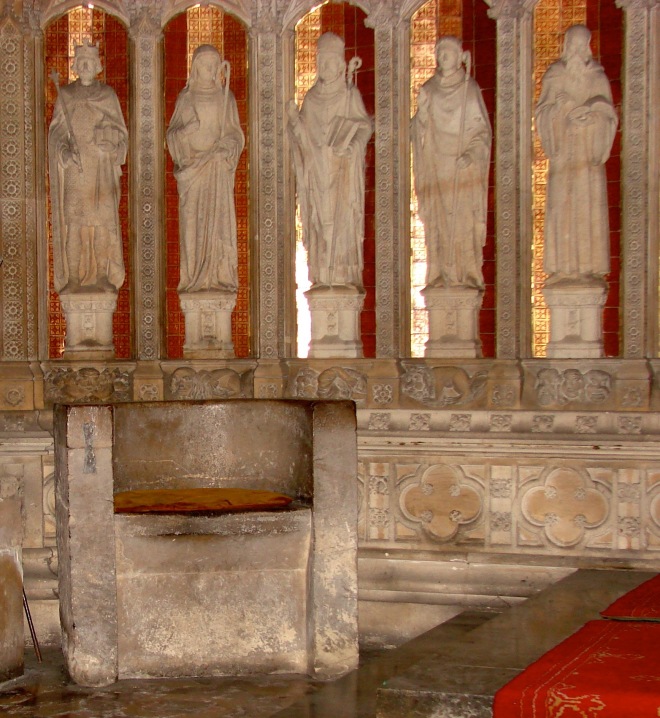
On 15th November 1482, William Weton, yeoman of North Ferriby, claimed sanctuary in the church of St John, Beverley, for killing John Atkynson of North Ferriby on 19th September. photo shows the sanctuary chair, or Frith Stool

On 15th November 1810, Robert Richardson, master of the Spurn lifeboat, and crew, performed the first rescue by the new lifeboat, to assist the John and Charlotte off Trinity Sand, River Humber, where she had been driven in a gale.

On 15th November 1915, Walter Beech, 47 of 25 Scarboro St, Hull, chief engineer/ Christopher Hall, 2ndengineer of Allison Tce, Hull, were lost with all other 8 crew of the steam trawler Edward B. Cargill when it struck a mine off Spurn Head.


November 14th

On 14th November 1067, William the Conqueror knighted Sir Lionel Saltmarshe of Saltmarsh and gave him the manor of Saltmarsh (needs verification)

On 14th November 1504, Richard Squier, tailor, of Catton, claimed sanctuary at the church of St John, Beverley, for the theft of cloth, and for breaking out of the King’s gaol in York.

On 14th November 1906, Thomas Anderton, 44, of 53 Francis St, Hull, deckhand on steam trawler Canada, drowned along with the ship’s cook, in the River Thames at Gravesend when the ship’s boat capsized.

On 14th November 1913, Dan Billany was born in Essex Street, Hull. An active socialist, he was a teacher, and author. His novel ‘The Trap’ was highly respected. As an officer in the EY Regiment, he was captured in 1942 and a Prisoner of War in Italy until released in 1943. Last seen 20.11.1943, fate unknown.

Dan Billany The Trap