September 19th

On 19th September 1069, Northumbrians (incl Morcar and Edwin) with help of Danes besieged York and took Sir Wm Mallet hostage; in retaliation, William razed York to the ground and began the Harrying of the North. In effect, this was ethnic cleansing; some villages in the East Riding were still worth a fraction of their value 20 years later, or simply described as ‘waste’.

On 19th September 1532, William Orrell, a gentleman from Hull, was recorded as having been in the sanctuary of Westminster Abbey for about a year.  He had confessed to murdering Hull merchant John Lownde and was involved in complex legal questions as to whether he was an outlaw or not. He lobbied the King for restoration of his properties and positions, and by the 1540s was described as a gentleman of the King’s household.

On 19th September 1576, orders were given by Mayor and aldermen in York that the  house and shop of Gregory Burgess, physician & apothecary, should be shut up, probably because he had moved to Hull the previous year to treat people suffering from plague; and that he should be banned from entering York until further orders.

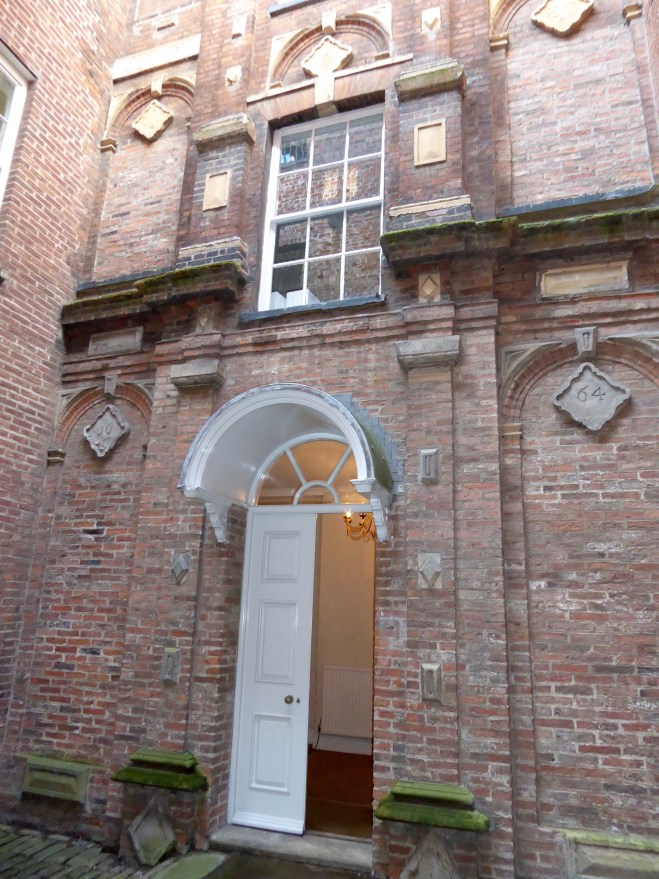
On 19th September 1674, bricklayer/builder William Catlyn, was elected Sheriff of Hull, but petitioned the town, pleading that his work took him to Lincolnshire, and he was unable to carry out the post. His petition seems to have succeeded, but he eventually became sheriff in 1683. Catlyn was responsible for building Wilberforce House, Crowle House, the Charterhouse and Master’s House (1628-1709). Brother of John Catlyn, Master of Hull Grammar School. photo shows Crowle House

On 19th September 1935, Herbert Morrison MP, and later High Steward of Hull, officially opened Queens Gardens, formed after the Queen’s Dock was closed in 1930. On the same day, the Wilberforce Monument, which had been moved from Monument Bridge, was rededicated by Wilberforce’s great granddaughter, Mrs Arnold Reckitt (nee Ann Barbara Wilberforce). Another relative of Morrison’s, Lord Peter Mandelson, later became High Steward of Hull.Crowle House
June 24th

On 24th June 1381, King Edward III issued a writ ordering rebel supporters of the Peasants’ Revolt to be arrested and punished.

On 24th June 1392, lightning struck Keyingham church and caught fire, and residents took ladders to douse the fire on the roof; a ladder holding 13 men broke, but no-one was injured, which was put down to a miracle of St Philip Ingleberd.

On 24th June 1643, Capt John Hotham,  having escaped from arrest, fled to Lincoln, planning to seize it for the King, and wrote to Parliament to say he could answer all charges against him. From Lincoln, he returned to his father in Hull.

On 24th June 1867, Charles Edward Smith, ship’s surgeon, aged 30, was presented with an illuminated testimonial, and a case of surgical instruments, in recognition of his gallant conduct on the whaler Diana of Hull, which had been trapped for months in ice and whose crew had suffered privations leading to scurvy.

On 24th June 1943, Mr T.R. Gale, of Estcourt Street, Hull, performed an act of gallantry during an air raid, for which he was later awarded the British Empire Medal. On the same night, Civil Defence volunteer Albert Henry Prissick of 15 Mersey Street, lost his wife and baby son, but carried on with the rescue of his neighbours. Hull Municipal Museum, Albion Street, was destroyed by fire.

On 24th June 1981, the Humber Bridge was opened to traffic; for 17 years it was the world’s longest single-span suspension bridge. On the same day, the Humber ferry service ended.

On 24th June 2011, marine artist Colin Verity died aged 87 in Market Weighton. Educated at Malet Lambert School, Hull and School of Architecture, Hull University. Flew Spitfires during WW2. Became principal architect, Hull City Council. Member RIBA, Royal Socy of Marine Artists, President Hornsea Art Society.  (b Darwen Lancs 7.3.1924)


Humber Bridge


May 28th

On 28th May 1554, Beverley priest Robert Thwenge was brought before judges at York for the 4th time on the charge that he had been an ordained priest and had afterwards married. He had married after the Reformation, but before Queen Mary repealed the Act. He said that he would rather continue with his wife, and did not wish to be restored as a minister. The record does not show what happened to him after this. Most priests agreed to separate from their wives and retain their livings after doing penance for their sin.

On 28th May 1721, Ann Watson, widow, of Stoneferry, was buried in St Augustine’s Church, Hedon. She bequeathed her whole estate at Stoneferry to charitable uses. Memorial in the church to the Watson family, including her son Hedon Watson.

On 28th May 1787, Edmund Foster, carver and gilder start a sale of his stock in trade at the Golden Boy, Lowgate, Hull. The sale was expected to last 28 days (not including Sundays). The stock included chimney pieces, gilded looking glasses and ornaments. An early ‘everything must go/closing down’ sale?

On 28th May 1857, Charles Francis Annesley Voysey was born, son of Rev Charles Voysey. Designer in the Arts and Crafts style and architect, winner of RIBA Gold Medal 1940. (d 12.2.1941)


Ann Watson memorial