January 24th

On 24th January 1882, Peter Hughes, 16, ship’s cook, died on board the fishing smack Gleaner on the Dogger Bank. He died at the hand of Edward Wheatfill, after two weeks of beating, starvation, and torture, including being tied naked on deck. Wheatfill was found guilty of wilful murder and executed at York on 28.11.1882.

On 24th January 1906, the name of Leona Sherman was found on the Hornsea electoral list for the General Election; there is no record whether she tried to cast her vote.

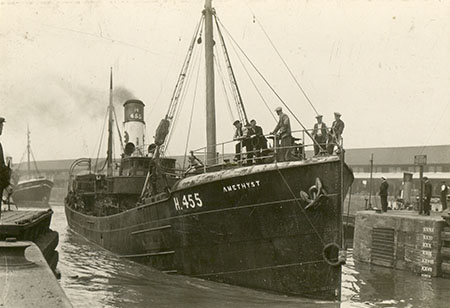
On 24th January 1937, Richard Baker, 28, skipper, of Bernadette Ave, Anlaby and all his crew were lost when the trawler Amethyst foundered off Kinnaird Head.

AMETHYST-H455-leaving-SAFD-450px

January 21st

On 21st January 1516, William Wilbert, husbandman of Brantingham, claimed sanctuary at the church of St John, Beverley, for asportation, which usually referred to theft, in this case described as ‘a felony committed over a sheep’.

On 21st January 1585, William Roper, Hull market keeper, was ordered to inspect all fish landed by Flemings and ensure it was fit for human consumption before being sold in the market.

On 21st January 1795, Henry Wolsey Bayfield was born in Hull. He joined the Navy at age 10, advancing to the rank of admiral. He took part in surveying the Canadian lakes, and was a notable artist. He lived to the age of 90, and is considered a Canadian hero, with many places named for him. Watch: https://www.youtube.com/watch?v=hGVmyGOjc04

January 20th

On 20th January 1577, John de Tradescant of Cottingham broke into the York house of John Paschal with 2 associates; they were convicted, hanged and their bodies given to the surgeons of the city to be dissected and anatomized.

On 20th January 1595, Robert Cripling and William Lucas, servants to Sir Francis Clifford, bet another Londesborough servant, George Ingmire, that they could beat him in a race on foot from Londesborough to Market Weighton; they won.

On 20th January 1652, John Rogers, Mayor, and Hull aldermen Edward Wingate, Durand Hotham, and Lance Roper, asked the Court of Chancery for help in compelling Mr Stiles and other former Masters and Brethren of Hull Charterhouse, to appear before them and produce documents to account for corruption in the management of the Charterhouse Hospital. (Things appear to have changed after this: a report in 1668 showed an increase in the number of poor cared for from 12 to 40.)

On 20th January 1782, Dr Robert Levett, or Levet, of Westella,  was buried in Bridewell church yard, London. He had died, aged 79, apparently of a heart attack. He had lived in Dr Samuel Johnson’s household for 20 years. Earned a living as a servant, waiter and physician to the poor. Johnson wrote a poem ‘On the Death of Dr Robert Levet’. Tablet in Kirkella church. B 1703 Westella.

On 20th January 1968, Ross Cleveland of Hull set out from Hull for the last time for the North-West coast of Iceland.

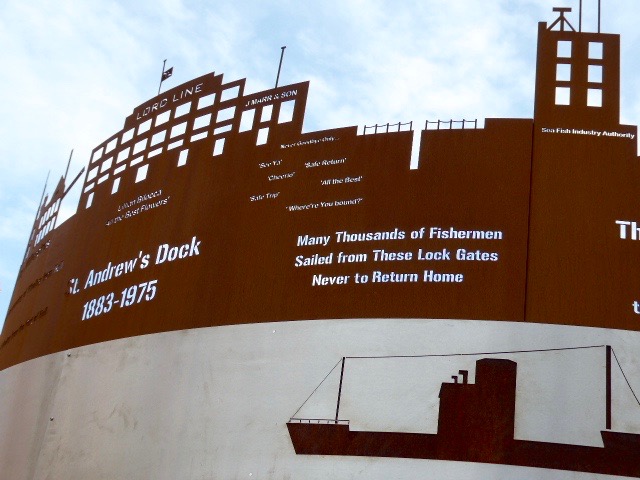
St Andrews Dock memorial
Zebedee’s Yard

January 18th

On 18th January 1482, William Rougthwayt, baker, of Beverley, claimed sanctuary in Durham cathedral for killing John Thomson at Beverley on 8 Dec; he claimed it was in self-defence. He wounded Thomson in the thigh with a dagger, and he died of the wound later that day, presumably from loss of blood.

On 18th January 1511, tailor Thomas Bonfay of Everingham claimed sanctuary at the church of St John, Beverley, for the theft of goods and chattels from Nicholas Suttell, a gentleman.

On 18th January 1582, Hull draper William Robertson was fined 5s8d for buying herrings landed from a Scottish ship, against the port regulations. Because he was ignorant of the statute, and promised not to reoffend, he was allowed to keep the herrings.

On 18th January 1801, James Evans was born in Hull. A teacher, Methodist minister and linguist, he developed a script for the previously unwritten Ojibwe and Cree languages, leading to almost universal literacy among speakers of these languages. d23.11.1846 in Canada.

james evans

January 12th

On 12th January 1808, Robert Escritt and John Paul, agricultural labourers, were probably the last people to be sentenced to the pillory in Driffield. They were found guilty of blackmailing gentleman farmer Francis Brown of Kelleythorpe, after accusing him of raping John Paul. They were sentenced to stand in the pillory at Driffield on 3 consecutive market days, and to a year in the House of Correction, Beverley. N.B. Sodomy was punishable by hanging at the time.

On 12th January 1819, William Clowes, one of the founders of Primitive Methodism,  began an evangelical mission in Hull, preaching in an old factory in North Street.               (b12.3.1780 Burslem, d3.3.1851, buried in Western General Cemetery).

On 12th January 1963, Hull Pilot cutter J.H. Fisher sank west of Spurn Point after colliding with the oil tanker Esso Glasgow, heading for Saltend in a blinding snowstorm. All crew were safely taken off. During the coldest weather in Britain since 1740, pilots also had to cope with ice-floes off Spurn, and the River Humber itself freezing near Brough. photo credit: Ian Burrett

Big Freeze 1963


January 11th

On 11th January 1582, Hull widow Jane Smyth was ordered to be put in the stocks at the next market, with a paper on her head, and given notice to quit the house she rented from the town, for cursing and slandering the mayor, justices, aldermen and the preacher, accusing them of  ‘punishing the town with water’ and punishing her son.

On the same day, Henrie Wakewood of Hull was ordered either to pay 10d a week to Elizabeth Bratton for the support of their child Isabell, and be whipped on market day, or to marry her and have his punishment deferred. Decision on Elizabeth’s punishment was deferred until she had been churched.

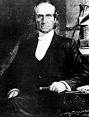
On 11th January 1642, Sir John Hotham was appointed by Parliament as the Governor of Hull.

john-hotham-1-sized


January 10th

st mary's sculcoates.JPG

On 10th January 1308, Ivo de Etton of Temple Hirst, near Selby, and William de la Fenne from Faxfleet had been preceptors (heads) of local houses of the outlawed Knights Templar order, when they were arrested and imprisoned by Henry II on instructions of Pope Clement V. Also arrested were Richard de Ryston, chaplain, Thomas Tyeth, claviger (or warden), and Roger de Hugunde or Hogyndon, a brother in residence at Faxfleet, and Adam de Crake, claviger, at Temple Hirst.

On 10th January 1511, Richard Elynor of North Cave claimed sanctuary at the church of St John, Beverley, for a felony, but the register does not give any detail of his crime.

On 10th January 1537, Sir Francis Bigod, of Settrington, and John Hallam, of Cawkeld near Watton, met to discuss rekindling the Pilgrimage of Grace, which had ended in December with promises to restore the monasteries and hold a Parliament at York. They planned to seize Hull and Scarborough before they could be fortified.

On 10th January 1646, Stephen Thompson of Humbleton was fined £400 as the owner of Scarborough Castle and a Royalist (a ‘delinquent’) in order to recover his goods which had been sequestered by Parliament.

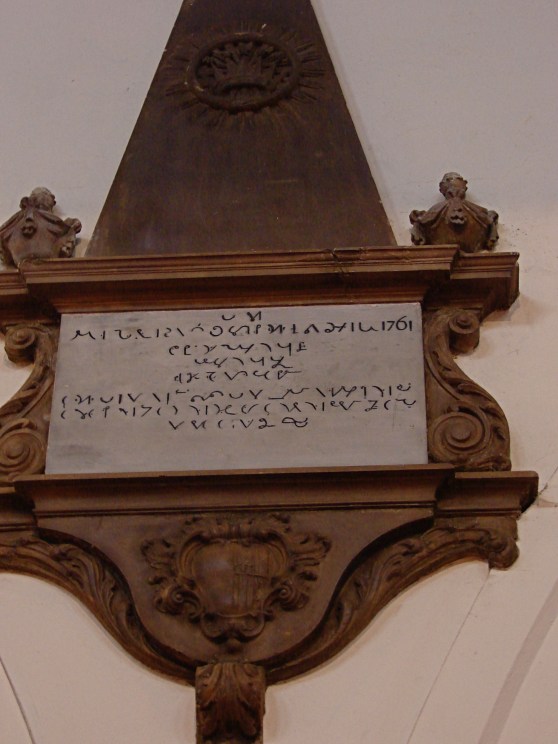
On 10th January 1761, Mrs Jane Delamoth died in Hull. Her memorial in St Mary’s Sculcoates may be the only memorial written in shorthand in the world. It says: ‘In the vault beneath this stone lies the body of Mrs Jane Delamoth, who departed this life 10thJanuary 1761. She was a poor sinner, but not wicked without holiness, departing from good works, and departed in the faith of the Catholic Church, in full assurance of eternal happiness, by the agony and bloody sweat, by the cross and passion, by the precious death and burial, by the glorious resurrection and ascension of Our Lord and Saviour Jesus Christ’. see photo

On 10th January 1783, Rear Admiral John Storr died in Hilston. He is buried in Westminster Abbey. (b 18.8.1709) He commanded the Revenge at the Battle of Quiberon Bay 20.11.1759. His father Joseph built Storr’s Tower at Hilston in 1750. It served as a hospital for troops camped on the coast in 1794–5 and later as a cottage, but was disused in 1990. His memorial is in Hilston church.

On 10th January 1849, Cottingham land agent Thomas Spenceley reported that he had measured the distance from the Spa Inn, Aldbrough to the sea in 1832 and again in 1848 and the loss of land due to coastal erosion was 28 yards in that period. On 6.8.1832 the distance was 160 yards; on 11.8.1848 it was 132 yards, an average loss of 5ft 3” per year.

On 10th January 1952, Madame Clapham (Mrs Emily Clapham) died aged 96, the former Court Dressmaker of Kingston Square, Hull. Her fashions for high society made Hull ‘the rage’ according to Sir Osbert Sitwell.

On 10th January 1968, Hull trawler St Romanus left port and made radio contact with the owners that evening. A Mayday call was heard, but not passed on. The official enquiry concluded ship probably lost on 11thJanuary, reason unknown.

On 10th January 1968, Hull trawler Kingston Peridot of Hull left port and was not contacted until after 26 January. The enquiry concluded she probably capsized on 26th  or 27th January, due to extreme weather.
January 6th

On 6th January every Plough Monday, in the15th and 16th centuries, Hull Trinity House  Guild presented the Miracle play of Noah in the streets of Hull.

On 6th January 1600, George Wolstenholme, Esq (59), Thomas Wilson, Esq (48), Richard Thomas (60), James Norrison (39), Robert Noke (43), Francis Mitchell (46), and Henry Hutchinson (29), all of Hull, murdered Captain Thomas Fletcher, of the ship Nancy, of Hull, mate Guy Foster, and William Forest and George Fowler, seamen of same ship. All 7 were convicted at York on Monday 2ndApril 1600 of murder and smuggling, and their bodies given to surgeons of York and Hull to be dissected and anatomized.

On 6th January 1764, flooding was so bad that the Holderness turnpike was unusable  between Hull and Bilton until 1stApril. One man and a horse were drowned attempting the route. The building of Holderness Drain was begun that year.

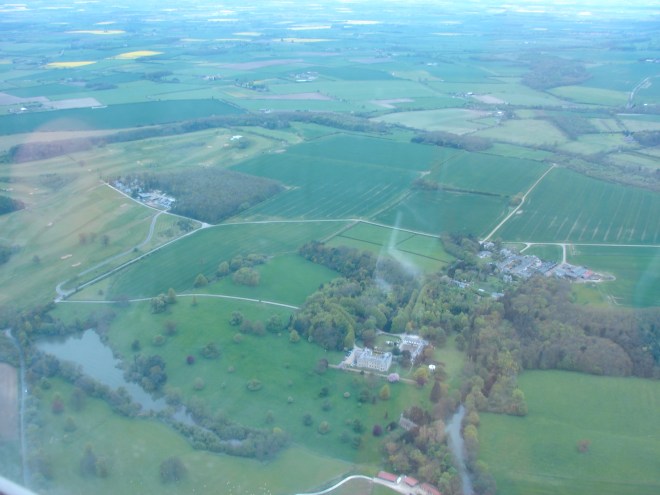
On 6th January 1839, the Nafferton house of Mr Thompson, a miller, was destroyed in ‘the Great Storm’ and his 2 sons, his daughter and a servant girl were all killed. Joseph Robinson Pease reported salt spray from the South-West on windows at Kilnwick Percy (i.e. it had come from the nearest coast in that direction, South Wales). photo shows Kilnwick Percy from the air

On 6th January 1840, William Dunn pleaded guilty at Beverley Sessions Court to a burglary. He was convicted and sentenced to transportation for life.

kilnwick percy.JPG


January 5th

On 5th January 1304, Sir John de Sutton was pardoned, because of his military service to King Edward II in Scotland, for taking hares in the King’s warren of Holderness.

On 5th January 1773, Mrs Bridget Briggs of Sproatley died and left money in her will to educate 10 poor boys and 10 poor girls in the village.

On 5th January 1824, the Port of Hull Society for the Religious Instruction of Seamen set up a nautical school for seamen and apprentices to receive practical and academic instruction, open several evenings a week. Many of the early students were illiterate.

On 5th January 1836, Captain James Clark Ross left Hull on an expedition to resupply 11 whaling vessels trapped in Arctic ice. About 600 men were in the overwintering ships.

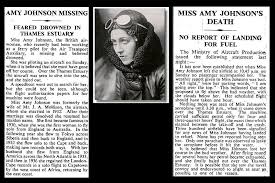
On 5th January 1941, Amy Johnson, while flying for the Air Transport Auxiliary from Blackpool to RAF Kidlington, went off course in bad weather and bailed out as her aircraft crashed.  An attempt was made to rescue her, but she died and her body was never recovered. There is still, however, controversy surrounding the circumstances of her death in the Thames.

AmyJohnson death

January 2nd

On 2nd January 1645, Sir John Hotham was executed for treason. He was buried, with his son John, in the Church of All Hallows, Barking. His lands passed to his grandson, aged about 10.

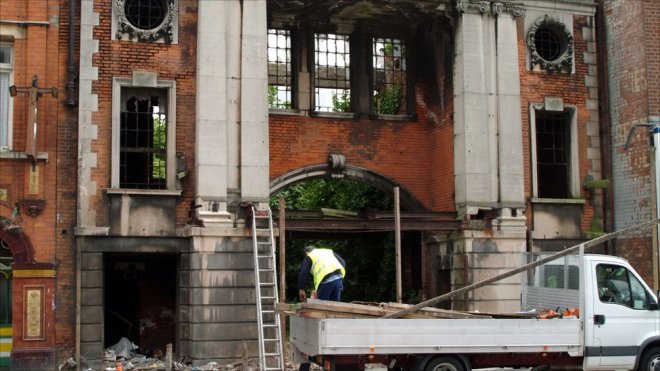
On 2nd January 2007, Historic England listed the former National Picture Theatre on Beverley Road, Hull, Grade II for its special architectural or historic interest. It is believed to be the only civilian WW2 bombed–out building, other than churches, remaining on its site.

nationalpicturetheatre